Vice President JD Vance Plans to Review Classified Information on UFOs
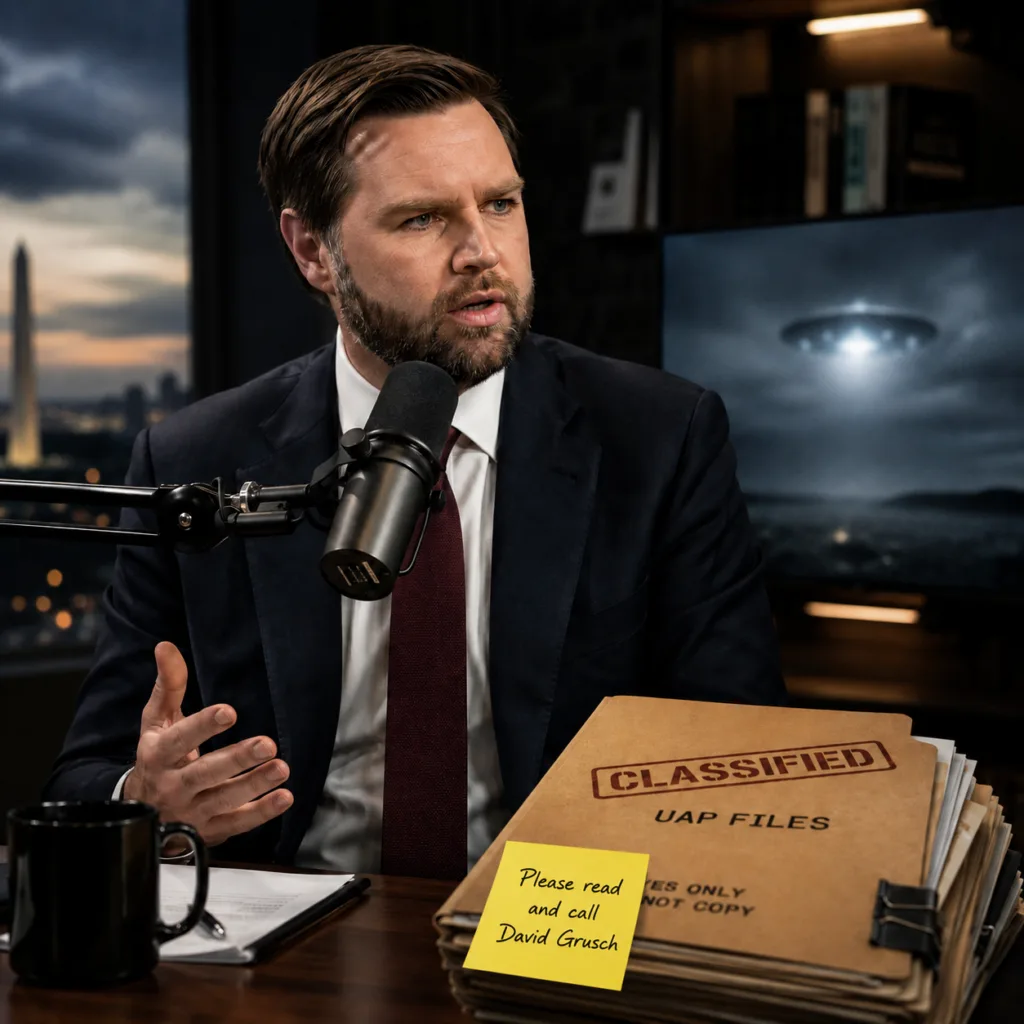
On June 18, 2026, Vice President JD Vance appeared on The Diary of a CEO podcast with Steven Bartlett while on a book tour promoting his new memoir Communion: Finding My Way Back to Faith, which was published on June 16, 2026. During the conversation about faith, rationalism, and personal experience, Bartlett asked Vance whether he thinks aliens could be real. Vance replied that he does not know but affirmed that he believes they could be. He stated that he had sworn to himself that he would go through the highly classified information about everything known about UFOs, though he had not yet done so because the demands of the job had taken priority. He also discussed conversations with people involved in exorcisms, shared a personal story of a possible mystical experience after his grandmother’s death, and said that the hyper-rational view of the world is not totally accurate and that there is some weird shit out there that cannot be explained.
Previously, in March 2026, during an appearance on The Benny Show with Benny Johnson, Vance had taken a stronger position, saying he did not think UFOs were aliens and suggesting they might be demons instead. The June comments represent a noticeable shift toward a more open stance in which he said he does not know the answer but believes aliens could be real. Both appearances show Vance expressing personal interest in the topic while connecting it to broader questions of faith and unexplained phenomena.
Vance’s comments come at a time when many members of the public find it difficult to accept that senior officials are not more deeply informed about UAP. This skepticism stems from years of high-profile whistleblower testimony, major sighting waves such as the New Jersey drone and UAP activity and the Alaska flap, and the overall volume of unexplained aerial phenomena reported in recent years. Against this backdrop, Vance’s statement that he has not yet reviewed the classified UAP files has drawn particular attention. Critics have also pointed to his close friend Jared Isaacman, the NASA Administrator, as appearing similarly uninformed or reluctant to engage more directly with the topic. Many find it hard to believe that the Vice President and the head of NASA — the two people who should be among the best positioned to know what is happening — are being fully transparent about what they know regarding UAP.
These remarks come against the background of a formal UAP transparency effort. On February 19, 2026, President Trump directed federal agencies, including the Department of War, to identify, review, and release government records related to alien life, extraterrestrial phenomena, UAP, and UFOs. This led to the creation of the Presidential Unsealing and Reporting System for UAP Encounters, known as PURSUE. Under this framework, the Department of War has released multiple tranches of files on a rolling basis, with the first on May 8, 2026, the second on May 22, 2026, and the third on June 12, 2026. The releases include historical documents, images, and videos, some of which remain unresolved.
Vance’s comments occur within a wider conversation about the potential for deeper disclosure under the current administration. That context has sharpened since David Grusch’s June 2026 media appearances, where he said the administration and cabinet “have the keys to the car” when it comes to releasing much of the UAP information he was exposed to. Grusch has claimed he personally saw recovered vehicles and photographs of craft in multiple shapes, including discs, crescent-shaped objects, boomerangs, egg-shaped vehicles, and other unusual forms connected to crash retrieval operations. He has also said that a legacy reverse-engineering program exists and that the U.S. government is aware of multiple forms of non-human intelligence, ranging from corporeal bipedal beings to sentient plasmoid entities. Congressman Eric Burlison has added another layer, saying Grusch told him about alleged “Nordics” and “Greys,” with the Nordics described as human-like and technologically ahead of us, and the Greys described as connected to a more advanced intelligence using psionic technology. While Vance did not address these specific claims, his willingness to discuss the possibility of aliens and his stated intention to review classified UFO information place his remarks inside a much larger disclosure debate. The question is no longer only whether officials will acknowledge UAP generally, but whether the current administration will move into the harder territory of UFO craft retrieval, biological evidence, reverse-engineering programs, and what senior officials may already know.
Parallel to these discussions, there are ongoing efforts to strengthen legal protections for UAP whistleblowers. Members of Congress, including Rep. Anna Paulina Luna and Rep. Tim Burchett, have pushed for an executive order and legislation to shield military and intelligence personnel who come forward with information about UAP programs from retaliation, career damage, or legal risks under existing secrecy laws. These initiatives reflect concerns that current safeguards remain insufficient even as the administration advances record releases through the PURSUE program.
President Trump has publicly noted the high level of engagement with the ongoing file releases, at one point commenting on the topic trending at number one and asking whether people are “enjoying it.” This environment of increased visibility, combined with rolling declassifications and high-level commentary from figures like Vance, has helped bring questions about unexplained aerial phenomena into mainstream political and media discourse.
Vance’s reference to conversations with people involved in exorcisms and the existence of “weird things out there that we cannot explain” intersects with a long-running line of inquiry that interprets certain unexplained phenomena, including auditory experiences often labeled as mental illness, as potentially involving non-physical or parasitic entities. Some researchers describe these as conscious, manipulative intelligences that interact with human consciousness, drawing parallels to historical and spiritual concepts of demons, archons, or interdimensional parasites. While Vance did not elaborate on these ideas in detail, his openness to phenomena beyond strict rationalist explanations.
One such briefing, described by Congressman Eric Burlison, involved multi-sensor documentation of non-conventional aerial objects during a controlled operation near sensitive military sites in early 2026. The briefing reportedly generated significant demand across House leadership, reflecting a growing appetite among elected officials for direct access to detailed, verified UAP data beyond general public releases.
Given the level of interest in that briefing and the broader push for transparency, many believe Vice President Vance should be among the first to receive a full update on what Burlison and other lawmakers have been shown. As the second-highest elected official in the country, with a publicly stated intention to review classified UAP information, Vance is uniquely positioned to bridge the gap between public curiosity, congressional oversight, and the classified record.