The Interdimensional Hypothesis
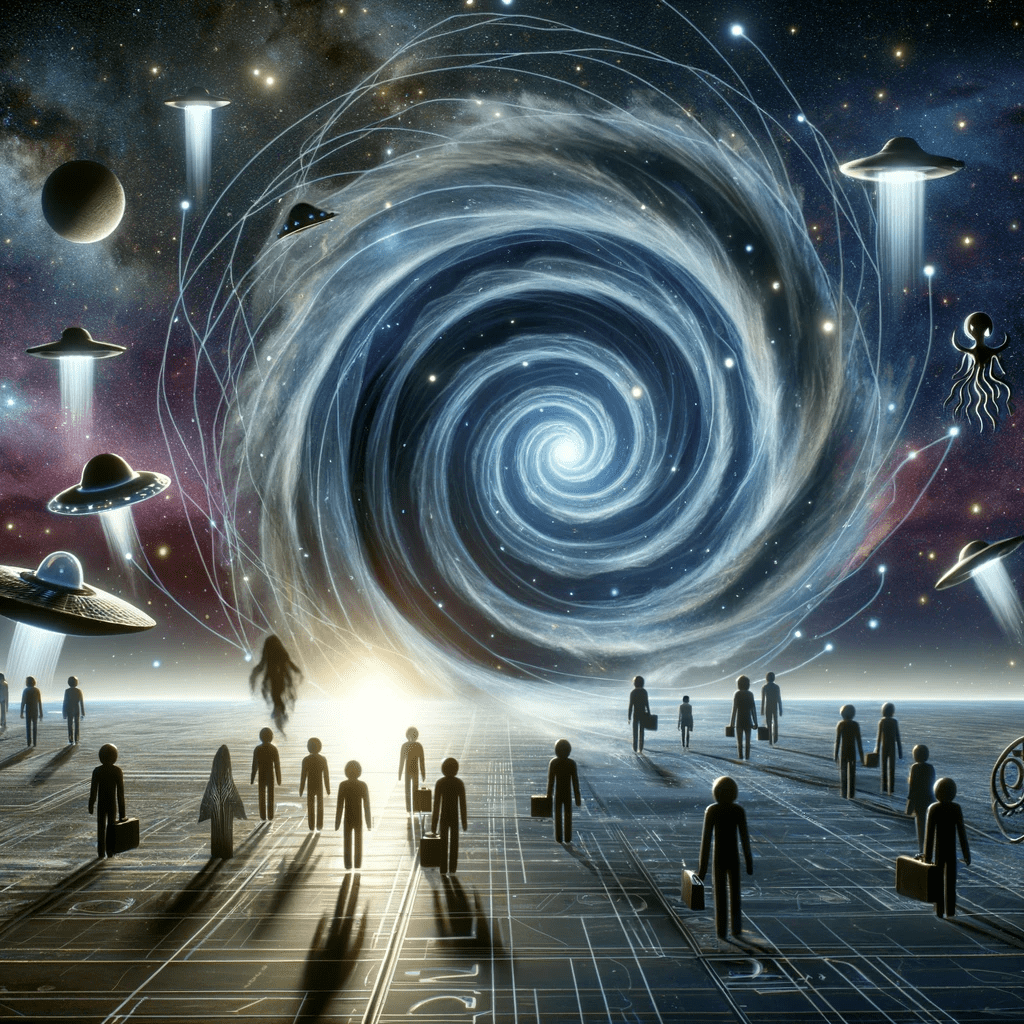
The Interdimensional Hypothesis presents a different way of understanding UFO sightings and encounters with non-human intelligence. Instead of assuming these events come from distant planets, this idea suggests they may originate from parallel dimensions or alternate realities that exist alongside our own. In this view, what people are seeing is not something traveling across space, but something crossing between layers of reality.
This concept is supported by theoretical frameworks in physics such as string theory and the multiverse. These models propose that multiple dimensions may exist beyond what humans can normally perceive. If that is the case, then interaction between these dimensions becomes a possibility, even if it is not yet fully understood or proven.
Two main pathways are often proposed to explain how such interaction could occur. The first is through advanced technology. The idea here is that highly developed systems could manipulate space-time itself, creating portals or wormholes that connect different dimensions. This is based on principles from general relativity, where space and time can be bent or distorted under certain conditions. In theory, such distortions could act as gateways between realities.
The second pathway focuses on consciousness. Some researchers and traditions suggest that the human mind may have the ability to reach beyond physical limits. Concepts like telepathy, astral projection, or altered states of awareness are sometimes described as ways to access other dimensions. These ideas are more commonly found in spiritual or metaphysical systems, but they continue to appear in reports of encounters and experiences that people struggle to explain.
The idea of interdimensional beings is not new. It appears throughout mythology, religion, and cultural traditions across the world. Angels, spirits, and other non-physical entities are often described as existing in realms separate from the physical world. In shamanic practices, individuals claim to interact with these entities through rituals or altered states of consciousness. Figures like Aleister Crowley described contact with non-human intelligences, including an entity known as Aiwass, which some interpret as coming from another dimension rather than another planet.
Within UFO research, several investigators have explored this possibility. Jacques Vallée suggested that UFO phenomena may represent something that interacts with human perception rather than simply being physical craft. John Keel also proposed that many paranormal events, including UFO sightings, could be connected to a hidden reality that influences human experience in ways that are not fully understood.
Certain well-known cases have been interpreted through this lens. The Rendlesham Forest incident in 1980 involved U.S. Air Force personnel encountering unusual lights and a structured craft near RAF Woodbridge. One of the witnesses, Jim Penniston, later described experiencing anomalies related to time and perception, along with receiving what he believed to be a coded message. Some interpretations suggest this could point to an interaction that was not strictly physical in nature. Penniston also described receiving what he interpreted as a binary code download after physically touching the craft, reportedly delivered rapidly into his mind and later claimed to contain messages related to human origins and exploration, along with experiencing distortions in time, further supporting the idea of a non-standard interaction beyond normal physical contact.
Another case is the reported abduction of Linda Napolitano in 1989. According to accounts investigated by Budd Hopkins, witnesses claimed to see individuals being levitated into a craft near the Brooklyn Bridge. The story included elements such as telepathic communication and fragmented or altered memories. These aspects have led some to consider whether the event reflects something beyond a conventional physical encounter. Accounts tied to the case also describe fragmented memory, telepathic elements, and disorientation, reinforcing the possibility of an interaction that operates partially within consciousness rather than purely in physical space.
Taken together, these cases and theories point toward a model where reality is more complex than it appears. The historical origin of this idea traces back to the late 1940s, shortly after the modern UFO era began. One of the earliest figures to formally propose an interdimensional explanation was Meade Layne, an American researcher and founder of the Borderland Sciences Research Associates. In the wake of the 1947 wave of sightings, Layne suggested that flying saucers were not spacecraft from distant planets, but what he described as “ether ships” originating from a parallel plane of existence he called Etheria. Some of these entities were described as potentially originating from etheric counterparts of other planets rather than only a parallel Earth. He proposed that these objects could materialize into physical reality and dematerialize back out by shifting their vibrational state.
Layne referred to this process using the term interdimensional hypostasis, describing a transition between an unseen realm and the physical world. His ideas were closely tied to trance medium Mark Probert and a group of communicators often referred to as the Inner Circle, linking the origin of the hypothesis directly to early forms of channeling and consciousness-based communication. These concepts were first presented in his Round Robin publications in the late 1940s and later consolidated in his 1950 work The Ether Ship Mystery and Its Solution. Although later researchers would refine and expand the concept, Layne’s framework introduced the core mechanics that continue to define the Interdimensional Hypothesis today.
In the decades that followed, figures such as Jacques Vallée and John Keel expanded on this foundation. Vallée connected UFO encounters with folklore, particularly in his 1969 work Passport to Magonia, proposing that modern sightings may be a continuation of older phenomena once described as fairies, spirits, or angels. He also introduced the idea of a possible control system influencing human perception and culture over time. Keel described what he called ultraterrestrials, hidden intelligences operating within a different energy spectrum that intersects with human perception. These later interpretations helped shape the modern version of the hypothesis, but they build directly on the original idea that the phenomenon may originate from a coexisting dimension rather than distant space. The Interdimensional Hypothesis does not replace other explanations, but it expands the range of possibilities. It suggests that some encounters may involve interactions with forms of intelligence that do not operate within the same physical framework as humans.
Whether approached through physics, spirituality, or firsthand reports, the idea challenges basic assumptions about space, time, and existence itself. It raises questions that remain unanswered, but it also provides a structure for thinking about experiences that do not easily fit within traditional explanations.
A more specific extension of this idea appears in the concept of interdimensional channeling. Some accounts describe individuals acting as receivers or intermediaries for non-human intelligence, with information being transmitted not through physical contact, but through shifts in consciousness. These experiences are often described as accessing a frequency or signal rather than encountering a physical being. In this sense, communication becomes less about location and more about alignment.
Reports of channeling frequently emphasize changes in mental state, breathing patterns, and emotional detachment, as if the individual is tuning into a different layer of reality. Some interpretations suggest that these processes may be connected to underlying structures in consciousness itself, possibly linked to quantum-level activity or energy fields that are not yet fully understood.
In certain cases, the transmitted information is described as philosophical or instructional, focusing on themes like the nature of the self, the illusion of separation, and the idea of returning to a unified source. This reinforces the possibility that interdimensional interaction is not always physical or visual, but informational and experiential. Instead of beings crossing into our world, the exchange may occur within the human mind acting as a kind of interface.
If communication can occur through consciousness alone, then encounters may not require physical craft or visible entities at all. What people interpret as contact could, in some cases, be the result of direct interaction between dimensions through awareness itself.
Taken together with reported sightings and physical encounters, channeling suggests that the phenomenon operates across multiple modes at once. It can appear technological, psychological, symbolic, or spiritual depending on how the interaction is perceived. This flexibility supports the idea that the underlying source is not limited to one form, but adapts to the observer, the environment, and the method of contact.
Advanced non-human intelligences are not necessarily traveling vast distances through space, but are instead moving through layers of frequency, entering and exiting our reality by shifting between states that humans cannot normally perceive. This reframes the phenomenon from one of transportation to one of transition, where visibility depends on resonance rather than proximity.
These experiences often include moments where physical reality appears to distort, time behaves inconsistently, or the environment takes on an altered, almost staged quality. Such reports support the idea that the interaction may not be fully anchored in conventional space-time, but instead occurs at the intersection of multiple realities.
Another key concept presented is that human perception itself may act as a limiting filter. If these beings operate within frequencies outside the narrow band that humans can detect, then most of their activity would remain invisible unless conditions change or the observer becomes temporarily aligned with that frequency range. This connects directly with earlier ideas about consciousness acting as a receiver, suggesting that perception and awareness may play a more active role in these encounters than previously assumed.
Rather than treating UFO sightings as isolated events, modern sightings may simply be a continuation of a much older phenomenon that has appeared in different forms depending on cultural context and technological understanding.
This perspective reinforces the broader Interdimensional Hypothesis by suggesting that reality itself may be layered and dynamic, with multiple forms of intelligence operating within overlapping fields. What humans interpret as sudden appearances or disappearances may, in fact, be transitions between these layers, briefly exposing a system that is normally hidden just beyond perception.
A final distinction that helps clarify the Interdimensional Hypothesis is the difference between interstellar travel and interdimensional travel. Traditional extraterrestrial models assume that advanced civilizations travel across vast distances in space, moving from one star system to another using highly advanced propulsion systems. However, the physical challenges of this type of travel are extreme. The distances between stars are so large that even traveling at or near the speed of light would require enormous amounts of energy and time, making routine visitation highly impractical.
Because of these limitations, some researchers have proposed that what appears to be advanced aerial movement may not be the result of faster spacecraft, but a completely different form of movement altogether. Interdimensional travel suggests that instead of crossing space, these intelligences shift between coexisting realities that are already present but normally hidden from perception.
In this framework, distance becomes largely irrelevant. If multiple dimensions overlap within the same physical location, then movement between them would not require long journeys, but rather a change in state or frequency. This idea aligns with theoretical concepts where different layers of reality intersect or exist simultaneously, allowing for points of transition where movement between them is possible.
Concepts like wormholes or higher-dimensional shortcuts suggest that advanced civilizations might access additional dimensions to effectively bypass the limits of space travel, folding distance rather than crossing it. This creates a hybrid view where interstellar travel is still possible, but only by utilizing interdimensional mechanics.
When placed alongside channeling, frequency-based perception, and the idea of layered reality, the distinction becomes clearer. Interstellar travel assumes distance and separation, while interdimensional travel assumes proximity and overlap. One requires movement across the universe, while the other requires access to what may already be here.
If non-human intelligence operates through overlapping dimensions rather than distant star systems, then many of the observed characteristics of UFO encounters begin to make more sense. What appears to be advanced travel may not be travel at all, but controlled transitions between states of reality that humans are only beginning to recognize.
A more recent development that brings the Interdimensional Hypothesis into the political sphere comes from statements made by Anna Paulina Luna, who has publicly discussed the possibility that some UFO-related phenomena may involve interdimensional beings. In interviews and public discussions, she has stated that information reviewed by lawmakers and testimony from credible witnesses suggest the existence of entities capable of operating outside conventional space and time.
According to her statements, these conclusions are based on classified briefings, photographic evidence, and reports from military personnel. She has emphasized that some of the observed phenomena demonstrate characteristics that do not align with known human technology, including movement patterns that appear to defy standard physics and reports of objects entering and exiting controlled airspace without explanation.
A more controversial and darker extension of the Interdimensional Hypothesis is presented in discussions surrounding interdimensional reptilian entities and chakra-based attachments. According to reports compiled from experiencers, researchers, and spiritual practitioners, these beings are not typically encountered as fully physical forms, but instead exist just outside the visible spectrum while interacting directly with the human energy system.
These entities are often described as reptilian or serpent-like in nature, remaining in a nearby dimension while attaching to the human body through specific energy centers, particularly the root and sacral chakras. These lower chakras are associated with survival, fear, desire, and emotional intensity, making them ideal points of access for influence.
The concept builds on earlier work by figures such as David Icke, as well as accounts from out-of-body researchers like Robert Monroe. Monroe described a form of harvested emotional energy referred to as “loosh,” introduced in his 1985 work Far Journeys, which is said to be generated by strong human emotions such as fear, pain, and anger. Some interpretations suggest that these interdimensional entities may feed on or utilize this energy, creating a functional relationship between emotional states and non-human intelligences.
Historical and mythological parallels are also frequently cited. Ancient traditions describe serpent or reptilian beings influencing humanity, from the Nāgas in Hindu texts to the Archons found in Gnostic writings. These entities are often portrayed as manipulating perception or interfering with spiritual development, which closely mirrors modern descriptions of interdimensional attachments affecting human consciousness.
In some cases, observers claim subtle indicators such as changes in a person’s eyes, emotional patterns, or behavior, suggesting the presence of an external influence operating through the individual. From this perspective, the interaction is not based on direct physical control, but on energetic influence. The entity remains external while subtly shaping thoughts, emotions, and impulses, effectively steering behavior through the manipulation of internal states. This aligns with the broader idea that interdimensional phenomena operate through overlap and resonance rather than direct physical occupation.
Various spiritual traditions and modern energy practices emphasize strengthening the body’s energy field as a form of protection. Techniques such as grounding, breathwork, focused awareness, and visualization are described as ways to reinforce the lower chakras and reduce vulnerability to external influence.
It suggests that some aspects of the phenomenon may operate not just around humanity, but through it, using the human system itself as a point of access. This reframes certain experiences not as external encounters, but as internalized interactions occurring at the boundary between consciousness and a hidden layer of reality.
This concept of energetic influence and attachment introduces a more intimate and potentially unsettling dimension to the Interdimensional Hypothesis. Rather than distant observers or occasional visitors, these intelligences may engage in ongoing, subtle interactions with human consciousness and biology. This shifts the discussion toward deeper questions about agency, intent, and the extent of human autonomy within a layered reality.
Ultimately, the Interdimensional Hypothesis expands the scope of the discussion rather than closing it. It also helps explain high-strangeness characteristics such as polymorphic appearances, craft that appear to change shape, telepathic interaction, apparent disregard for inertia, and distortions of space and time that are difficult to reconcile within purely interstellar models. It also opens the door to hybrid interpretations, where interdimensional mechanics may work alongside advanced technology or other unknown processes, rather than replacing them entirely. It suggests that reality may be layered, dynamic, and interactive, with multiple forms of intelligence operating within overlapping domains.
It invites continued exploration, careful analysis, and a willingness to consider that the boundaries of reality may be far more complex than previously imagined.