Presidential Unsealing and Reporting System for UAP Encounters (PURSUE) – Release 1
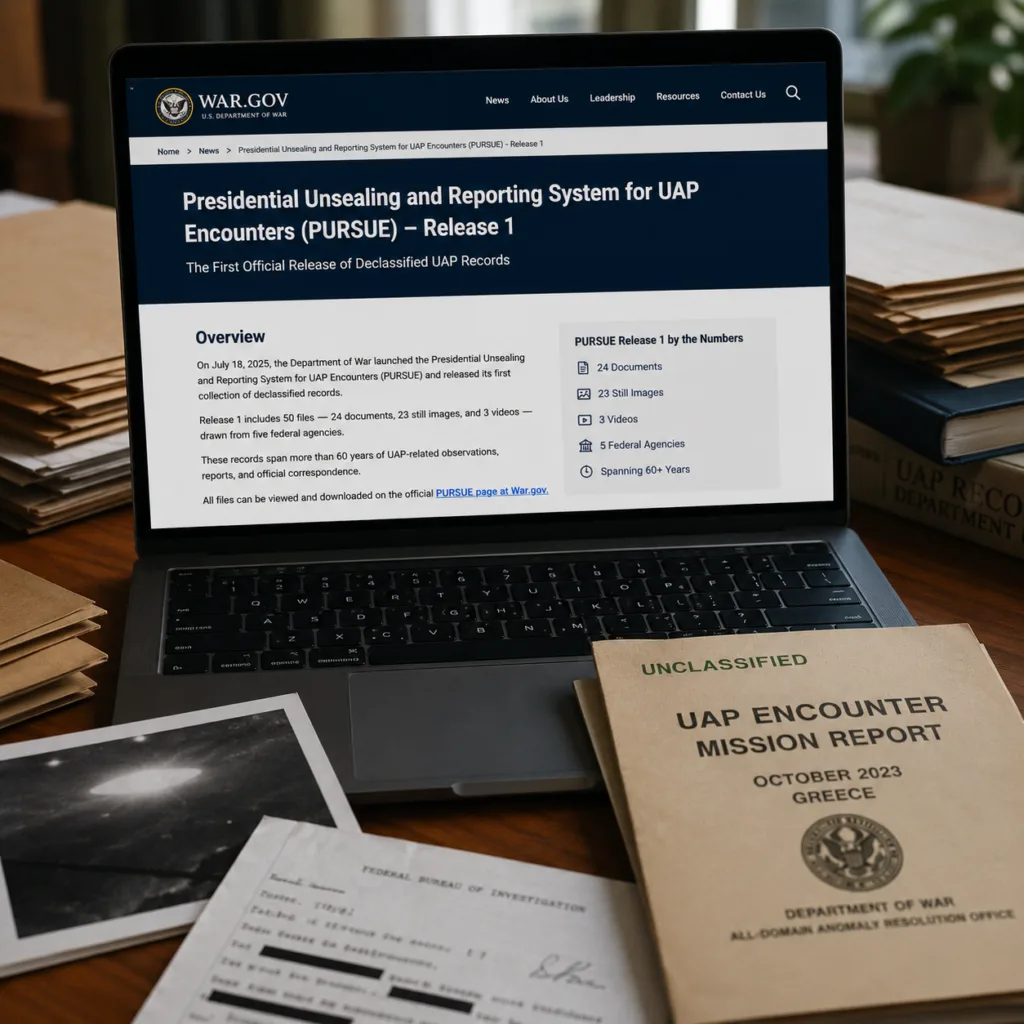
On May 8, 2026, the U.S. Department of War published Release 01 of its new UFO and UAP file archive under the Presidential Unsealing and Reporting System for UAP Encounters, also called PURSUE. The release follows President Donald J. Trump’s February 19, 2026 directive to identify and release government files connected to alien life, extraterrestrial life, UFOs, UAPs, and related government information. The Department of War describes the project as a government-wide effort, supported by the Office of the Director of National Intelligence, to find, review, declassify, and publicly release unresolved UAP-related records and historical documents held across the federal government.
The Department of War describes PURSUE as a rolling release program, with new tranches expected every few weeks as records are found, reviewed, declassified, and cleared for public release.
This first release is not a small symbolic drop. It contains a large mixed set of PDFs, videos, images, historical records, mission reports, interview files, cables, transcripts, and technical material. The files come from several agencies, including the Department of War, the FBI, NASA, and the Department of State. PURSUE is organized around source documents: mission reports, FBI files, NASA transcripts, State Department cables, images, videos, historical memos, incident summaries, and internal correspondence.
What makes this release important is not just the number of files. It is the range. Release 1 stretches from old FBI flying-disc files and Apollo-era NASA material to recent military and intelligence reports from 2023, 2025, and 2026. In other words, this is not only a historical archive. It also points toward recent unresolved UAP cases that the government still cannot publicly explain.
One of the most historically important records in Release 1 is not a sighting report at all. It is a July 18, 1963 memorandum from the Executive Office of the President’s National Aeronautics and Space Council titled “Thoughts on the Space Alien Race Question.” Addressed to Robert F. Packard in the State Department’s Office of International Scientific Affairs, the memo says recent discussions had raised the question of what to do if alien intelligence were discovered in space.
Its conclusion is the key part. The memo says that although plausible science suggested the United States would not find another intelligent race, the probability that such a race would be found was finite and should not be completely ignored. It then states that if one were found, the government would need to determine quickly whether it was primitive, comparable to U.S. nuclear-era spaceflight, or based on physics beyond Einstein.
The announcement names several interagency partners behind the release, including the White House, ODNI, DOE, AARO, NASA, the FBI, and additional intelligence community components. PURSUE is not being presented as a narrow Pentagon project. It is being framed as a whole-of-government UAP archive.
Release 1 also reaches back before and around the modern flying-disc era. A 1945 Air Ministry document titled “Balls of Fire — Red” records unexplained wartime aerial fireball reports. A 1948 Air Force file includes a Hobson, Ohio flying-disc report and correspondence about foreign aircraft concepts, including German flying-wing designs. The incident-summary files then show how early military investigators used checklists to record date, time, witness, shape, color, altitude, speed, direction, sound, trail, weather, and whether a sketch or photograph existed.
The final FBI section uploaded adds an important 1950 New Mexico thread. It summarizes “green fireball,” disc, and aerial-phenomena reports in the Southwest, including work by Dr. Lincoln La Paz of the University of New Mexico’s Institute of Meteoritics. The file says many reported objects varied from brilliant white to amber, red, and green, and that roughly 150 observations had been reported over two years by observers ranging from unaided witnesses to scientific and military observers. It also includes La Paz’s analysis of anomalous luminous phenomena, a chart comparing meteors, meteorites, green fireballs, and disks or variations, plus a photograph analysis of an unknown aerial phenomenon taken at Datil, New Mexico.
The FBI Files: From Flying Discs to Modern Encounters
A major portion of Release 1 comes from the FBI. The largest FBI entry appears to be the 62-HQ-83894 case file, broken into multiple sections. The file description says it includes investigative records, eyewitness testimony, public reports, photographic evidence, media coverage, and material related to UFOs and “flying discs” between June 1947 and July 1968.
Some of the strongest historical FBI material shows how early the government began formalizing UFO reporting. One 1949 Air Force intelligence memorandum titled “Unconventional Aircraft” says its purpose was to continue Air Force requirements for information on sightings of unconventional aircraft and unidentified flying objects, including so-called “flying discs,” and to establish procedures for reporting such information. The reporting checklist asked for details such as time and place, number of objects, formation type, color, shape, apparent construction, exhaust, lights, propulsion, control, maneuverability, sound, trail, effect on clouds, and whether astronomical objects or known aircraft could explain the sighting. That matters because the file shows that the government was not merely collecting rumors. It was trying to standardize what observers should report.
Release 1 also adds a much clearer modern FBI case: the September 2023 UAP sighting tied to LiDAR testing at a U.S. site. The composite sketch shows a bronze or gold ellipsoid object in daylight, positioned over a grassy area near trees, with a bright white-blue burst of light behind or beside it.
That timeframe is huge. It begins at the dawn of the modern UFO era, right around the 1947 wave of flying-disc reports, and runs through the period when UFOs became a serious public, military, and intelligence issue. The file description also says earlier versions were partly available through the FBI Vault but with more redactions and missing pages. Release 1 claims to include a more complete case file, with newly declassified pages and only minor redactions.
The historical FBI files cover three main lanes: early flying-disc reports, structured government reporting, and public UFO culture. The stronger examples include the Bethel, Alaska airline-captain report of a cigar-shaped aluminum object moving at an estimated 270 to 290 miles per hour; an August 1952 Savannah River Plant telegram about two E. I. du Pont employees seeing a blue-orange saucer-shaped light over the plant area; and a 1957 Havana cable about a luminous object over Matanzas Province that reportedly landed and left an oval burned area.
One of the most important FBI historical records in this group is the Socorro, New Mexico file from April 1964. The FBI report describes Officer Lonnie Zamora reporting an unidentified flying object near Socorro between about 5:45 and 5:50 p.m. The report records regular depressions in the ground, burned clumps of grass inside some of the depressions, and circular marks where exhaust or propulsion may have blown loose sand aside. It also says no other person saw the object in the area that night and that no other object was noted in the area.
Several files describe a September 2023 UAP sighting at a U.S. test site. One record is a composite sketch based on witness accounts. FBI interview records describe contractors arriving for LiDAR tests after receiving the site briefing, then encountering an object near a gate with good visibility shortly after 7:00 a.m. One witness described a linear object with a super bright white light on its east side. The object was metallic gray in color, had no wings or exhaust, appeared larger than a drone, smaller than a Boeing 737, and roughly one to two Blackhawk helicopters in length. It was estimated to be about 5,000 feet above ground level, moving east to west parallel to the ground. The object was visible for roughly five to ten seconds before the light went out and the object vanished.
Other FBI interview records connected to the same event describe the gate malfunctioning before the sighting. One witness reported that the gate opened only a little and then closed three separate times before finally opening completely and staying open. Another record says the witness later felt freaked out, had weird dreams, and had trouble sleeping during the first two nights after seeing the object.
These are not casual anonymous reports from decades ago. They are modern FBI interview records tied to a recent UAP case.
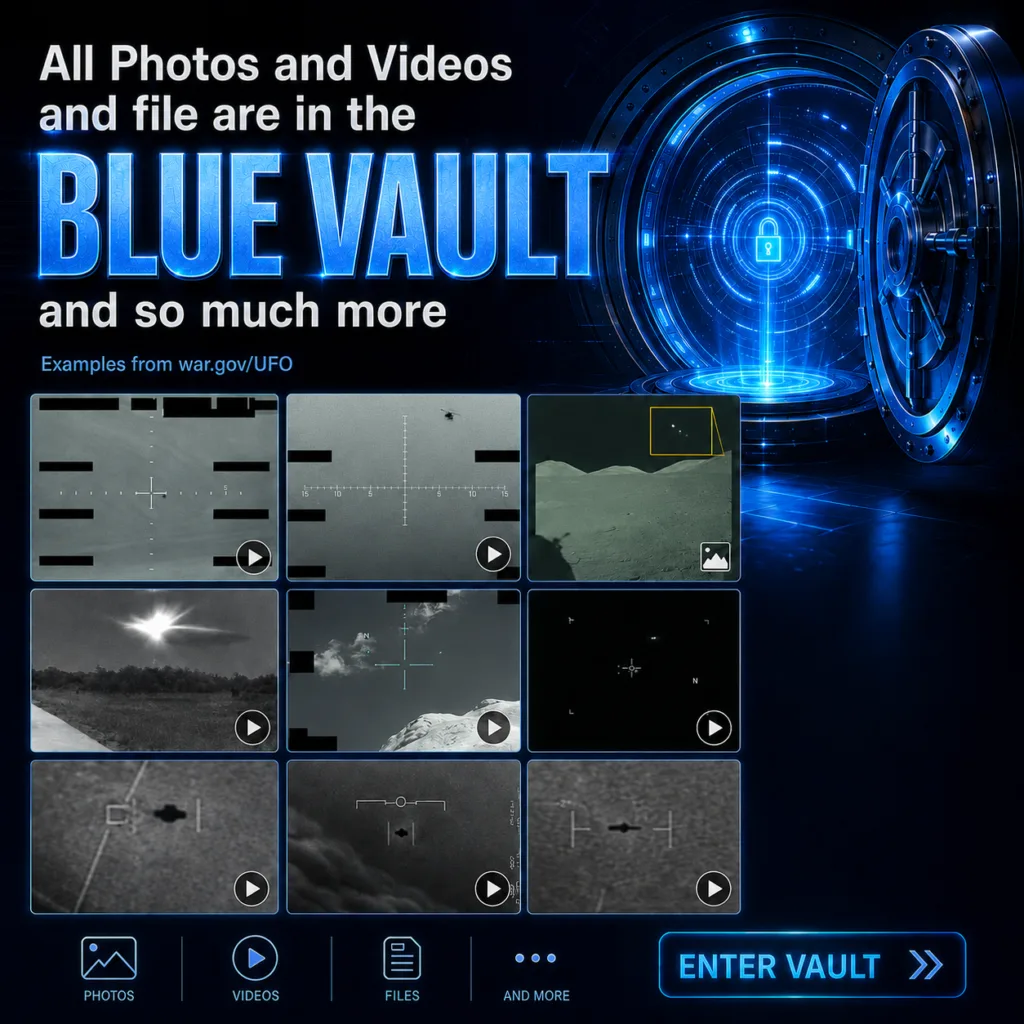
Release 1 also includes a series of FBI photo stills showing small dark objects or paired dark shapes in a sensor-style view with heavy redactions. The stills appear to capture a longer sequence from around 18:10 to 18:21 according to the on-screen timestamps, with crosshair-style markings and redacted side data. Some images show only a tiny dark speck against a gray sky or horizon line, while later images show darker paired shapes or a larger irregular dark form near the top of the frame. By themselves, the still images do not explain what is being shown, but they give the article a useful visual record of the type of imagery included in Release 1: low-resolution, grayscale, sensor-derived views where the important context is often missing or redacted.
The Western U.S. Event May Be One of the Most Compelling Files
One of the most striking entries in Release 1 is titled Western US Event. It summarizes statements from seven U.S. persons employed by the federal government who separately reported seeing several unidentified anomalous phenomena in the western United States over two days in 2023.
The Western U.S. slide document describes three two-person federal law enforcement teams who independently reported seeing orange orbs launch smaller red orbs at dusk over two separate days. The larger orange orb reportedly appeared for only one or two seconds, released red orbs in small groups, then disappeared. The red orbs usually moved horizontally away from the larger object, though some were said to move upward at an angle or swoop downward.
The same file describes a large fiery orange orb seen by two federal law enforcement special agents at dusk. Later AARO measurements estimated it was roughly 1,050 meters from the observers and between 12 and 18 meters in diameter. The witnesses described it as hovering near a rock pinnacle without noticeable sound. The file then shifts into two stranger pre-dawn reports: one involving agents pursuing what they first thought was a car in a restricted zone, and another involving a transparent kite-shaped object roughly six meters off the ground. One witness using night vision goggles said faint stars seemed visible through it.
Late 2025 Orb Reports Add Another Layer
Release 1 also includes several files and images tied to late 2025 events in the western United States. Many are connected to the FBI or the Department of War, including photo entries, infrared stills, and reports involving orbs.
One Department of State file is especially interesting. It is described as an FBI 302 interview with a senior U.S. intelligence official who gave a first-hand account of a UAP encounter at a U.S. military facility. The mission began after reports of orbs or lights and sounds like thuds from something falling or hitting the ground. During a helicopter search, LP/OP personnel reportedly observed a “super-hot” orb under FLIR hovering at ground level before it moved at high speed, headed east and south, and broke into two objects. The helicopter moved to intercept, but the object continued some 20 miles away and was too fast for the helicopter to match.
The same statement describes repeated orb formations over the next several minutes. Witnesses and pilots reported swarms of lights moving in all directions, two large orange orbs with white or yellow centers appearing above the rotor disk, additional orbs flaring up below them, and formations of four to six orbs flaring up one at a time before flaring down in reverse order. The file notes that many sightings were above the helicopter and outside its FLIR camera angle, meaning the record includes both instrument-aided and naked-eye observations.
NASA and the Apollo Material
Release 1 includes NASA records connected to Apollo, Gemini, and Skylab missions. The NASA material preserves crew transcripts, technical debriefings, light-flash discussions, particles, possible booster debris, distant flashing objects, and scientific observation records.
The Apollo 11 technical crew debriefing identifies itself as a July 31, 1969 NASA technical crew debriefing. In one visible section, Buzz Aldrin describes the first unusual object seen about a day out from Earth or close to the Moon, saying it had a sizeable dimension and that the crew put a monocular on it. The Gemini 7 transcript records Houston asking whether a sighting was the booster or a natural sighting, while the crew discusses a “bogey,” the booster, and many small particles. Apollo 12 and Apollo 17 records also preserve crew discussions of lights, fragments, possible S-IVB-related debris, and a reported bright flash on the lunar surface north of Grimaldi.
The Skylab technical crew debriefing adds another NASA human-observation thread. In the Skylab 1/2 debriefing, the crew discusses unusual visual phenomena, including light flashes seen by astronauts even with eyes closed. The crew compares the flashes to spots, sunbursts, streaks, arrows, cosmic particles, and exit streaks, while also debating whether the source was eye-related, cosmic radiation, medical effects, or something connected to orbital conditions. The value of the NASA records is not that they prove one answer. It is that they preserve the uncertainty and the technical discussion around what crews actually reported.
State Department Cables Show Global Reporting
The Department of State files widen the story beyond U.S. military and intelligence settings. Release 1 includes UAP-related cables from places such as Papua New Guinea, Kazakhstan, Georgia, Turkmenistan, and Mexico.
The Papua New Guinea cable from January 1985 is a good example. The U.S. Embassy in Port Moresby received an inquiry from Papua New Guinea’s National Intelligence Organization about reported high-altitude, high-speed overflights on January 24. The reports included fast-moving objects with lights, contrails, and noise. One report the NIO gave some credence to came from an Air Niugini pilot whose radar reportedly picked up aircraft moving south to north at high altitude and high speed after takeoff from Wewak. The embassy said it knew of no B-52 overflights and no U.S. aircraft in Papua New Guinea airspace on that date.
The State Department material also includes a very different kind of UFO file from Turkmenistan. A 2004 cable titled “Turkmenistan, Civil Society and UFOs” discusses a local UFO group that became a practical civil-society partner for NGOs, small businesses, and humanitarian projects.
A Mexico cable from September 2023 is also more political than investigative. It appears in a weekly political blotter and includes “Mexican Congress Hears Testimony on Alien Life” among several political and security items. Its value is not that it confirms alien life. Its value is that U.S. diplomatic reporting treated the Mexican congressional hearing as a notable political event worthy of inclusion in an official embassy cable.
The Kazakhstan/Tajik Air cable from January 1994 is even more direct. It reports that Tajik Air chief pilot Ed Rhodes and two American pilot colleagues encountered a UFO while flying a Boeing 747SP at 41,000 feet over Kazakhstan. The object first appeared as an intensely bright light approaching from the east at great speed and at an altitude much higher than their aircraft. The crew reportedly watched it for about forty minutes as it maneuvered in circles, corkscrews, and rapid 90-degree turns under very high G forces. The cable says the pilots later flew under contrails left by the object, which Rhodes estimated at about 100,000 feet. Rhodes and the crew rejected a meteor explanation and said the object appeared extraterrestrial and under intelligent control, while the embassy added that it had no opinion and was reporting the account for what it may be worth.
The Georgia cable from October 2001 is different. Despite the title “UFOs Over Georgia,” the file is really about Russian denials of aircraft activity and alleged bombing in the Kodori Gorge. Russian officials denied that Russian planes had violated Georgian airspace, while one official said reports of planes in the area might as well have been about “UFOs.” The embassy comment was blunt: the UFO explanation would be humorous if the airspace violations were not so serious. This file is important because it shows that not every “UFO” item in Release 1 is a mysterious craft report. Some are diplomatic cables where the word UFO is used in political or rhetorical context.
These files matter because they show that UAP reporting was not limited to American skies. Diplomatic channels also carried strange aerial reports from other countries. That does not mean every foreign report was extraordinary, but it does show that the U.S. government collected and preserved international UAP-related information through official channels.
One newly reviewed Air Intelligence Information Report from October 1955 adds a striking international example. It describes three highly reliable U.S. observers traveling by rail in the Trans-Caucasus region of the USSR who reported seeing flying saucers or flying discs near Atjaty and Adzhikabul. According to the report summary, the first disc ascended almost vertically from a slow speed, emitted a vapor-like trail, accelerated sharply at about 6,000 feet, and headed north. A second flying disc reportedly performed similar actions about one minute later. The document says the significance to the USAF project on unidentified flying objects was remarkable and could add evidence to many saucer reports.
The strongest modern thread is the orb and object reporting from 2023 through 2026. These records sit beside older material from the flying-disc era and spaceflight-era NASA records, creating a bridge between historic UFO reporting and current UAP reporting.
The Department of War mission reports in these batches are more operational and much more heavily redacted, but they still show several UAP encounters being formally logged. One Mediterranean Sea mission report describes a triangular metallic UAP observed during return to base at 13:19Z while the aircraft was transiting over coordinates listed in the file at 24,989 feet MSL and 168 knots. Another Arabian Gulf report describes a probable UAP observed at 12:46Z, with no mission impact and the aircraft continuing its original tasking.
An April 2025 INDOPACOM email record shows how short, sanitized “tearline” summaries were approved for public use. In that file, a U.S. aircraft reportedly observed one possible UAP for 12 seconds at 23:53Z on April 10, 2025, then another possible UAP for 23 seconds at 00:07Z on April 11, 2025. In both cases, the altitude and speed were unknown and no interference was noted. The email chain matters because it shows the internal step of confirming what could be treated as unclassified before public release.
Other Arabian Gulf reports describe objects with different speeds and behaviors. One file says the UAP looked like a balloon and was traveling with the winds at 31,000 feet MSL. Another describes a possible UAP observed briefly with an estimated velocity of 321 knots, which then increased speed and changed direction toward the east. A separate report describes two possible UAPs with estimated velocity of 278 knots that increased speed and changed direction toward the south. These reports are short, redacted, and cautious, but they are important because they show UAP events being captured through routine military reporting channels.
The Djibouti mission report adds another modern case. It describes two round white-hot UAPs moving dynamically south at approximately 240 nautical miles per hour. The wording is brief, but the description is notable because it refers to two objects, a thermal appearance, motion, direction, and estimated speed.
Release 1 includes more range fouler material from 2020. A Gulf of Aden form from September 4, 2020 describes a round cold object in infrared, tracked for about eight minutes while the aircraft was over the Gulf of Aden. The object was reported as traveling 168 degrees at 277 mph and making a few abrupt directional changes. Another Gulf of Aden form from October 15, 2020 describes a round cold object in infrared, tracked for roughly one minute, moving at about 20 mph and also making abrupt directional changes. A separate August 31, 2020 debrief says an initial object crossed the sensor screen and was then surpassed by another object of the same size and shape but moving at much higher speed. At one point, three objects were reportedly on screen at the same time moving among each other.
Another Arabian Sea range fouler form from August 24, 2020 describes three possible unidentified small air contacts during routine operations in the North Arabian Sea. The pilot reported no electronic support indication, no radar track, and no IFF track. The contact distance, speed, and precise course were unknown, though the objects appeared to be on a westerly heading. The form marks the contacts as round and also marks wings or airframe, showing how uncertain the visual identification was. The observer first saw one contact, lost it behind a cloud, then regained contact and saw two additional contacts due east of the first object. All three appeared to maintain relative course, speed, and altitude.
Several Persian Gulf and Strait of Hormuz reports from 2020 are sparse but useful. They show UAP observations appearing inside long ISR and NAVCENT support missions, often with guard calls, full-motion video exploitation, weather notes, and only brief object descriptions. A May 14, 2020 Middle East range fouler debrief is stronger: while performing an ISR tasking at night, the crew reported a solid white object crossing the field of view above the water, then reacquired and followed it as it appeared to make erratic movements above the water.
Release 1 also includes several newer 2022, 2023, and 2024 mission reports that show how ordinary military reporting can capture unusual events without resolving them. A July 2022 Syria mission report records an armed reconnaissance aircraft observing an unidentified aerial phenomenon while supporting Operation Inherent Resolve. The available text is heavily redacted, but it still places the UAP observation inside a long mission with IMINT and SIGINT collection, full-motion video exploitation, and a formal MISREP record.
A December 2022 Iraq mission report is similarly sparse but important. It records a possible UAP observed near Baghdad during an ISR mission, again with FMV later exploited. Like many of the Department of War files, the release preserves the timing, mission type, operating area, sensor context, and review trail, while leaving the object itself largely unexplained.
A November 2023 Syria report describes one probable high-confidence UAP shaped like a “bouncy ball” that came from the south near co-altitude, dropped altitude, safely passed the aircraft, and maintained roughly 424 knots for at least seven minutes before going out of range. The report says there were no emissions, no effect on the aircrew, and it was not considered a threat to the aircraft or public safety.
A January 2024 Greece mission report describes a round diamond-shaped UAP with a straight, non-maneuvering probe or tail at the bottom. It reportedly appeared only on the SWIR camera, lasted about two minutes, and moved at approximately 434 knots while maintaining a steady flight path with altitude changes but no trajectory change.
An October 2023 Greece mission report adds a separate water-level case. It describes a seemingly circular object that was too small for detailed identification, flying just above the surface of the ocean. The UAP reportedly made multiple 90-degree turns at an estimated 80 mph before the aircraft lost it from the feed after about three minutes. The report lists the object as solid, says there were no effects on persons or equipment, and records the observer assessment as benign.
A 2024 United Arab Emirates / Gulf-area mission report describes a glowing hot spherical unidentified object with a vertical unwavering cylindrical pole or bar attached below it, possibly a reflection in water. Another United Arab Emirates / Persian Gulf area report from October 2023 records two separate UAP observations during an OP SPARTAN SHIELD ISR mission launched from Al Dhafra, after a professional guard call from Iranian Air Defense telling the aircraft to maintain distance from the border.
An October 2024 Syria report describes a misshapen, uneven ball of white light. The file says multiple glares or lights of unknown origin appeared at different angles and directions, including light or glare crossing directly over the FMV camera feed and halo effects at the top of the feed. Aircrew assessed it was not a lasing event, considered it benign, and reported no mission impact.
A February 2023 Syria mission report involving a two-ship F-15E flight is one of the more operationally complex entries. The mission narrative says the flight received multi-function radar jamming near Shaddadi at FL270, then observed three possible UAP near Shaddadi at FL240. A later entry in the same mission records one possible balloon at FL210. This file is important because it places possible UAP observations inside an air-defense context that also included radar jamming and tactical aircraft activity.
Another March 2023 Syria report records a two-ship F-16CM defensive counter-air mission that observed multiple possible UAPs while operating in Syrian airspace. The available narrative is brief, but it helps show that Release 1 includes fighter-aircraft mission reporting, not only remotely piloted aircraft or sensor-platform reports.
Another 2024 report describes a high-speed object during a weapons event. After release of an AGM-176, the weapons systems officer and combat systems officer observed an unidentified object fly through the aircraft sensors at high speed, creating infrared lens flare on MX-20 and MX-25 sensors, indicating a significant heat source. The file notes it is unknown whether an object detached from the primary UAP immediately before leaving the sensor field of view.
Another October 27, 2020 range fouler debrief is especially strange. It describes two contacts, with radar lock and target pod video obtained, but the aircraft was unable to get closer than 16.9 nautical miles for better identification. The target pod reportedly showed two infrared-significant contacts, and one range fouler was circling around the other before both were gone in 1/30th of a second. The report also notes two red blinking strobes and received noise jamming.
The email correspondence files are also important because they show the review process behind public release. One August 2024 email record approved an unclassified tear-line summary for an October 31, 2024 event in which a U.S. aircraft observed a possible oval or orb-shaped UAP for more than two hours. Another March 2023 Pacific Time Zone record describes a large blue featureless triangular object with powerful whitish-blue lights along its perimeter. The civilian reporter said it hovered near a national security facility for about three minutes, then moved higher in a jerking or jumping manner, with a total observation time of about eight minutes.
Release 1 also contains a Syria mission report from November 18, 2016. It is not framed as a classic UFO encounter. It describes a P-8A observing an unidentified low-flying object about 55 nautical miles northwest of Latakia, Syria. The object was assessed as possible missile activity, traveling at approximately 500 knots on a southeasterly heading. Another Eastern Mediterranean / Iraq-related mission report records one possible small UAP during an ISR mission, along with separate observations of foreign aircraft activity, including a possible Su-30 reaction and a probable Su-27/35 landing near Al Assad Airfield.
Release 1 does not resolve the cases. It documents them. Many records remain heavily redacted, 108 entries are marked as redacted. The key point is that Release 1 places older UFO files, spaceflight records, diplomatic cables, launch and range-safety documents, and modern military UAP reporting side by side.