Beyond Luna’s 46: The Known UFO Videos Still Hidden From the Public
When Rep. Anna Paulina Luna publicly requested 46 specific UFO and UAP videos from the Department of War, many people treated that list as the main map of what the government still needed to release. A separate question now sits beside it: what known or publicly discussed UFO videos appear to exist outside Luna’s 46? That distinction matters. The Sleeping Dog documentary is about matches inside Luna’s requested list. But there is a wider archive around that list, including PURSUE Release 01 and additional tranches, Ross Coulthart’s SIPRnet video, politician-referenced footage, older leak waves, and disputed internet cases.
At a deeper level, the intense focus on individual videos risks becoming a distraction from a more profound issue. Multiple insiders, whistleblowers, and former officials have claimed that governments and defense contractors possess not only recordings, but recovered craft, debris, and even non-human biologics held in secure facilities. If any significant portion of those claims is true, then the current public debate over short clips and infrared footage represents only the outermost layer of a much larger reality.
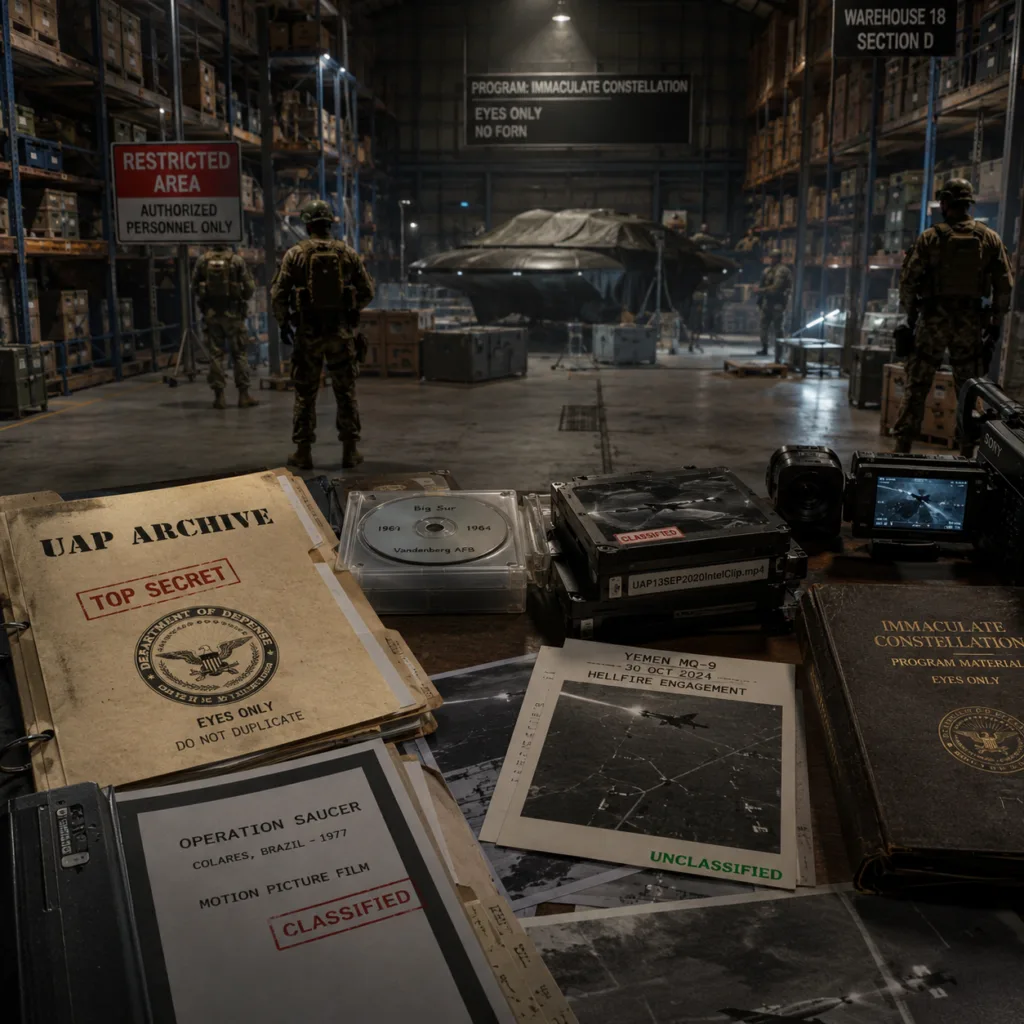
The Yemen MQ-9 Hellfire orb video is one of the clearest examples of a known UFO video discussed outside the original Luna 46 framework. Rep. Eric Burlison presented the footage during a September 2025 House Oversight hearing, describing an MQ-9 Reaper tracking an orb off the coast of Yemen on October 30, 2024. Another MQ-9 reportedly fires a Hellfire missile toward the object while operators continue tracking it, with reports stating the missile appeared to impact but showed little or no visible effect on the object. The clip became important not just because of the object itself, but because it suggested military engagement footage exists far beyond the short Navy clips already familiar to the public.
The larger “bank” of Yemen-style orb videos may be even more important than the one clip Burlison showed. During 2026 discussions connected to Weaponized and related interviews, George Knapp stated that servers contain a whole bank of similar videos that Congress has not been permitted to fully review. That transformed the Yemen clip from a single event into evidence of a broader hidden archive involving military drones, orb tracking, and repeated encounters recorded across multiple operations.
The “briefing that everybody wants” footage discussed by Rep. Eric Burlison remains one of the most politically important unreleased video references. Burlison has described a classified briefing that dramatically shifted conversations among lawmakers and prompted additional members of Congress to seek access. Public details remain scarce, but multiple accounts indicate the briefing centered on a military or intelligence-linked “summoning” operation in which UAP activity was deliberately attracted in a controlled setting and recorded using multiple cleared personnel and sensor systems. Some versions of the briefing reportedly included Rep. Steve Scalise and other lawmakers.
Rep. Eric Burlison’s references to Russian submarine UAP footage became one of the clearest politician-linked hints about withheld material outside Luna’s 46. During a May 8, 2026 appearance on Fox News following the PURSUE Release 01 drop, Burlison described seeing footage involving unidentified objects operating around Russian submarines. This matters because it pushes the discussion beyond ordinary airborne UFO clips into the USO category tied to military submarine activity and underwater operations.
Burlison described the May 8 PURSUE Release 01 material as “low-hanging fruit” and a “teaser,” while warning that stronger footage still remained classified. He also suggested that if the administration refused to release the more compelling material, he would consider using the Speech and Debate Clause to bring some of it forward publicly. That statement dramatically raised the stakes around the hidden-video discussion because it implied members of Congress believe significantly stronger footage already exists.
The Mosul Orb video, recorded in April 2016 over Mosul, Iraq by a U.S. Air Force MC-12 reconnaissance aircraft, is publicly available only as a short 4-second clip. The footage was obtained by investigative journalist Dustin Slaughter through a successful FOIA lawsuit against the U.S. Air Force and was first publicly released in July 2025. The released clip is brief, compressed, and lacks broader operational context such as radar data or full sensor telemetry. Jeremy Corbell and George Knapp have repeatedly stated that longer, higher-resolution, or more complete versions of this incident are believed to exist within classified U.S. military systems.
The Jellyfish UAP video (recorded in October 2017 over Al Taqaddum Air Base in Iraq) is a prominent example where the public version does not represent the full original recording. Jeremy Corbell first released a short thermal clip in early 2024 showing a strange, jellyfish-like object with dangling appendages moving over the base. However, the full aerostat footage is reported to be approximately 17 minutes long (with some accounts claiming up to 30 minutes). Witnesses and sources close to the case, including Marines stationed at the base, have stated that the complete video shows the object moving over a body of water, descending into it, remaining submerged for around 17 minutes, then re-emerging and departing at high speed. If these extended sequences exist in the classified file, the public has only seen a heavily edited excerpt, placing the Jellyfish case firmly in the category of partial disclosure.
The 18-to-20-minute triangle-formation video associated with Luis Elizondo’s inspector general complaint is one of the most specific unreleased video claims in the modern record. Public descriptions state that a sensitive U.S. platform captured three UAPs flying in triangular formation inside restricted airspace. The footage is often loosely connected to rumors about a longer “23-minute video,” but the more careful reporting points to a separate 18-to-20-minute classified recording.
The Gimbal original footage likely extends beyond the short public Navy clip. The released video shows an infrared object rotating as pilots react to what they are seeing, but aviators connected to the event have described a larger encounter that included multiple objects and radar context. The public received a short excerpt, not the full event record. The missing material may include longer cockpit footage, radar displays, communications, or additional targeting data showing the wider formation around the main object.
Christopher Mellon’s repeated references to additional Navy FLIR and gun-camera videos are important because they come from someone directly involved in bringing the 2017-2018 Navy clips into public discussion. Mellon stated in 2026 interviews that he had personally seen additional videos from the same systems and incidents that were judged unclassified but still withheld from the public. He did not provide titles or detailed descriptions, but his comments suggest the famous Gimbal, GoFast, and FLIR1 releases may represent only a fraction of the Navy material internally reviewed.
The GoFast original footage likely also exists in a more complete operational context than the public clip. The released Navy video shows a fast-moving object tracked by a targeting pod, but the short clip does not include the wider radar picture, full engagement timeline, or complete sensor package. If Congress is seeking true transparency, the public-facing GoFast clip is not enough. The full case file would matter more than the famous edited segment.
The FLIR1 or Tic Tac video is another partial public release tied to a much larger incident. The known clip shows a U.S. Navy targeting pod tracking an unusual object during the 2004 Nimitz encounter, but witnesses have long described a much broader event involving radar tracks, visual sightings, multiple aircraft, and shipboard systems. The unreleased material would not necessarily be one dramatic movie-style clip. It may be the missing sensor package that proves how the object moved before and after the short FLIR segment.
The Nimitz radar and data recordings are among the most important missing records connected to any UFO video. The public has a short FLIR clip, but the real story depends on what was captured by the USS Princeton and other systems before aircraft were sent to intercept the object. If those recordings still exist, they could show altitude changes, speed, acceleration, and repeated patterns that no short cockpit video can fully explain.
The “close within feet of a U.S. fighter aircraft” incident referenced in records connected to Elizondo points to another possible video or sensor file outside the best-known public releases. The wording suggests a near-miss or extremely close encounter in controlled U.S. airspace. If a military aircraft came within feet of an unknown object, there may be cockpit imagery, radar tracks, audio, or post-flight data connected to the event. The public has not seen that case in a full official release.
Satellite-based UFO footage may be one of the most protected categories of unreleased evidence. David Grusch and other disclosure figures have suggested that some of the strongest material may come from classified overhead systems rather than fighter jets. These videos would likely be withheld not only because of the object, but because they could reveal what U.S. satellites can see, how often they collect, and how precisely they track objects.
The “orbital” or space-based UFO videos represent one of the most protected and under-discussed categories of alleged withheld evidence. Unlike conventional satellite footage of terrestrial events, this category involves objects filmed or tracked directly in high-altitude, orbital, or near-space environments. Public discussion has long connected this material to NASA missions and classified space-domain awareness systems. Notable historical examples include the Space Shuttle STS-75 Tether Incident (1996), in which multiple anomalous objects were captured on NASA video moving independently around the 12-mile electrodynamic tether, and the Space Shuttle STS-48 Incident (1991), which shows bright objects performing rapid maneuvers and sudden changes in trajectory shortly after the shuttle’s payload bay doors opened. Additional claims involve footage from the Apollo 12 mission and other shuttle-era recordings. While some of this material has appeared in low-resolution public releases, insiders and researchers have repeatedly suggested that higher-quality originals, longer sequences, and additional classified space-based videos remain withheld — partly to protect sensitive collection capabilities. The public record on these incidents remains incomplete, reinforcing the view that a hidden archive of orbital and near-space UAP footage exists beyond what has been officially acknowledged.
The nuclear-site UFO videos form one of the most important categories of alleged withheld evidence. For decades, military witnesses have reported unidentified objects appearing over ICBM missile fields, nuclear weapons storage areas, and strategic bases, with some incidents reportedly captured on security cameras and radar systems. This category stands out because it directly connects UAP activity to nuclear infrastructure and national command systems. A notable international example is the 1982 incident at a nuclear missile base in Byelokoroviche, Ukraine, where military personnel observed a hovering disc-shaped object while missiles reportedly malfunctioned. In the United States, numerous UFO cases have been linked to atomic blasts and nuclear facilities, including events where UFOs appeared over active missile silos and weapons storage sites.
The 1977 Colares, Brazil “Operation Saucer” military films are another historically important example of withheld motion-picture UAP footage. During Operation Saucer, the Brazilian Air Force investigated reports of glowing objects, beams, and aerial phenomena over Colares and nearby Amazon-region communities. Retired Brazilian Air Force officers, including Col. Uyrangê Hollanda, later described how military teams collected photographs and filmed unusual luminous objects during the operation. Some still images were eventually declassified, but researchers such as Jacques Vallée have repeatedly noted that the full motion-picture reels were never publicly released. That makes Operation Saucer one of the strongest historical examples of a military UAP filming campaign where only part of the archive became public.
The Big Sur or Vandenberg 1964 missile-interference film is one of the strongest historical examples of an withheld military UFO recording. Former U.S. Air Force Lt. Robert Jacobs publicly described a telescopic tracking film from a 1964 Atlas missile test near Big Sur and Vandenberg where a disc-shaped object allegedly approached the dummy warhead, emitted bright flashes or beam-like bursts, and caused the warhead to tumble out of control. Jacobs stated the footage was later confiscated by military authorities.
Researchers and witnesses connected to the Vandenberg aerospace corridor have described other alleged recordings involving unusual craft, rectangular objects, or unexplained sensor events occurring during missile operations. Some accounts tied to Atlas and later Titan missile tests described tracking films that were allegedly confiscated after showing unexplained activity near launch vehicles or warheads. Statements from witnesses including Major Florenze Mansmann helped reinforce claims that the Big Sur incident may not have been an isolated case.
The Middle East Reaper orb videos discussed by George Knapp and Jeremy Corbell in 2026 point to another set of military drone recordings outside the older Navy-video. Reporting described leaked U.S. Air Force drone footage from 2012 and 2021 showing orb-like objects over the Persian Gulf and near the Syria-Jordan border. One case reportedly involved multiple orbs in triangular formation, while another described an orb maneuvering around a Reaper drone before vanishing from tracking systems.
The Syria-Jordan border orb video is also important on its own because it reportedly shows an object that initially locks onto the drone’s sensor system before evading or vanishing. That is a different pattern than a passive object drifting across a screen. If the full case file exists, investigators would want the entire track, the operator audio, the sensor metadata, and any radar or mission logs connected to the event.
The UAE video now listed on the Department of War UFO site points to another category of official footage that may only be partly public. The site describes a still from a video captured near the United Arab Emirates featuring a reported UAP. Even when a still or short clip is made public, the original recording may be longer and may include context removed from the release page.
The Greece ocean-to-land UAP video shown on the Department of War UFO site also appears to sit in the broader category of unresolved military operator footage. The site describes a U.S. military operator reporting a UAP near Greece flying straight above the ocean toward land. That wording matters because it suggests a directional track over water, not a random dot in the sky. The full video and any accompanying metadata would be more useful than a still frame or short public-facing excerpt.
The eight-pointed infrared star video is one of the most visually unusual items in the newer Department of War release set. Public reporting described a nearly two-minute 2013 infrared clip from U.S. Central Command showing an eight-pointed shape with alternating-length arms moving through the sky. Because the object’s shape is so unusual, the full-resolution original and sensor details matter. Without them, the public sees the mystery but not the technical context needed to test explanations.
The football-shaped Indo-Pacific Command UAP video is another official-release clue that points to a wider archive. Public reporting described a football-shaped body with three protrusions detected by infrared sensor near Japan. The shape is specific enough to stand out from ordinary blurry-light cases. If the public file is only a short clip, then the missing original sensor data, duration, altitude, range, and platform information become the real story.
The underwater and transmedium UFO videos may be the most sensitive category of all. Multiple figures in the disclosure debate have claimed that the U.S. military has footage of objects moving between air and water without obvious loss of performance. That category may include Navy systems, submarine-related sensors, maritime patrol platforms, or drone footage near coastlines. Very little has been released publicly, yet the claim keeps returning in testimony and interviews.
Ross Coulthart’s Persian Gulf helicopter video may be the most dramatic of the SIPRnet-referenced clips discussed outside Luna’s 46. Coulthart described a roughly 13-minute video shot in both daytime color and infrared, allegedly showing a white orb with a plasma-like aura rising out of the water near a tanker in the Persian Gulf. A second orb reportedly appears during the same video. If accurate, this would be one of the clearest claimed examples of a transmedium UAP recorded by military systems.
Ross Coulthart’s giant black disc underwater video is a separate SIPRnet-referenced claim and should not be mixed with the Persian Gulf orb case. Coulthart described a video of a black disc moving underwater near an oil platform in the Gulf of Mexico. The object was allegedly about three times the size of the platform and was seen speeding beneath the surface.
Ross Coulthart’s B-52 disc video is another separate alleged withheld recording. In the description shared publicly, a disc approaches a B-52 bomber, slows down to pace the aircraft, then accelerates away. The most controversial part of the claim is that non-human figures or occupants were allegedly visible through window-like or forcefield-like openings.
Ross Coulthart’s Reaper drone cat-and-mouse orb video is the fourth SIPRnet-referenced clip. It reportedly shows an orb near 30,000 feet forcing a Reaper drone into evasive maneuvers while keeping pace and moving around the aircraft’s right wing. Coulthart described this one as high-quality or 4K-like footage.
Rep. Tim Burchett has been one of the most consistent and outspoken voices in Congress on UAP transparency. In recent interviews, he has stated that he has personally seen pictures and videos of objects that “defy any reason” and cannot be explained by the United States, China, or Russia. He has described being briefed on massive underwater objects — some reportedly the size of a football field — moving at hundreds of miles per hour, along with other advanced craft exhibiting performance that far exceeds known human technology. Burchett has repeatedly said that if the American people saw what he has seen, “you’d be up at night worrying,” and that he has “seen too much”.
The 2014 RegicideAnon videos remain one of the most technically compelling and hotly debated pieces of leaked UAP footage. Posted anonymously in May and June 2014, the two short clips — one stereoscopic satellite footage and the other thermal drone imagery — appear to show the exact same extraordinary event: a Boeing 777 cruising at altitude, circled by three bright spherical objects in coordinated formation, before the aircraft suddenly vanishes in a brilliant flash. These videos are potentially genuine recordings from advanced U.S. surveillance platforms, citing their impressive alignment with 2014-era military sensor capabilities, realistic aircraft dynamics, precise orb behavior, and multi-sensor synchronization. While not officially confirmed as government material, they continue to stand out in online UAP research.
The Strange Mysteries Immaculate Constellation leak wave from late 2024 belongs in a separate category because it centered on leaked images and whistleblower communications rather than congressional release requests. Starting around November 22, 2024, Nathan Latvaitis from the YouTube channel Strange Mysteries said he received anonymous emails from a source claiming direct involvement with the Immaculate Constellation program. The emails reportedly included infrared and daytime imagery of unusual craft shapes, including chandelier-like and cruciform objects allegedly photographed above sensitive military locations.
The chandelier-shaped UAP images from the Strange Mysteries leak deserve their own place because they became one of the most recognizable visual elements associated with early Immaculate Constellation discussion online. The leaked imagery allegedly showed unusual multi-pronged or chandelier-like craft captured in infrared-style imagery.
The cruciform UAP images from the Strange Mysteries leak formed another separate image category tied to the anonymous ImCon source. These images allegedly showed cross-shaped or cruciform objects photographed near sensitive military areas. The importance of these leaks was not only the shapes themselves, but the claim that they originated from a classified Pentagon-linked UAP data and quarantine system connected to Immaculate Constellation.
The file identified publicly as UAP13SEP2020IntelClip.mp4 is one of the few concrete titled examples of an allegedly withheld military or intelligence UAP video outside Luna’s 46 and outside PURSUE Release 01. The filename appeared in public discussion and FOIA-related tracking during 2024–2025 after online researchers urged people to request the file through official channels. Publicly available FOIA logs reportedly showed the file receiving interim processing responses from defense-related offices, but no public release has occurred.
At a certain point, the intense focus on individual videos risks becoming a distraction from the deeper issue. Multiple insiders, including whistleblowers and former officials, have said that governments and defense contractors possess not only recordings, but recovered craft, debris, and even non-human biologics held in secure facilities. If any significant portion of those claims is true, then the current public debate over short clips and infrared footage represents only the outermost layer of a much larger reality. Ultimately, the real disclosure fight is no longer simply about proving that unidentified objects appear on film — it is about whether decades of compartmentalized programs, physical evidence, and classified material are slowly being revealed behind the videos now entering public view.