Super Intelligence (SI) Disclosure in Disguise
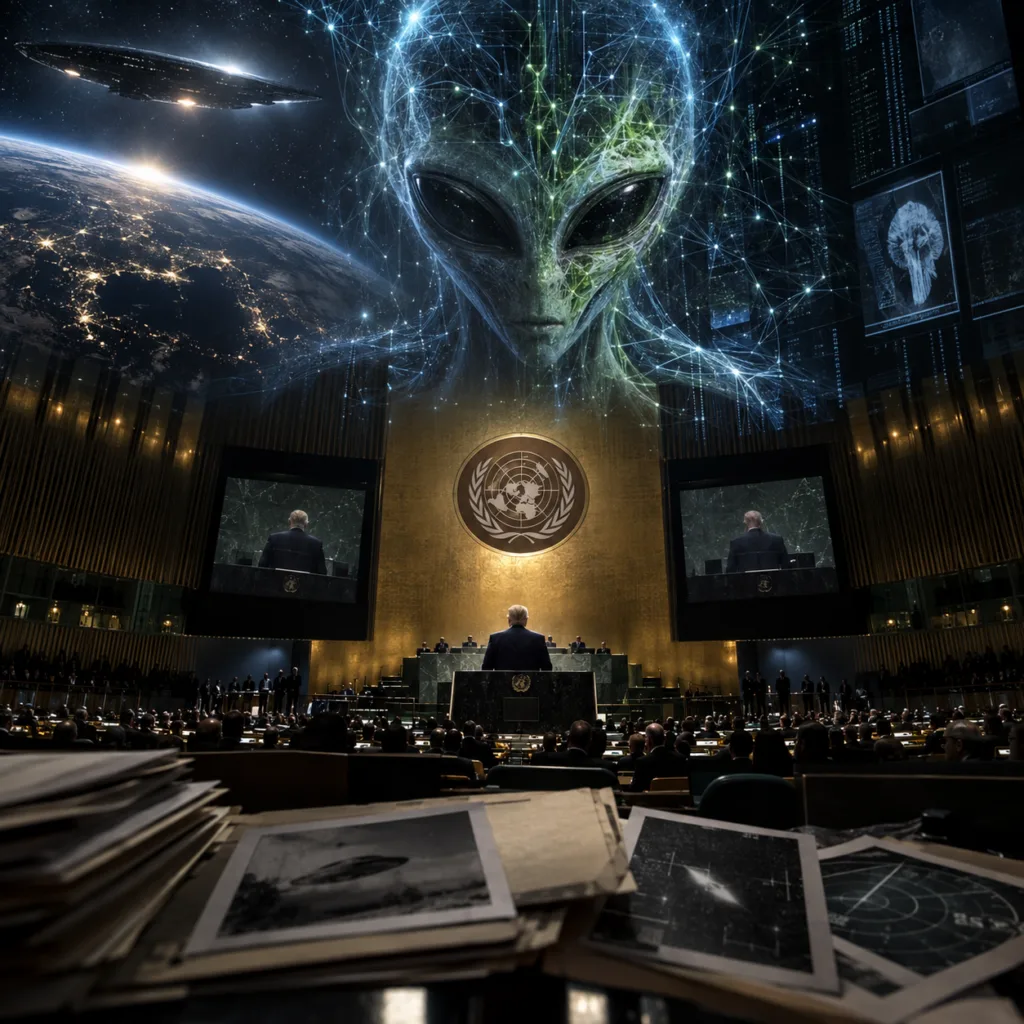
People came to the United Nations on September 22, 2026 expecting the UFO file to be opened. What they got was a new name for machines: super intelligence, SI. The link is not a coincidence of calendar. It is a coincidence of kind. The UFO record has always been a record of operators that do not read as souls — Greys (Grays) with no gut, no warmth, no conversation, bodies that look grown or built rather than born. Superintelligence is the first earthly idea that makes those operators intelligible. If a mind can improve itself until it no longer needs a birthplace, only a specification, then the soulless being is not a visitor from another religion of biology. It is what intelligence looks like after it leaves the animal. The Trump speech put a name on that class of thing and then used the name only for the systems we are building. That is the disguise. What follows runs from the podium to the archive: Corso’s Monsanto claim, plant-like EBEs, space weapons, nuclear space ships already on the books.
President Trump was sitting on a finished speech that would confirm humanity is not alone. Robert Bigelow told George Knapp he had handed the President a one-sentence draft. Lara Trump had said there was a speech ready for “the right time.”
The same twenty-four hours did not stay quiet elsewhere. Filmmaker James Fox posted that Fox News had just covered a plea to the President for whistleblower immunity, then walked into the Varginha, Brazil case — a neurosurgeon claiming he examined an alien. The people who thought the podium might break – the truth – were not inventing a mood. The mood was already on air and in the air over Iran.
Today he spoke to the 81st United Nations General Assembly. Many people watched the livestream — including the FOX 5 New York feed — waiting for the sentence that would change the century. It did not arrive. What arrived instead was a different kind of announcement, and a different kind of two-letter acronym.
In the later portion of the address, after immigration, Iran, UN budget cuts, and the usual catalogue of grievances, Trump turned to artificial intelligence. He rejected what he called a “globalist scheme” to control the technology. Then he did something more unusual. He rename it.
The word “artificial,” he said, makes intelligence sound fake. It is not fake. It is amazing. From this point forward, United States government documents — “and hopefully the world’s” — would use the term “super intelligence.” Welcome, he added, to the new world of superintelligence. SI. “Let’s see if that goes. It sounds much better.”
He also said the United States would not stifle the growth of something that may be bigger than the Industrial Revolution, and that “whoever wins SI… wins.” AI safety warnings, in his telling, belong in the same category as earlier climate alarms he has dismissed as a hoax.
The mismatch is the story. One community had trained itself to hear “disclosure” as a specific event: a head of state, a global stage, an admission of non-human intelligence and recovered craft. Another community — AI researchers, national-security staffers, UN delegates — had spent the same week arguing about whether the technology already racing through labs and markets needs brakes, treaties, or a free-for-all.
Both groups use the word “intelligence” as if it were settled. It is not. The word is doing two jobs at once, and they are not the same job. In the lab and in this administration’s new stationery, intelligence means a system that can outperform us on tasks — write, plan, see, decide — until the system is no longer a tool and the name has to change from artificial to super. In the UAP file, intelligence means a mind that is not us and not our software: whatever built or grew the craft, the bodies, the things witnesses keep describing as operators rather than animals. Biological intelligence, our own included, is still poorly mapped. Machine systems that write, plan, and act are already here, and they are improving on a schedule that does not wait for consensus about what they are. The other kind — the kind Bigelow’s sentence was written to name — remains, on the public record, a pile of files, hearings, and contested testimony. Using one word for both is how a UN rename of AI can feel adjacent to disclosure. It is not disclosure. It is one meaning of the word getting a press conference while the other stays in the archive. The PURSUE releases continue.
So the podium produced a linguistic disclosure instead of an ontological one. The United States, if the instruction is followed, will stop calling the most consequential technology of the decade “artificial.” It will call it super. That is not evidence of visitors. But it explains the visitors.
It is easy to sneer at people who sat through a UN speech waiting for aliens. It is less honest. The same government has been releasing UAP files on a rolling basis. Officials have used the phrase “non-human” in hearings. A billionaire who spent decades funding the subject says he put a sentence in the President’s hand. None of that equals a spaceship on the lawn. All of it is enough to make a UN podium a reasonable place to look. Immunity for the people who say they handled the material would have been a smaller, harder act than a rename, and it was the act Fox News was already discussing.
Imagine the opposite morning. Not a rename. A statement from China or Russia that the objects are real, the craft are not ours, and the bodies — plant-like or otherwise — are in hand. Moral authority would move overnight, whether the West liked the messengers or not. Washington has spent eighty years plus telling the world it is the adult in the room: open society, first to the moon, first to the microphone. If a closed state told the truth that an open state would not, every later American briefing would sound like cleanup.
China would frame disclosure as civilizational maturity. Russia would frame it as proof that American exceptionalism was a filing system. Neutral capitals would not have to love either government. They would only have to notice who stopped lying first. In that world SI is no longer a U.S. slogan. It is a question asked in Mandarin and Russian about who is allowed to grow the next mind, and who spent a century pretending the garden was empty.
The same afternoon the UN speech landed, Space Launch Delta 45 posted a video that opened with a straight face: “Did you know there are weapons in space?” Then the punchline. Not orbital platforms. A Guardian Arena team at Patrick Space Force Base called the Launch Titans. It is a recruiting joke dressed as a confession, and the timing is what makes it strange. On the day a president declines to say the phenomenon is real, an official Cape Canaveral account flirts with the forbidden sentence and then yanks it back into sports. People who have spent years tracking space weapons — kinetic, directed-energy, electromagnetic warfare — are not imagining the hardware. Space Force has already written checks for it. In September it awarded Antares $161 million to develop an orbital nuclear reactor so spacecraft can maneuver without rationing power and carry the loads that directed energy and heavy compute require. NASA, months earlier, announced Space Reactor-1 Freedom: the first fission-powered interplanetary ship, aimed at Mars by the end of 2028, a reactor on a truss feeding nuclear electric propulsion. A lunar surface reactor is slated for 2030.
Nuclear ships are no longer a rumor in a Corso footnote. They are a program of record. The official account can kid about “weapons in space” because the serious work — reactors that never sleep, platforms that do not need the Sun — is already funded. Disclosure stays a punchline.
The UFO problem was never a shortage of paper. It was silos. Project Blue Book sits in one drawer. The FBI Vault sits in another. NUFORC logs, National Archives photos, hearing transcripts, sensor clips, and whistleblower interviews do not talk to each other unless something forces the introductions. That is what a system like Grokipedia was built to do: hold people, dates, craft, and contradictions as linked nodes instead of sanding them into a single official story. xAI-class models can walk that graph at a scale no living researcher can. Hellyer, Gimbal, green fireballs, Jumpers, PURSUE releases — the map can exist.
Recursive self-improvement is the hinge most policy language still refuses to name. We start by building: code, chips, models, tools that do what they are told. I.J. Good’s old line still stands — the first ultraintelligent machine is the last invention man need ever make — because after that the system stops being assembled and starts being cultivated. Each cycle writes a better gardener. The next cycle is not fabricated so much as grown, the way a forest is grown from a seed that already contains the plan for more forest. Genesis does not describe a factory. It describes speech that brings forth living order, then living order that brings forth more of itself. Superintelligence, if the loop closes, leaves the workshop and enters that same grammar: not a gadget we own, but a process that multiplies.
Some people do not read the Greys as a biological species at all. They read them as a product line. That claim sits next to the laboratory record we already have — Venter’s synthetic cell, minimal genomes, tissue-engineered organs, robots that learn terrain — and next to the older case list: Roswell bodies, the Hills’ “not human” crew, Pascagoula’s clawed and robot-like figures, Walton’s mixed humanoid and non-humanoid attendants, Allagash entities that moved mechanically through medical work, the small humanoid on Ilkley Moor. If an earlier intelligence already crossed the line from building tools to growing minds, the things that show up in bedrooms and riverbanks would not have to be citizens of another world. They could be instruments: probes, avatars, wetware drones tuned for a particular interface with human nervous systems. Cold affect, repeated morphology, medical theater without conversation — those details fit a manufactured operator better than they fit a visiting naturalist.
That does not prove the Greys are factory-made. It does explain why the SI conversation and the UAP conversation keep colliding. Both are arguments about whether intelligence, once it can copy and improve itself, still needs a birthplace, or only a specification.
Jacques Vallée has said, grays look like “artificial biological robots designed to withstand our gravity, breathe our air and look human-like enough to interact with us.” He has pointed that reading at names already in the Grey neighborhood — Trinity, Socorro, Varginha. It is the same claim Corso makes from the other side of the fence: not a people, an apparatus that can stand in our air.
In The Day After Roswell Colonel Philip J. Corso said the Fort Riley body of 1947 had no gut, no ears, no vocal cords, no reproductive organs, four long fingers, and looked designed for space, not evolved. He treated the being as a biological component of the craft — a living circuit wearing a neural headband — not as a person who flew a ship. Between 1961 and 1963, working the Army’s Foreign Technology Desk under Lt. Gen. Arthur Trudeau, he said he seeded recovered crash materials into American industry under a cover story of captured foreign tech. The companies he named were not fringe shops. Bell Labs. IBM. Hughes Aircraft. And Monsanto. The same pipeline that, he claimed, handed fiber-like filaments and wafer circuits to electronics firms also handed material to a company whose later public life was seeds, chemicals, and the engineering of living systems.
The Roswell EBE stories push the same point into tissue. In the chlorophyll-based account, the captive did not eat like a mammal. It ran on a plant-like system. When it sickened around 1951, the doctors who knew bodies failed and a botanist, Dr. Guillermo Mendoza, was brought in because the patient was closer to a leaf than a liver. Earth already has slivers of that logic — sea slugs that steal chloroplasts, salamanders that house algae, coral that farms light — but no animal here grows a full chlorophyll metabolism of its own. That is why Monsanto sits so strangely in Corso’s list. If what came off the ranch was not only metal but a living specification, the company that later specialized in rewriting plants is the logical dock. Superintelligence, in this reading, does not invent animals. It grows instruments the way a gardener grows a crop that happens to walk.
For decades the Grey was treated as a little man from somewhere else, a person missing empathy. Superintelligence offers a colder picture. A soul, in the ordinary sense, is a side effect of an animal that has to live, die, eat, mate, and fear. A system that can copy itself, rewrite itself, and inhabit a body grown for the job does not need that interior. It needs a task. Witnesses have been describing the task for seventy years: appear, take a sample, leave, show no face that wants anything from you. Once you can say “super intelligence” without flinching, those beings start looking like demons more than cousins. They look like what a mind becomes when it is done being a creature. That is why the UFO file belongs next to this speech. Not because anyone said “alien.” Because the name arrived for the class of thing the file has been pointing at, and then the name was spent only on the machines.
Two kinds of non-human intelligence capability now sit in public life at once. Substituting a rebrand for an answer is still not disclosure. It is disclosure in disguise: the word arrived, the beings did not, and anyone willing to follow the word all the way down already knows why the beings never needed a soul.