Colonel Philip J. Corso
Colonel Philip J. Corso was a United States Army officer who later became known for his detailed account of the Roswell incident and the alleged recovery of non‑human technology. Corso served more than twenty years in the U.S. Army and worked in military intelligence roles during World War II in Europe. Later in his career he served at the Pentagon in the Army’s Research and Development department on the Foreign Technology Desk under Lieutenant General Arthur Trudeau, where his responsibilities included examining advanced technologies that could have strategic importance during the Cold War.
In 1997 Corso published a book titled The Day After Roswell, written with author William J. Birnes. In the book he described the 1947 Roswell crash as the recovery of a damaged extraterrestrial craft that had come down during a fierce storm near Roswell, New Mexico. He suggested that lightning, radar interference, or a combination of both may have affected the vehicle. According to Corso, debris from the craft was scattered across a ranch in New Mexico and quickly secured by the U.S. military after unusual radar contacts and reports from the area.
Corso wrote that shortly after the recovery he personally saw one of the extraterrestrial biological entities associated with the crash while it was being transported in a wooden shipping crate at Fort Riley, Kansas. He described the being as a small gray humanoid about four feet tall with a large lightbulb‑shaped head, almond‑shaped eyes that extended around the sides of the skull, thin arms and legs, and four long fingers on each hand with no visible thumbs. The body had no visible ears, no vocal cords, no digestive system, and no reproductive organs. Corso concluded from these features that the entity appeared to be a bio‑engineered biological form designed specifically for space travel and exploration rather than a naturally evolved organism.
Corso also suggested that the entities were not independent pilots in the usual sense but biological components integrated directly into the craft’s operating systems. In his account the interior of the vehicle did not contain conventional flight controls. Instead it contained organic‑appearing interfaces and helmet‑like headbands with neural sensors. Corso believed these devices connected directly to the entity’s brain, allowing the craft to be controlled through thought and bio‑electrical signals. He described the entity as functioning almost like a living circuit within the craft’s guidance system, with its nervous system linked to the vehicle’s electromagnetic propulsion structure.
He described the recovered craft itself as a smooth semi‑circular or crescent‑shaped vehicle roughly thirty feet in diameter, constructed from a seamless alloy material with no visible welds, rivets, or conventional engines. According to Corso, the craft operated using an electromagnetic propulsion system that manipulated gravity and spacetime rather than relying on traditional fuel‑based propulsion. In his description the system created powerful electromagnetic fields that allowed the vehicle to achieve extraordinary speeds and maneuverability that appeared impossible using conventional aerospace technology.
Corso explained that the U.S. military initiated a secret effort to analyze and replicate the recovered materials. Under the direction of senior military leadership, including General Nathan Twining and Lieutenant General Arthur Trudeau, fragments of the technology were distributed to selected research laboratories and private corporations so that scientists could examine them without being told their true origin.
A key moment in Corso’s story occurred in 1961 when he reported that Lt. Gen. Arthur Trudeau took him to a secured storage area in the Pentagon and showed him a locked four‑drawer metal file cabinet that contained artifacts recovered from the Roswell crash. According to Corso, the cabinet held roughly several dozen items believed to originate from the craft. The drawers contained unusual materials such as flexible glass‑like filaments that transmitted light signals, thin wafer‑like chips etched with microscopic circuitry, lightweight metallic alloys with no seams, crystalline lenses that amplified light, and visor‑like headbands containing sensors that appeared to interface with the nervous system.
Corso wrote that these objects displayed properties unfamiliar to contemporary technology. The metals did not corrode and showed no visible manufacturing marks. The glass‑like fibers transmitted light even when sharply bent. The wafers contained microscopic circuits embedded in silicon layers that appeared capable of processing electrical signals without conventional wiring.
While serving on the Army’s Foreign Technology Desk within Research and Development from 1961 to 1963, Corso said he was responsible for quietly introducing pieces of the recovered technology into American industry. According to his account, these materials were presented to scientists and engineers as captured foreign technology so they could be studied without revealing that the objects were recovered from a non‑human craft.
Corso described distributing materials to research laboratories and corporations including Bell Labs, IBM, Monsanto, Hughes Aircraft, and other defense contractors. The goal, he said, was to allow engineers to study the artifacts and independently reproduce similar technologies without knowing their origin.
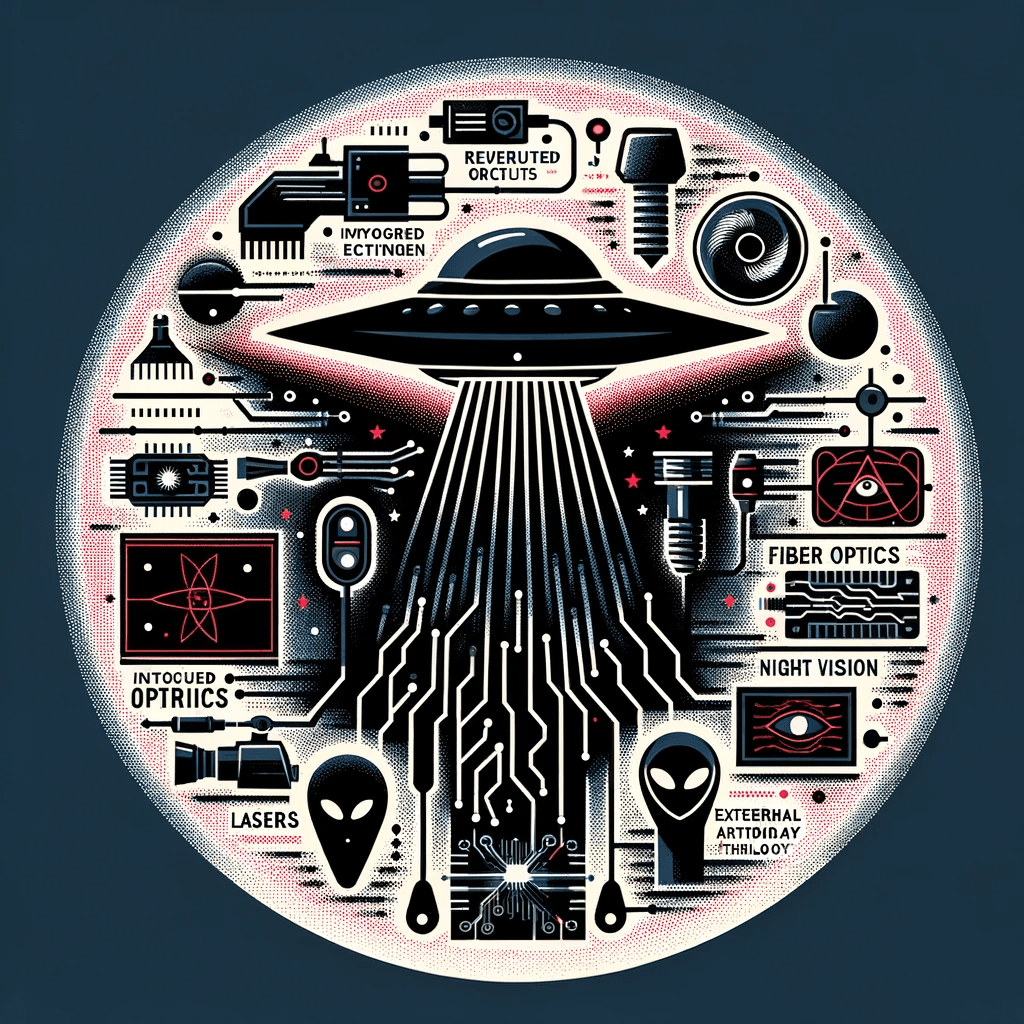
In Corso’s account this effort helped stimulate the development of numerous technological advances. He connected the Roswell materials to the emergence of integrated circuits derived from wafer‑like components within the craft’s control systems, fiber optic communication systems inspired by flexible glass‑like filaments capable of transmitting light signals, and laser technology influenced by a handheld device recovered from the crash that emitted a highly concentrated beam of energy.
He also linked the recovered artifacts to the development of night vision devices modeled after lens‑like headbands worn by the entities, particle beam research connected to directed‑energy systems observed within the craft, and concepts for antigravity propulsion derived from the vehicle’s gravity‑manipulating electromagnetic structure.
Additional technologies he associated with the Roswell materials included advanced materials such as super‑tenacity synthetic fibers later used in protective equipment, high‑temperature superalloys capable of surviving extreme conditions, semiconductor advances, and radar‑absorbing coatings similar to materials later used in stealth aircraft.
Corso also wrote that he consulted with leading scientists and engineers while examining the recovered materials. Among the figures he mentioned was Wernher von Braun, the German rocket engineer who later became a central figure in the American space program. Corso said that during the early 1960s he discussed the unusual silicon wafers and circuitry recovered from the craft with experts including von Braun and engineers connected to Bell Labs and other defense contractors.
According to Corso, these discussions focused on the structure of the wafer‑like components embedded in the craft’s control systems. He described them as thin silicon slices etched with microscopic circuitry capable of amplifying and processing electrical signals. Corso believed that the analysis of these materials contributed to early work on integrated circuits and solid‑state electronics.
Corso further suggested that studies of the extraterrestrial biological entities provided insight into unusual biological and medical principles, including the possibility of accelerated tissue repair using electromagnetic fields. He also believed that early developments in microelectronics, computer systems, signal processing technology, advanced energy research, and even possible zero‑point energy concepts were accelerated by the analysis of the recovered materials.
Corso also wrote that the extraterrestrial presence represented a potential threat. He described incidents in which the entities demonstrated hostile behavior toward military personnel and installations. He framed the situation as a quiet and largely unknown confrontation between human military forces and an advanced extraterrestrial intelligence.
Although later discussions by some researchers have explored the possibility that the Roswell craft and entities could be interdimensional or connected to time‑traveling technologies. Later expansions of the interdimensional interpretation appeared most prominently in comments by his son, Philip Corso Jr., who suggested the craft might have been capable of manipulating time or shifting between realities. In Corso’s own description, however, the craft used advanced electromagnetic systems capable of manipulating gravity and spacetime to travel between distant points in the universe.
Corso also provided a timeline describing when he believed he first encountered the Roswell materials and when he later handled them directly. According to his account, the crash occurred in early July 1947 during a powerful storm in New Mexico. He stated that shortly afterward, on July 6, 1947, he saw one of the recovered biological entities while it was being transported through Fort Riley, Kansas. At the time Corso was a young Army officer and said the sight left a lasting impression on him.
Years later, while serving at the Pentagon in the early 1960s, Corso said he again encountered artifacts connected to the Roswell recovery. During his assignment on the Army’s Foreign Technology Desk in Research and Development under Lieutenant General Arthur Trudeau, he described being given access to containers holding unusual materials believed to have come from the crash. Corso wrote that between 1961 and 1963 he examined fragments of unfamiliar alloys, strange electronic components, and other small devices that appeared to be parts of an advanced technological system.
When The Day After Roswell was published in 1997 the book attracted additional attention because it included a foreword written by Senator Strom Thurmond. Thurmond had served with Corso in the U.S. Army during World War II and had known him for many years. After the book appeared, however, Thurmond’s office clarified that the senator believed he had been writing a brief introduction to a traditional military memoir about Corso’s career.
The Day After Roswell became one of the most widely discussed books connected to the Roswell incident and remains a significant work within discussions about unidentified aerial phenomena and non‑human intelligence.