What the Hell is Going On?

On May 8, 2026, Fox News’ The Will Cain Show featured Rep. Eric Burlison of Missouri discussing the same-day release of the first batch of UAP and UFO files through the new government site at war.gov/ufo.
The interview came after the Department of War posted a large group of newly released unresolved UAP records connected to President Trump’s transparency directive. The release was presented as a presidential unsealing of UAP encounter files and described as an unprecedented level of transparency, with supporters arguing that no previous administration had gone this far.
Burlison described the release as only an opening step. He said that every previous president had either dismissed or mocked the UAP issue, while President Trump was choosing transparency. He also said that what dropped that day was only the tip of the iceberg and that he expected more compelling disclosures to follow.
The strongest moment from the interview came when Burlison said he understood the public’s frustration because he had experienced it himself. He said he had seen videos that he believed were in the process of being declassified and that more material was likely still coming. He then added that if those videos were not declassified, he would probably make an effort to release them himself under speech and debate protections.
Burlison also gave a clearer sense of the kind of footage he was referring to. He said much of what he had seen was similar to what had already been released that day, but that some videos were especially interesting because of the environment and circumstances around them. He specifically mentioned videos of UAPs flying around Russian submarines and aircraft firing on some of these UAPs. He said he was teasing that information because he was using the interview to tell the administration that if those videos were not released, he had the ability to get them and release them himself.
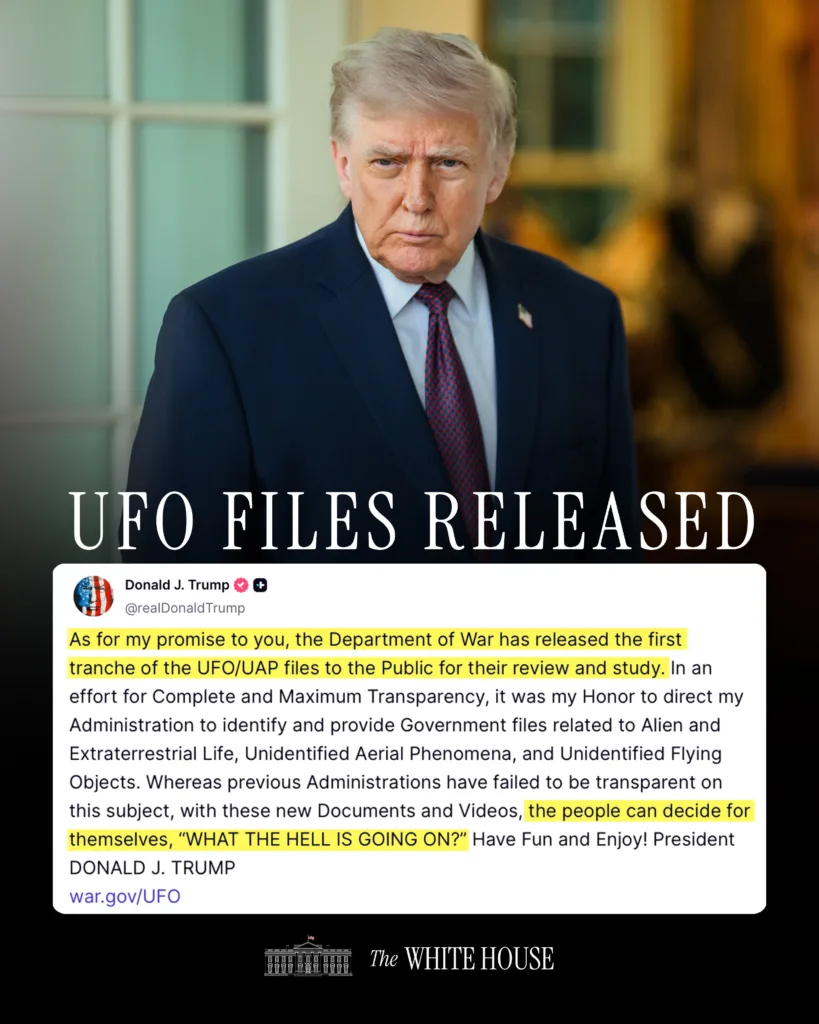
The White House also promoted the release through an official post showing President Trump with the words “UFO Files Released.” The post included Trump’s statement that, as promised, the Department of War had released the first tranche of UFO and UAP files for public review and study. He framed the move as part of “Complete and Maximum Transparency” and said his administration had been directed to identify and provide government files related to alien and extraterrestrial life, Unidentified Aerial Phenomena, and Unidentified Flying Objects.
Trump’s statement also contrasted the release with previous administrations, saying they had failed to be transparent on the subject. The most striking line was his declaration that, with the new documents and videos available, “the people can decide for themselves, ‘WHAT THE HELL IS GOING ON?’” The statement then pointed readers to war.gov/ufo.
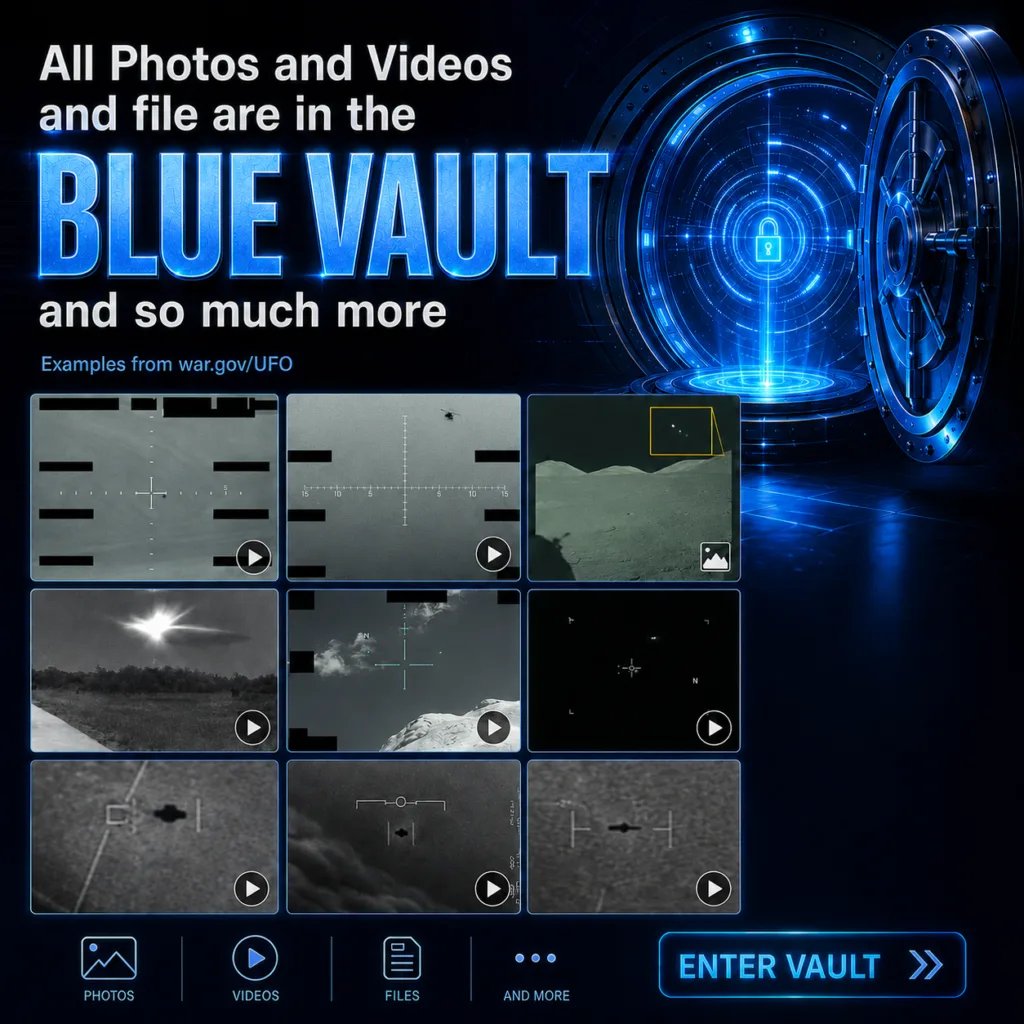
The files were made available at war.gov/ufo, with additional records expected to be released by the Department of War on a rolling basis. The release was framed as the beginning of a continuing disclosure process, not the final word. The files were a mix of PDFs, videos, and images from multiple agencies as part of the Presidential Unsealing and Reporting System for UAP Encounters, known as PURSUE Release 01.
A fuller breakdown of PURSUE Release 01 shows why this first tranche matters: it is not just a collection of random UFO clippings, but a mixed archive of FBI files, NASA records, State Department cables, mission reports, historical memos, images, videos, and modern UAP cases stretching from the early flying-disc era into recent military reporting. That broader context helps explain why the release immediately became part of a larger fight over what has been held back, what has been declassified, and what may still be sitting behind agency walls.
In a Fox News interview with David Grusch and Bret Baier on Special Report with Bret Baier. When Baier asked whether the public was on the edge of getting more details connected to actual alien beings, Grusch said that decision was up to the president’s team and that he supported them. But he also said he had recently been made aware that some actors inside certain intelligence agencies, including the DIA and CIA, were blocking parts of the president’s appointed team from gaining access to and control over historical records.
Grusch then pointed to Under Secretary of Defense for Intelligence and Security Bradley Hansell as someone he expected to address the issue. He said some of the material was under Hansell’s area of responsibility, especially on the national program side, and connected that to the need to reveal historical National Security Council records on the UAP issue.
Official descriptions and contemporaneous coverage described the newly released material as including Apollo mission orbs, desert star-like craft, silent hovering objects, photos, videos, and government records. The release was presented as a major first step in Trump’s transparency promise, while the official message around it stressed that this was not a one-time dump, but the start of a rolling process where more UAP records would be reviewed, declassified, and posted over time.
The broader release appears to include records from multiple government sources, including the FBI, Department of Defense, NASA, and the State Department. The files reportedly cover incidents going back decades, with sightings from the 1940s onward and cases spread across different parts of the world.
Public reaction has been mixed. Some disclosure supporters view the release as historic because it places a major collection of UAP records in one public location. Others have called the first batch underwhelming, arguing that much of it appears to contain older reports, lower-resolution videos, and material that does not yet answer the biggest questions.
That split reaction is probably why Burlison’s comments stood out. He did not present the May 8 release as the end of the story. Instead, he described it as a teaser and suggested that stronger material may still be waiting inside the declassification pipeline.
One of the most noteworthy videos in the initial release is DOW-UAP-PR38-Unresolved-UAP-Report-Middle-East-2013 (1 min 46 sec infrared sensor footage from a U.S. Central Command platform in the Middle East, 2013). It stands out because the report comes from a relatively recent active military setting rather than older historical records. Official AARO descriptions note that the reporter provided no oral or written description of the observation. The footage depicts an area of contrast resembling an eight-pointed star with arms of alternating length. At approximately 10 seconds, the sensor zooms in; from 11–29 seconds the object moves with a visible trail. This makes it one of the most important recent military video files to examine closely.
Another standout video is DOW-UAP-PR48-Unresolved-UAP-Report-INDOPACOM-2024 (1 min 39 sec infrared sensor footage from a U.S. military platform in the Indo-Pacific, 2024). The report highlights a recent active military case from INDOPACOM. Official AARO descriptions note that the reporter provided no oral or written description of the observation. The sensor tracks a single area of contrast for the full duration, with wind turbines visible in the scene. This makes it one of the most important recent military video files to examine closely.
A third key video is DOW-UAP-PR49-Unresolved-UAP-Report-Department-of-the-Army-2026 (1 min 49 sec infrared sensor footage from a U.S. military platform, 2026). The report points to a very recent Department of the Army submission from an active military setting. Official AARO descriptions note that the reporter provided no oral or written description of the observation. This makes it one of the most important recent military video files to examine closely.