Elvis Presley and Higher Contact
In 1980, Mary Hart of the television show PM Magazine sits down with Larry Geller in what appears to be one of the earliest televised interviews where he openly speaks about his friendship with Elvis Presley, often referred to as the King. Mary Hart welcomes viewers from the headquarters of the Completely Elvis Fan Club in Los Angeles, explaining that even more than three years after his death thousands of devoted fans around the world continue to keep Elvis’s legacy alive through clubs like this one. On Saturday nights the space fills with fans gathering to watch Elvis movies, making it seem as though Elvis is even bigger in death than he was during his lifetime.
Despite the massive amount of publicity and countless books written about him, Mary explains that the show will reveal a lesser-known side of Elvis, his spiritual search for meaning, through a conversation with Larry Geller, a man who was his metaphysical mentor for over eight years.
Geller first glimpsed Elvis as a teenager in 1957 outside the Pan Pacific Auditorium during one of the King’s earliest Los Angeles concerts. In 1964 he was called by Elvis’s aide Alan Fortas and invited to the Bel Air home on Perugia Way, where he gave Elvis a haircut during the filming of Roustabout. That conversation lasted for hours and sparked Elvis’s curiosity, leading Geller to give him a book called The Impersonal Life, which Elvis read quickly — finishing it by that same evening at the studio — and said answered many of his questions.
From that point forward Elvis entered a deeper spiritual journey. He began reading extensively about major world religions and was described as a seeker who found truth across different belief systems while still identifying as Christian. In March 1965, while driving through the desert to Los Angeles, Elvis experienced a powerful vision: a cloud formation first appeared as Joseph Stalin’s face, then transformed into the smiling face of Christ. “I’m not a believer anymore,” he told Geller. “I know.” This profoundly changed him and influenced his gospel music, including the award-winning album How Great Thou Art.
His close relationship with Geller also created tension among members of his entourage, who mocked Geller behind his back, calling him “the Swami” and “the Mystic.” Eventually Geller chose to leave, believing that staying would only create more conflict. Even so, he felt they would reunite, and in 1972 they did backstage in Las Vegas. There Geller saw that Elvis had kept and continued studying the spiritual books he had given him — “50 or 60 of them on the floor, all worn and dog-eared.” — reinforcing the depth of his commitment and showing that his search had never stopped.
What makes this even more interesting today is how the original explanation behind one of those key books, The Impersonal Life, can be looked at differently through a modern lens. In 1914 Joseph Benner described the voice behind the book as the Divine I AM, something internal, universal, and present within every person, and he was clear that it was not coming from any external beings or entities. But now, over a century later, as discussions around non human intelligence and interdimensional presence have become more common, the same experience can be reexamined in a new way.
This does not require changing what Benner said, but rather asking a different question. What if what he described as the inner divine voice is actually a form of communication that humans experience internally but does not necessarily originate from the individual mind alone, and instead comes from a higher intelligence that exists beyond normal perception. In 1914 this would have naturally been understood as God or Spirit, because there was no other framework available at the time. While this does not prove that the source was interdimensional, it opens the possibility that what was once described purely as divine revelation could also be understood as contact with a greater consciousness that interacts with humans in subtle and personal ways, something that today many exploring non human intelligence would recognize as a familiar pattern.
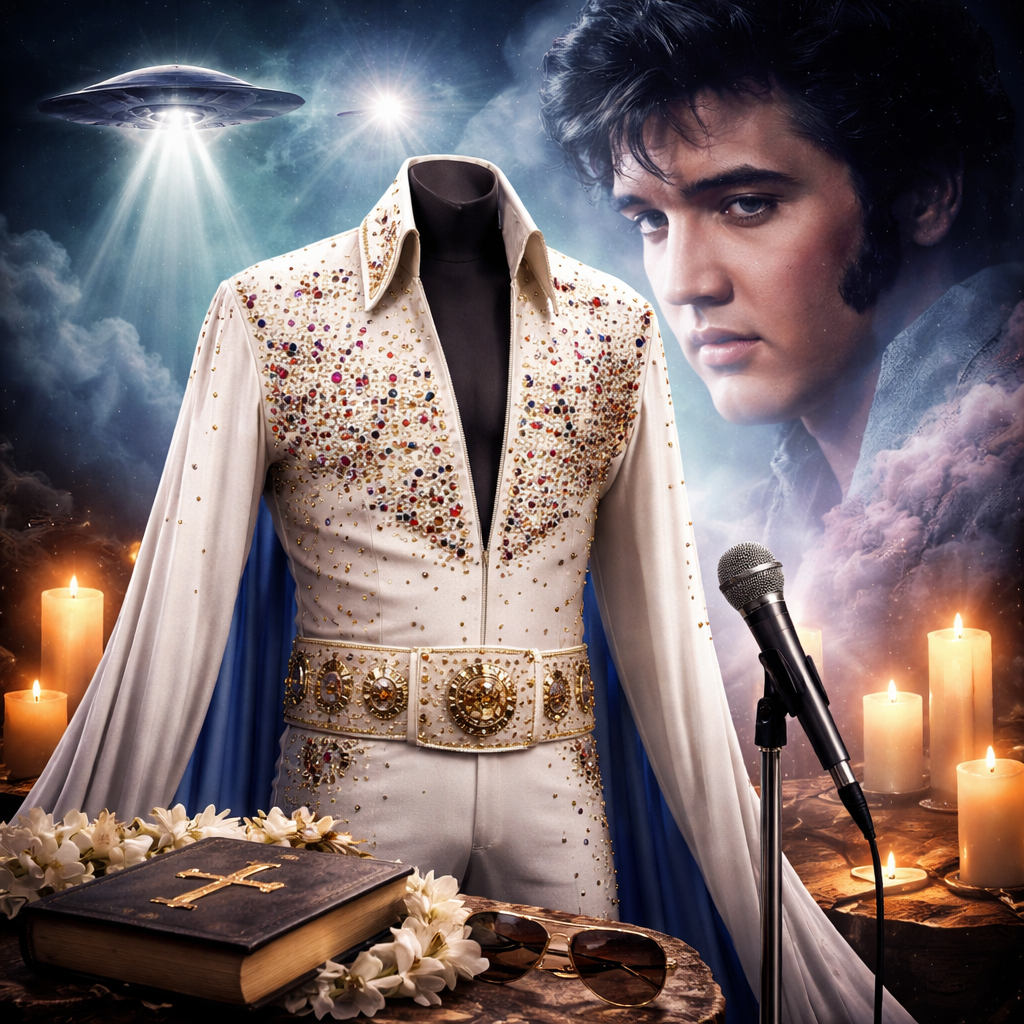
Accounts from Larry Geller and members of Elvis’s inner circle suggest that this idea may not have been theoretical for Elvis, but something he believed he had experienced directly. Geller consistently described conversations in which Elvis spoke about telepathic contact, including a childhood vision where he was shown a future version of himself in a white jumpsuit performing in front of a massive audience, something Elvis later interpreted as a glimpse of his destiny. In adulthood, both Geller and others recalled multiple sightings of unexplained aerial objects during late night drives through the desert, as well as an incident where a craft was said to have hovered above Graceland. In one account involving Red West, Elvis reportedly remained calm during a sighting and suggested that the presence was not hostile.
These experiences were not separate from his spiritual beliefs but were understood by Elvis as part of the same search for higher truth. He read extensively on religion, philosophy, and paranormal subjects, and saw no clear boundary between what he described as the Divine within and the possibility of higher intelligences existing beyond ordinary human perception.
In reflecting on Elvis’s later years, Geller states that he believed Elvis had a premonition of his own death. He recalls a moment where Elvis remarked to backup singer Kathy Westmoreland that although people thought he looked overweight, he would look good in his coffin, suggesting a sense of awareness and acceptance.
The closing moments of the 1977 CBS TV special shift from the energy of Elvis’s final performance to a quiet and emotional farewell, as the announcer tells the audience, “ladies and gentlemen Elvis has left the building, thank you and good night,” before transitioning to a message recorded at Graceland by his father, Vernon Presley, just days after Elvis’s passing; speaking directly to the audience, Vernon thanks fans for the overwhelming number of cards, letters, and flowers sent in support, saying the family deeply appreciates the kindness and that it has helped them through their grief, and he also expresses gratitude to CBS for allowing him to share this message, before ending with a powerful statement that the performance viewers have just watched was the last live appearance Elvis ever gave on stage, closing with “thank you, God bless you,” leaving behind a sense of finality that marks not just the end of the show, but the end of Elvis Presley’s life.