Peter Levenda
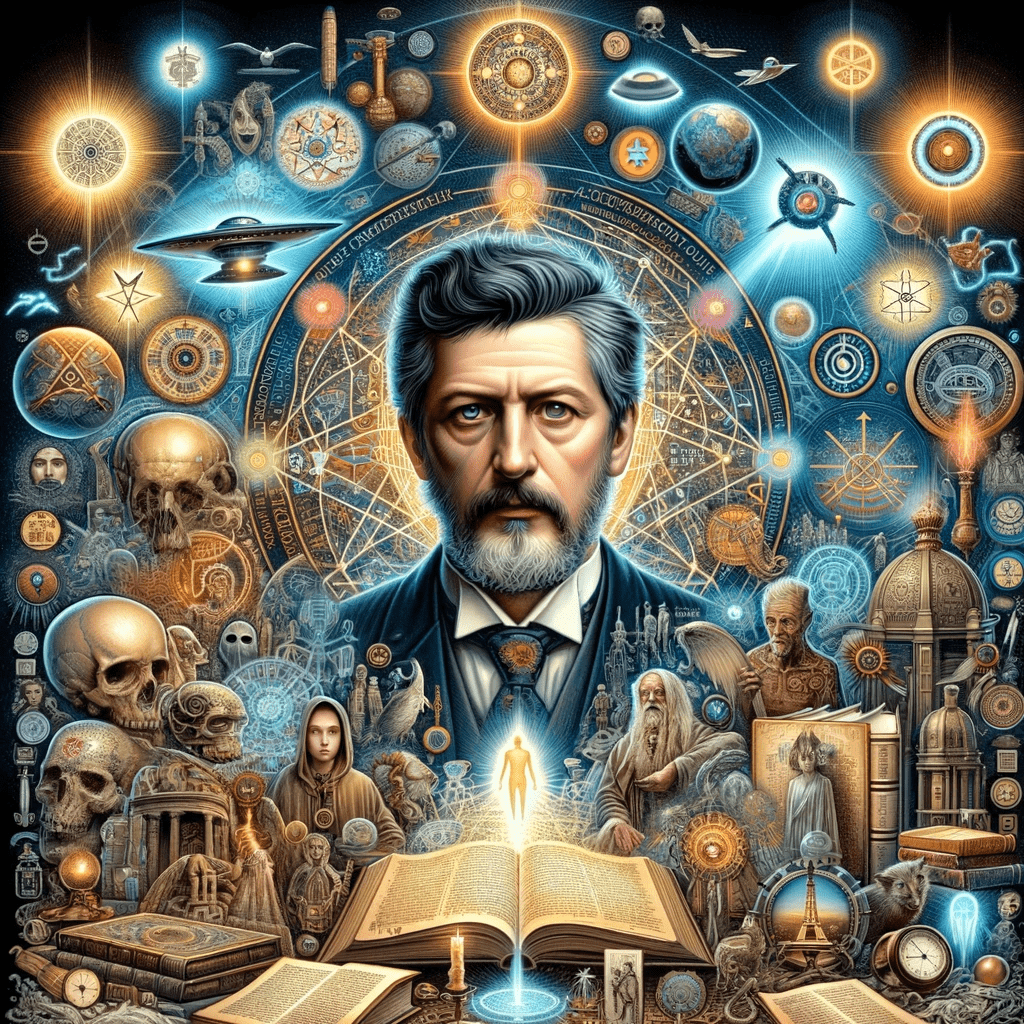
Peter Levenda is an American author and researcher known for his work on occultism, esotericism, religious history, and the historical relationship between belief systems and political power. Over several decades he has written numerous books examining hidden traditions, secret societies, intelligence history, and the role of mystical or symbolic ideas in shaping cultural and political movements. In more recent years he has also become widely known for his research into UFOs and UAPs through his collaboration with Tom DeLonge on the Sekret Machines series.
Levenda was born in 1950 in the Bronx, New York. During his childhood he lived in several different locations across the United States including New York, Gary in Indiana, Chicago in Illinois, and towns in New Hampshire. These frequent moves exposed him to a variety of cultural and intellectual environments that later influenced his interests in history, religion, and mythology. He later pursued academic studies in religion and culture and earned a Master of Arts in Religious Studies and Asian Studies from Florida International University, along with a certificate in Asian Studies. Early in his life he also served as an auxiliary police officer for the New York Police Department.
One unusual story from his youth frequently mentioned in biographical accounts occurred in June 1968 when Levenda, then seventeen years old, attended the funeral of Senator Robert F. Kennedy at St. Patrick’s Cathedral in New York City. According to Levenda’s own recollections, he managed to enter the cathedral and briefly helped lead the procession leaving the service, an event he later described as a formative moment during a turbulent period in American political history.
Before becoming widely known as an author, Levenda worked internationally in business and technology fields. He spent more than seven years living in Kuala Lumpur, Malaysia while working as an executive for an American telecommunications manufacturer. During this period he worked across Asia and was among the early American business figures conducting commercial activity in China after diplomatic relations between the United States and China normalized in the 1970s. His professional career also included work in Southeast Asia, Latin America, and Europe before he eventually shifted his focus toward writing, research, and historical investigation. Over the course of his research career he has traveled to dozens of countries studying archives, religious sites, and historical records related to occult traditions, intelligence activity, and political history.
One of his best known books, Unholy Alliance: A History of Nazi Involvement with the Occult, examines ideological, mythological, and symbolic influences surrounding aspects of Nazi Germany. The book investigates how mystical traditions, nationalist mythologies, and esoteric beliefs circulated within parts of the Third Reich and influenced certain political and cultural movements during that period.
While researching material for Unholy Alliance, Levenda traveled extensively through Europe and South America examining archives, historical sites, and intelligence records related to post-war Nazi networks. During research in Chile in 1979 he was briefly detained at Colonia Dignidad, a secretive compound associated with Nazi expatriates and later linked to the regime of Augusto Pinochet. Experiences such as this shaped his approach to historical investigation and reinforced his focus on the connections between ideology, secrecy, and power.
Another major work, The Secret Temple: Masons, Mysteries, and the Founding of America, explores the influence of Freemasonry and related philosophical traditions on the intellectual climate of the early United States. The book examines Enlightenment-era symbolism, philosophical ideas, and the role of fraternal organizations in shaping aspects of early American thought and political culture.
Levenda has also written extensively about the relationship between occult traditions and political structures in the United States. His three-volume work Sinister Forces: A Grimoire of American Political Witchcraft investigates a wide range of controversial historical events and cultural movements through the lens of esoteric symbolism and hidden influence. The books explore topics such as intelligence operations, political assassinations, ideological movements, Cold War era psychological experimentation, and the cultural climate surrounding events such as the Manson murders.
Several of Levenda’s works examine the connection between literature, mythology, and occult traditions. These include The Lovecraft Code, Dunwich, and Starry Wisdom, a trilogy exploring how the fictional universe created by H. P. Lovecraft influenced later occult interpretations. In these works Levenda examines the ideas of Kenneth Grant and the Typhonian magical tradition, which interpreted Lovecraft’s cosmic entities as symbolic representations of forces or intelligences existing beyond ordinary human perception.
Levenda has also written books exploring broader historical and mystical traditions including Ratline, which investigates alleged Nazi escape networks after the Second World War, Stairway to Heaven, which examines esoteric traditions connected to religion and magic, The Tantric Alchemist, which studies connections between Eastern and Western mystical traditions, and Rites of the Mummy, which explores magical symbolism and ritual traditions in historical contexts.
He has also written Dead Names: The Dark History of the Necronomicon, a book examining the history of grimoires and the cultural influence of the famous fictional occult text associated with H. P. Lovecraft. In occult circles Levenda has sometimes been linked to the authorship of the controversial Simon Necronomicon, a modern grimoire published in 1977 that blended Lovecraftian fiction with ancient mythology and occult ritual.
Levenda has appeared in numerous documentaries, television programs, and interviews discussing his research. He has appeared as a commentator on programs such as Ancient Aliens and in various documentary productions addressing historical occult traditions, intelligence history, and unexplained phenomena.
His research expanded further into the study of UFOs and UAPs through his collaboration with Tom DeLonge on the Sekret Machines project. The Sekret Machines series includes both fictional narratives and nonfiction companion volumes examining government secrecy, historical UFO incidents, and the cultural history surrounding unidentified aerial phenomena.
The nonfiction Sekret Machines books, including Gods, Man, and War, attempt to place modern UFO sightings within a broader historical framework that includes ancient religious encounters, mystical experiences, and reports of otherworldly beings found throughout human history. Levenda explores how accounts of angels, demons, divine messengers, or supernatural visitors recorded in ancient texts may represent earlier interpretations of encounters with unknown intelligences.
Within these books Levenda also discusses the possibility that the UFO phenomenon may not be limited to physical spacecraft originating from distant planets. Instead he examines theories suggesting that some encounters could involve non-human intelligences operating beyond conventional space-time or interacting with human consciousness in ways that challenge purely material explanations. In this context the phenomenon is sometimes described using terms such as interdimensional, ultraterrestrial, or consciousness-based.
Similar themes appear in Levenda’s earlier work Sinister Forces, particularly in discussions of mysterious entities sometimes referred to as “The Nine.” These channeled intelligences, reported during experiments involving researchers such as Andrija Puharich and individuals connected to Cold War era intelligence circles, are examined as possible examples of non-human entities interacting with human affairs. Levenda considers whether such phenomena might represent extraterrestrial visitors, psychological manifestations, or intelligences originating from dimensions beyond ordinary perception.
Across interviews and writings connected to the Sekret Machines project, Levenda has argued that government secrecy surrounding UFO encounters has prevented the public from fully understanding the phenomenon. He has examined historical military cases, intelligence community interest in UFO reports, and the possibility that advanced technologies beyond current human capabilities may be involved in some sightings.
Peter Levenda’s work therefore occupies a distinctive position between historical research, religious studies, and investigations into unexplained phenomena. Through books, documentaries, lectures, and collaborations such as Sekret Machines, he continues to contribute to discussions surrounding occult traditions, secret history, and the enduring mystery of UFOs and UAPs.