Screen Memories and Traumatic Childhood Grey Alien Experiences
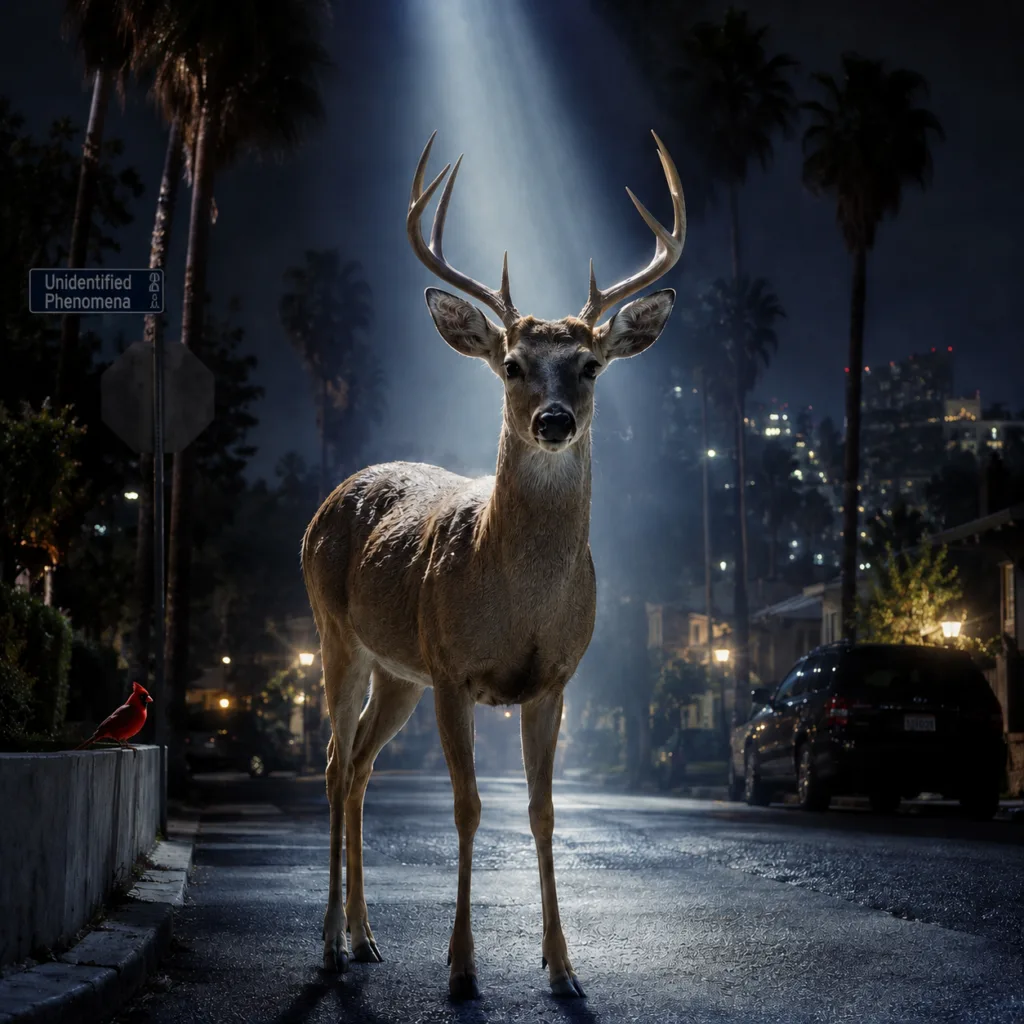
For decades, ufologists and abduction researchers have documented a consistent and disturbing pattern: Non-Human Intelligence frequently uses animals as screen memories to mask traumatic childhood encounters with gray aliens. Witnesses under hypnosis repeatedly describe how benign-seeming wildlife — especially deer with large, expressive eyes — later transform to reveal small gray beings in their bedrooms, paralysis, floating sensations, invasive medical procedures, and profound lifelong impacts.
This “screen memory phenomenon,” as Budd Hopkins termed it, represents one of the most compelling and recurring elements in the entire body of UFO abduction literature.
A vivid modern illustration of this phenomenon appears in an official movie poster. It shows a majestic buck deer standing calmly in a dramatic beam of light on a nighttime Los Angeles street lined with palm trees, a bright red cardinal perched on a nearby streetlight. Far from random promotional imagery, this scene serves as the central visual and thematic hook for Steven Spielberg’s highly anticipated film Disclosure Day, set for theatrical release on June 12, 2026. In the film, the animals are not mere background details — they are the key to its biggest revelation about Non-Human Intelligence already living among us.
In the trailers, CinemaCon footage, and early screenings, deer, red cardinals, goats, raccoons, and other familiar North American wildlife repeatedly appear behaving in deeply unnatural ways. Groups of deer stand motionless in suburban yards or outside windows, staring intently at the humans inside — including Josh O’Connor’s character. A prominent buck fearlessly enters a young girl’s bedroom, connected to Emily Blunt’s meteorologist character’s childhood, approaches her calmly by the bed, and later leads her, accompanied by the cardinal, in a dreamlike procession with other animals toward a house emanating a bright light.
Red cardinals boldly enter through windows, landing on kitchen tables, fingers, or even the buck’s antlers, staring directly and calmly at characters amid the growing chaos. Goats and raccoons join the coordinated gatherings, showing zero fear as they intrude into human spaces. Across every sequence, the pattern is unmistakable: intense, telepathic-style eye contact, complete fearlessness, and deliberate intrusion into personal environments.
These creatures guide or observe during key childhood contact moments, offering a stark, unsettling contrast to the human panic and military response unfolding around them. These animals function as embedded proxies for Non-Human Intelligence already present on Earth, hiding in plain sight. They serve as comfortable, non-threatening interfaces for contact, observation, and repressed memories.
Spielberg masterfully blends the sense of wonder from E.T. and Close Encounters of the Third Kind with a distinctly modern high-strangeness dread, making the familiar feel profoundly alien. The eye-zoom reveal — where the camera moves across a deer’s face to show a classic gray humanoid alien with large black eyes staring back at the child version of Blunt’s character — drives home the twist.
This motif draws directly from decades of documented UFO abduction research rather than pure invention. It centers on the concept of screen memories — false or implanted recollections that mask traumatic encounters with NHI.
The term was originally coined by Sigmund Freud in his 1899 paper “Screen Memories,” referring to real childhood events that symbolically hide deeper repressed thoughts or traumas. Budd Hopkins popularized and transformed the idea for UFO research in the late 1970s and early 1980s, particularly in his landmark book Missing Time (1981) and later Sight Unseen (2003), where he described it as the “screen memory phenomenon.”
In the abduction, screen memories are externally imposed by the entities themselves — a form of mental camouflage or “merciful amnesia” designed to soften the psychological impact and allow witnesses to continue their daily lives. Under hypnotic regression, these screens often dissolve to reveal gray aliens and missing time. Hopkins provided compelling evidence through cases involving multiple witnesses in shared encounters, where two or more people independently reported seeing exactly the same impossible deer with identical details: expressive black eyes, telepathic communication, and an unnatural calm. This consistency strongly suggests external implantation rather than individual hallucination.
The clearest parallel appears in the Virginia Horton case from Missing Time. The abductee consciously remembered only a beautiful, telepathic deer in the woods that stared with conscious awareness, felt like a “person” or best friend, and communicated “good-bye.” Hypnosis later revealed it as a screen memory for an actual alien encounter, complete with physical evidence such as a nosebleed. Hopkins noted that deer with large, expressive black eyes frequently appear as implanted images. Mike Clelland’s The Messengers (2015) further explores birds — especially owls, often giant and unnatural — as the most common screen-memory stand-ins that regress into gray aliens. Raccoons, goats, squirrels, cats, and other animals play similar roles as psychic projections for what researchers call “variety attenuation,” reducing the shock of true NHI contact.
The film’s red cardinals elegantly fit the broader “messenger birds” archetype, echoing folklore in which they symbolize visitors from beyond. Abduction experiences frequently begin in early childhood or even infancy, often involving repeated traumatic encounters with gray aliens. Many abductees report fragmented memories of small beings in their bedrooms at night, floating sensations, intense lights, paralysis, and invasive medical procedures. These childhood events are commonly masked by screen memories of animals or other benign figures, allowing the trauma to remain buried until hypnosis or spontaneous recall brings the gray entities into view. Researchers like Hopkins and John Mack documented how such early-life contacts shape the individual’s entire life, creating patterns of missing time, unexplained scars, nightmares, and a profound sense of otherness.
Together, these elements show NHI using familiar animals to interface gently with humans — or to remain undetected in plain sight. Spielberg has also drawn subtle parallels to his own earlier works, such as the animal lures in his 2002 miniseries Taken. As Spielberg’s film brings this long-documented phenomenon into mainstream awareness, the animals on that striking poster may prove to be its most memorable and lasting image. By grounding its central twist in real experiencer reports — especially the corroborated, shared screen memories of identical impossible deer — the movie resonates deeply with decades of UFO research. It delivers a gentle yet profound reminder: what we see every day in nature might be far more than it seems, and the disclosure many have awaited may already be unfolding through the lens of traumatic childhood grey alien experiences filtered through screen memories.