ODNI Issues Preliminary Guidance on UAP Disclosure
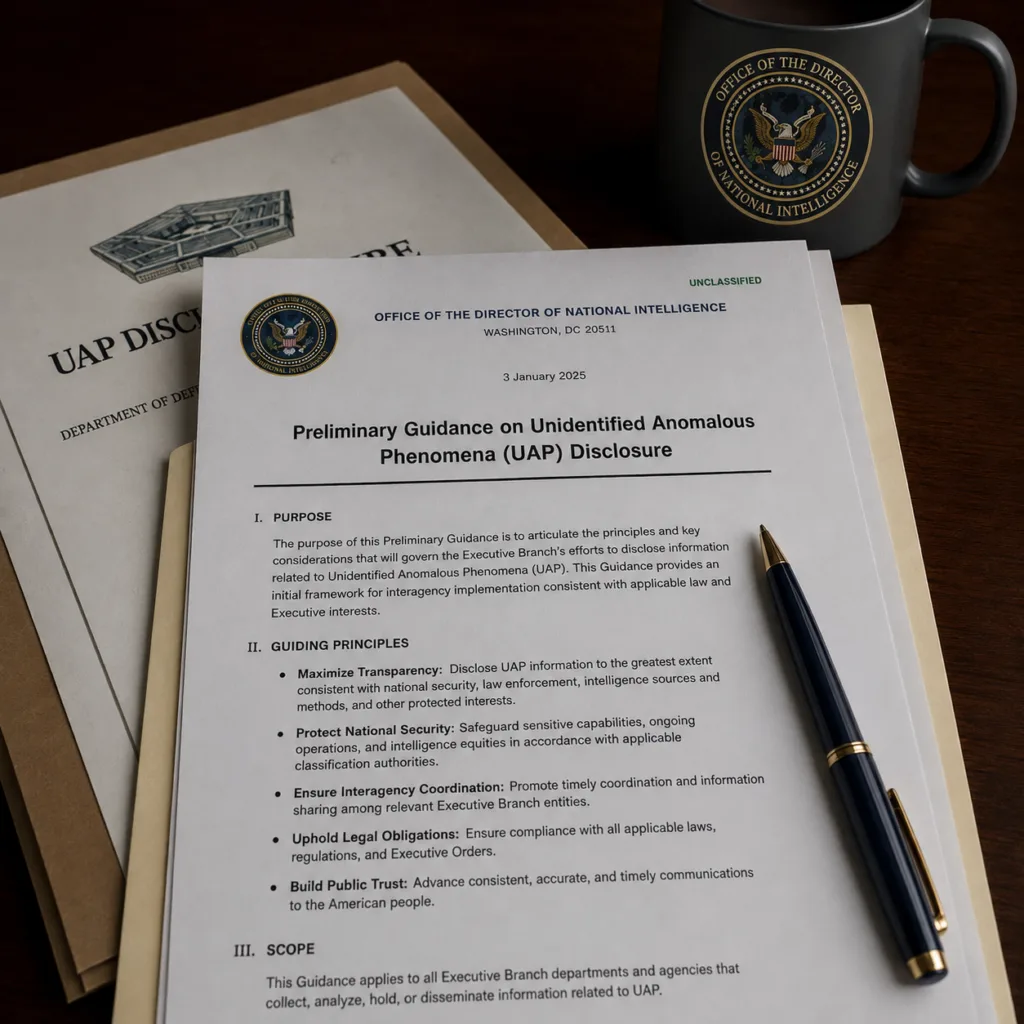
On July 31, 2026, the Office of the Director of National Intelligence issued preliminary guidance designed to encourage the disclosure of information related to unidentified anomalous phenomena, previously known as UFOs. Global law firm DLA Piper published a detailed legal alert on the development examining its statutory foundations, contractual implications, and practical consequences for government contractors and personnel.
The guidance is an unclassified memorandum signed by Principal Deputy Director of National Intelligence Aaron Lukas. It implements presidential direction under the Trump Administration’s Presidential Unsealing and Reporting System for UAP Encounters Task Force.
The memorandum requires the Department of War and the Intelligence Community to create processes ensuring that current and former government employees and contractors holding alleged UAP information can disclose it to authorized representatives of the All-domain Anomaly Resolution Office or the PURSUE Task Force. Prior non-disclosure agreements, agreements, oaths, or commitments are waived for these authorized disclosures. Within thirty days of receipt, every Intelligence Community element must coordinate with ODNI to name a PURSUE designee. Agencies must inform their workforces that any previous or existing NDAs prohibiting disclosure to the President or to designees such as PURSUE are no longer in force. Personnel with knowledge of UAP information should report all such information to AARO or an authorized PURSUE representative. Detailed reporting procedures are to be disseminated within the same thirty-day period, and the Department of War and ODNI will issue broader follow-on guidance for the overall PURSUE transparency effort. Critically, the guidance does not authorize public disclosure of classified information or create a new direct channel to Congress outside existing statutory mechanisms. Disclosures remain confined to designated executive-branch recipients.
This ODNI action sits within a multi-year trajectory of UAP oversight and transparency efforts. Congress established AARO in the Fiscal Year 2022 National Defense Authorization Act. The Fiscal Year 2023 NDAA created a secure authorized-disclosure channel to AARO that already overrides certain NDAs, restrictions under Executive Order 13526, and other legal barriers. It also prohibits retaliation by agencies and contractors against individuals making authorized disclosures. The Fiscal Year 2024 NDAA established a UAP Records Collection at the National Archives and Records Administration. The bipartisan UAP Disclosure Act, including proposed independent review and eminent-domain provisions over technologies of unknown origin and non-human intelligence materials, continued advancing in 2026, including as a House amendment to the Fiscal Year 2027 NDAA. In early 2026, President Trump directed agencies to identify and begin releasing UAP-related files. The Department of War launched the PURSUE Task Force in May 2026 and has released multiple tranches of declassified materials since then. The July 31 guidance is framed as operationalizing the existing statutory pathway more systematically across the Intelligence Community while advancing the administration’s transparency initiative.
DLA Piper’s alert draws several important distinctions. The preliminary guidance focuses primarily on NDAs, agreements, oaths, and commitments. By contrast, the Fiscal Year 2023 NDAA authorizes disclosures to AARO notwithstanding a wider range of legal restraints, including certain classification rules and other provisions of law. In that sense, the statutory channel is broader than the language of the preliminary guidance itself. The guidance is agency policy, not statute, and does not expand the anti-retaliation protections already enacted by Congress. Standard contractual language that permits disclosures in accordance with Applicable Law should already incorporate the Fiscal Year 2023 NDAA framework. NDAs that also treat relevant agency guidance as part of Applicable Law may provide additional comfort for authorized disclosures. The preliminary guidance addresses Intelligence Community employees more explicitly than contractor employees, and clarity on contractor procedures is expected in the forthcoming detailed guidance. Any NDA purporting to prohibit disclosure to the President would be highly unusual and potentially unlawful, given the President’s ultimate classification authority.
Government contractors and individuals should note that existing anti-retaliation protections under the Fiscal Year 2023 NDAA remain fully in force, and contractors should ensure internal whistleblower and related policies stay aligned with the statute. Until detailed follow-on procedures are issued, individuals contemplating disclosures lack complete operational instructions, so waiting for the more comprehensive guidance may be prudent for clarity. The broader statutory authority to disclose to AARO already covers more ground than the NDA-focused preliminary guidance, and future guidance may or may not fully reflect that wider scope. Passage of the UAP Disclosure Act, particularly its eminent-domain provisions, could introduce additional issues for private entities holding relevant materials.
The ODNI preliminary guidance represents a concrete administrative step that lowers formal barriers to internal reporting of UAP information. By declaring certain NDAs no longer in force for disclosures to the President’s designated channels and requiring agencies to notify their workforces, it reduces one longstanding rationale for silence inside the government and contractor community. At the same time, the process remains tightly controlled. Reporting is directed into specific internal offices. Declassification and public release continue to be managed by the executive branch. The distinction between facilitated internal reporting and actual public transparency remains significant. For contractors, the combination of the existing statutory framework, the new guidance, and the pending detailed procedures creates both reduced legal risk for authorized disclosures and a need for careful policy review.
That controlled character of the releases has drawn sharp public criticism. Following the fifth PURSUE tranche on August 7, 2026, Dr. Phil McGraw described the Pentagon’s approach as a magic trick, arguing that officials wave partial files and grainy footage in one hand while keeping the more consequential material out of view. He noted that even after presidential direction to lift gag orders, potential witnesses are still directed through the same long-standing offices, effectively moving the lock to a different room rather than opening the door, and that the public dumps arrive without clear investigation status, chain-of-custody details, or technical analysis that independent researchers could evaluate.
The pressure for broader action continues. On August 12, 2026, documentary filmmaker James Fox released a short video calling directly on the President to grant formal immunity and waive remaining nondisclosure agreements so that UAP whistleblowers, including those citing claims by David Grusch about classified videos and photographs of recovered craft and nonhuman occupants, can share what they know with the public without legal risk. The montage features lawmakers such as Representatives Tim Burchett and Eric Burlison alongside other witnesses, and closes with the explicit challenge that only the President holds the authority to unlock the remaining information for the American people.
Earlier private advocacy had already pointed in a similar direction. In the first episode of the Bigelow Podcast, Robert Bigelow recounted meeting President Trump in the Oval Office on February 6, 2026, and urging a simple public confirmation that a non-human intelligent presence has long been on Earth using spacecraft far beyond human capabilities, while also stressing the need for legal protections so that longtime gatekeepers holding knowledge of recovered craft and related programs could eventually speak without fear of prosecution.
The thirty-day implementation clock from late July 2026 points toward late August for the naming of PURSUE designees and the release of detailed reporting procedures across the Intelligence Community. Additional public releases under PURSUE and further legislative activity on the UAP Disclosure Act are expected to continue shaping the landscape. DLA Piper’s analysis provides a useful legal roadmap for those operating under government contracts or NDAs.