Michaelmas

Michaelmas is a Christian feast celebrated on September 29 in honor of Archangel Michael, often regarded as the leader of heaven’s armies and protector of the faithful. While today it may not be as widely recognized, for centuries Michaelmas carried both spiritual weight and practical importance—and some now see its echoes in modern sky phenomena. Known in tradition as the Guardian of Heaven and, the Watcher of the Skies, Michael’s presence continues to inspire both reverence and wonder. To be clear, when we speak of unidentified phenomena, UFOs, and lights in the skies, part of this is believed to be the interdimensional Archangel Michael.
The feast of Michaelmas has been observed since at least the 5th century. Pope Gelasius I, who reigned from 492 to 496, played a role in formalizing it in the Western Church. The early popes honored Michael because of his strong biblical presence as a divine warrior and protector. In the Book of Daniel, he is described as the great prince who defends the people of Israel, and in the Book of Revelation (12:7) he leads the heavenly host against the dragon. These passages convinced early church leaders that Michael embodied God’s power to shield the faithful from spiritual and worldly dangers. By setting a feast in his honor, the Church highlighted his role as both celestial defender and intercessor for humankind.
Below, a video captures a striking moment at Michaelmas Vespers, where light falls directly upon the high altar during the Magnificat. This visual sign of radiance at worship has long been taken as a reminder of Michael’s role as Guardian of Heaven and Watcher of the Skies.
In addition to liturgical celebrations, images of Archangel Michael have endured for centuries in Christian art. One of the most notable examples is a Byzantine icon from around the 12th century, where Michael is shown with wings, a staff, and a globe representing divine authority over the world. Preserved today in collections such as the Byzantine and Christian Museum in Athens, this icon reflects how Michael was envisioned as both heavenly protector and cosmic guardian. The image continues to inspire reflection on his enduring place in faith and culture.
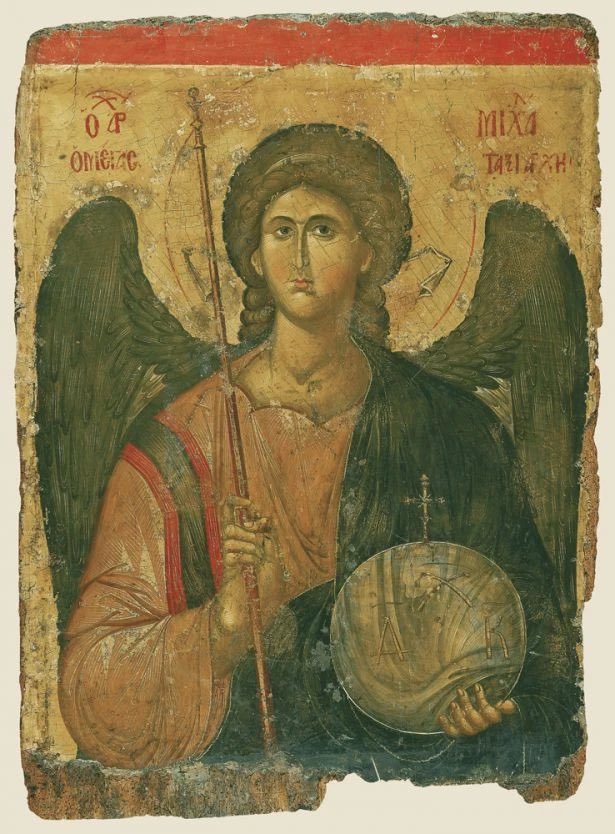
Archangel Michael is portrayed in scripture as a powerful defender against evil. In Revelation, he is described leading angels in battle against the dragon, symbolizing his role as a divine protector. Because of this imagery, Michael became the patron of soldiers, guardians of the Church, and even nations themselves. The feast of Michaelmas celebrates his role in safeguarding truth and justice, reinforcing the idea of light triumphing over darkness.
Michael appears as a guardian and deliverer during cosmic struggle. His image is one of strength, intervention, and protection in both earthly and heavenly realms.
Beyond its religious roots, Michaelmas was once a cornerstone of the medieval calendar. Falling just after the autumn equinox, it marked the close of the harvest season. Traditionally, rents and debts were paid on this day, making it a financial turning point of the year. Many universities, particularly in England and Ireland, began their academic sessions at Michaelmas, and some still name their fall term the Michaelmas term. Celebrations often included fairs, markets, and special meals. Goose was the traditional dish for Michaelmas dinner, believed to bring protection from poverty in the year ahead.
Michaelmas was one of the old “quarter days” that divided the year, along with Christmas on December 25, Lady Day on March 25, and Midsummer on June 24. These dates structured social, agricultural, and financial life, ensuring a rhythm to the year that tied communities to both nature’s cycles and the Church calendar.
In recent years, some have suggested that Michael’s guardianship may not be only symbolic. Reports of luminous aerial phenomena and unexplained skycraft have led certain thinkers to draw parallels between ancient depictions of archangels and modern sightings of mysterious lights in the heavens. From mystical traditions to contemporary speculation, Michael is sometimes imagined as an active cosmic guardian, intervening not just in spiritual battles but also in realms visible above us.
Though mainstream theology is cautious, these ideas offer a bridge between faith and phenomena. Ancient texts describe cosmic struggles, while modern witnesses report sky events that stir questions of higher intelligences. Whether one interprets these as divine, interdimensional, or symbolic, the link between Michaelmas and celestial guardianship invites reflection.
Though fewer people mark Michaelmas today, its echoes remain. Churches still honor the feast, rural traditions linger in parts of Britain and Ireland, and universities carry forward the name of the Michaelmas term. At its heart, the feast blends reverence for a heavenly protector with the practical needs of earthly communities—and perhaps points to a mystery still unfolding in the skies above us.
The prayer most closely associated with Archangel Michael is the Prayer to St. Michael the Archangel. Written by Pope Leo XIII in 1886 after he reportedly had a vision of evil forces threatening the Church, the prayer quickly spread throughout Catholic practice. For decades it was recited after Mass, and even today it remains one of the best-known invocations for protection:
“Saint Michael the Archangel, defend us in battle; be our protection against the wickedness and snares of the devil. May God rebuke him, we humbly pray: and do thou, O Prince of the heavenly host, by the power of God, thrust into Hell Satan and all the other evil spirits who prowl about the world seeking the ruin of souls. Amen.”
Michaelmas brings together history, faith, and even UFO speculation about the skies. From its 5th-century beginnings to medieval traditions, from Byzantine icons to modern reflections, the feast reminds us of humanity’s enduring need for protection and order in a world that often feels uncertain. It stands as a marker of time, a celebration of harvest, a call to justice, and for some, a signpost pointing toward mysteries still unfolding above us.