I Can’t Talk to You About Alien Life
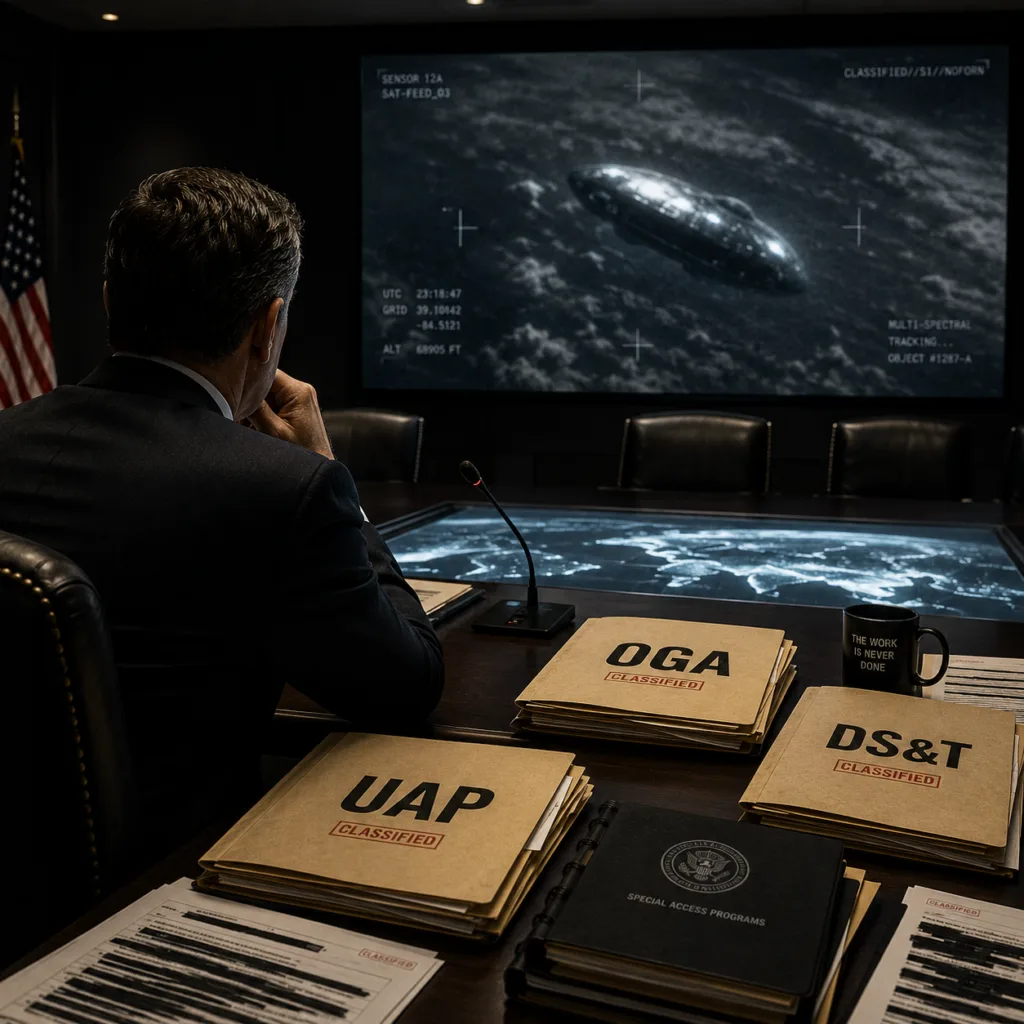
The Office of Global Access (OGA) is reported to be a highly secretive division within the CIA’s Science and Technology Directorate (DS&T), tasked with coordinating the retrieval and analysis of unidentified flying objects (UFOs) worldwide. As the current Director of the Central Intelligence Agency, John Ratcliffe now sits atop this chain of command and bears ultimate responsibility for any programs or materials associated with OGA and DS&T. Yet his public silence on these matters stands in contrast to earlier statements and fuels ongoing questions about transparency.
In a January 2023 Fox & Friends appearance, co-host Pete Hegseth pressed John Ratcliffe directly on the existence of alien life. Ratcliffe hesitated before replying, “Well, um, I can’t talk to you about, you know, uh, any potential alien life, um, uh… so I’ll just leave it at that.”
At the time of the interview, Pete Hegseth was a prominent Fox News host and co-host of Fox & Friends Weekend. A U.S. Army National Guard veteran and author, Hegseth had become a well-known conservative media figure, often discussing national security, military issues, and politics. He had supported Donald Trump’s 2016 campaign and served as an informal advisor in Trump-world circles. His role at Fox gave him a platform to engage high-profile guests like Ratcliffe on current events, including occasional forays into unexplained phenomena and government transparency.
Ratcliffe, for his part, was a former Director of National Intelligence serving as a private citizen. He had previously been more forthcoming. In March 2021, during an interview with Maria Bartiromo, he stated there were “a lot more” UAP sightings than had been made public, including objects seen by Navy and Air Force pilots and captured by satellite imagery that performed actions difficult to explain with known technology.
Fast forward to 2026. Ratcliffe was confirmed and sworn in as Director of the Central Intelligence Agency on January 23, 2025, making him the first person to serve as both DNI and CIA Director. He now holds ultimate oversight of the entire agency, including the Directorate of Science and Technology (DS&T) and the CIA’s little-publicized Office of Global Access (OGA).
Despite this powerful position, and despite ongoing Department of War/Pentagon UAP releases under the PURSUE initiative (with tranches on May 8, May 22, and June 12, 2026), Ratcliffe has not made a major public UAP address as CIA Director. Even after the 2023 House UAP hearing, he told Bartiromo that the government had more information than it was sharing and favored greater transparency — though not “full transparency” due to national-security limits.
This current silence stands out. DS&T and the Office of Global Access have been repeatedly named in UAP reporting and congressional witness materials, with the disputed element centered not on whether OGA exists inside DS&T, but on what it has allegedly been used for — including global retrieval operations and handling of exotic materials. As documented in official congressional submissions, former DS&T Director Glenn Gaffney has been specifically accused of blocking the transfer of alleged non-human materials from Lockheed Martin to Bigelow Aerospace during the AAWSAP era, preserving CIA custody of the materials.
Meanwhile, Ratcliffe’s public focus has centered on a “fundamental reshaping” of CIA technology efforts. In late June 2026, he highlighted advances in AI, quantum computing, procurement reform, cyber capabilities, and the restructuring of the former Directorate of Digital Innovation into the new Directorate of Mission Systems.
The historical precedent of CIA deep-sea operations adds another layer of intrigue. The Glomar Explorer, famously built under the cover of a Howard Hughes deep-sea mining venture, was in reality a CIA project (Project Azorian) to recover a sunken Soviet submarine in the 1970s. The ship’s advanced capabilities and the “Glomar response” (“neither confirm nor deny”) it inspired have long fueled speculation about its potential use in other classified underwater retrieval missions — including alleged UAP-related activities in subsequent decades. Such programs highlight the CIA’s enduring expertise in covert recovery operations, a capability that some connect to modern OGA discussions.
In his new role as Secretary of Defense, Pete Hegseth has continued to engage symbolically with the topic. Following President Trump’s February 2026 declassification directive on UAP and extraterrestrial matters, Hegseth reposted the statement on X and added an alien emoji alongside a saluting symbol — one of the early official signals tying the administration’s transparency push to the UAP conversation.
Recent testimony has heightened concerns about potential interference. In May 2026, longtime CIA operations officer James Erdman III told a Senate committee that elements within the intelligence community illegally spied on UAP whistleblowers, investigators, and personnel involved in transparency efforts. Erdman, who worked with the Directors Initiatives Group under DNI Tulsi Gabbard, alleged monitoring of communications and intimidation tactics targeting figures connected to UAP inquiries. Such claims add weight to long-standing accusations of institutional resistance within the CIA to full disclosure.
Whether Ratcliffe’s quiet approach as CIA Director reflects standard agency caution, strategic timing amid rolling releases, or something else remains an open question for those closely following the UAP story. Now that he is ultimately in charge of DS&T and OGA — the very entities long alleged to manage global UFO retrieval and analysis — his restraint carries particular weight. The contrast between his earlier comments and his current position at the top of the agency most often linked to these legacy programs continues to fuel discussion about the future of disclosure.