Flatland: A Romance of Many Dimensions
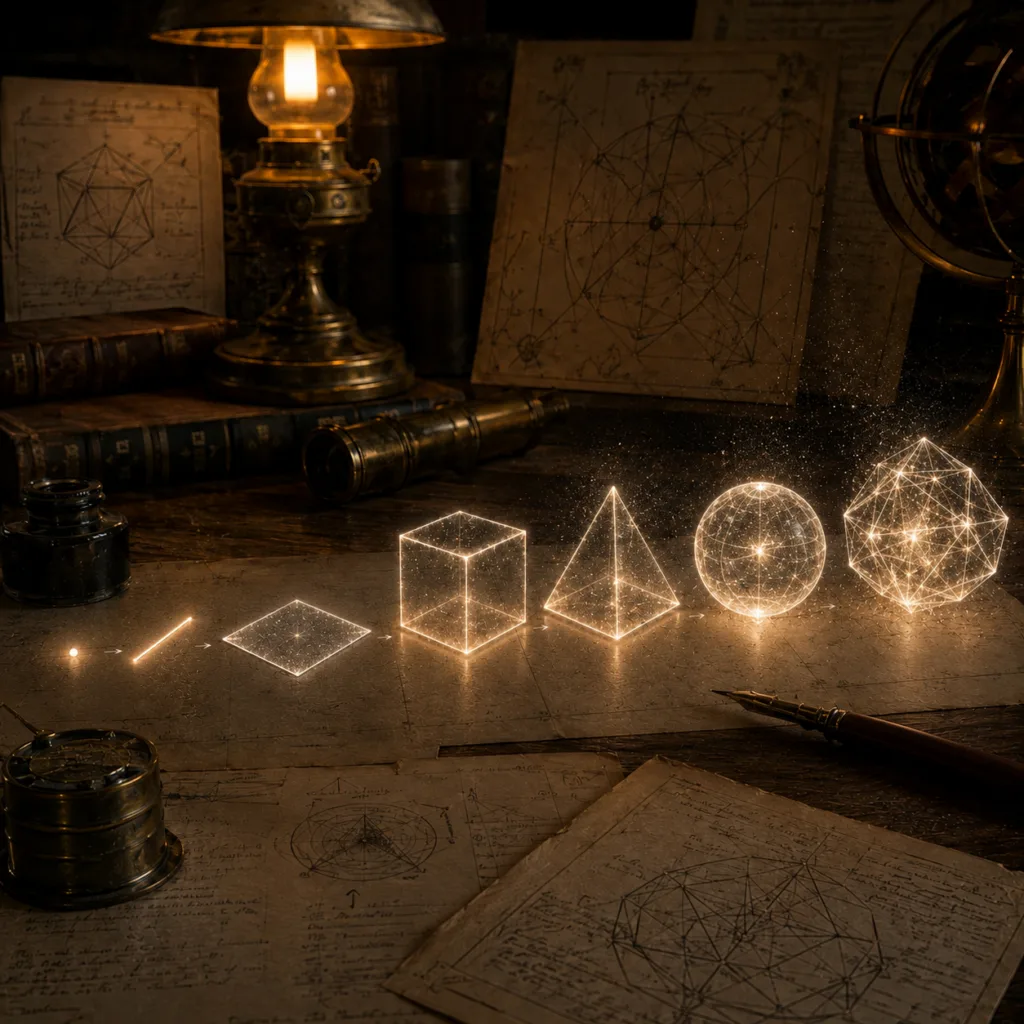
Flatland is frequently used as a conceptual tool in discussions of UFOs and UAPs, particularly by those who favor the interdimensional hypothesis over the traditional idea of extraterrestrial spacecraft from other planets. In the story a three-dimensional Sphere intersects the two-dimensional plane and appears to the Flatlanders as a point that grows into a circle, changes size, and then vanishes. Many researchers apply the same logic one dimension higher, suggesting that a being or craft existing in four or more spatial dimensions could intersect our three-dimensional space in ways that appear to violate known physical laws, producing the sudden appearances, impossible maneuvers, and vanishing acts often reported in UFO sightings.
Flatland: A Romance of Many Dimensions is a satirical novella by the English schoolmaster, theologian, and classicist Edwin A. Abbott, first published in 1884 under the pseudonym “A Square.” Though modest in length, the book has endured as one of the most influential works of mathematical fiction, blending geometry, social critique, and philosophical inquiry into the nature of perception and knowledge.
The narrator, A. Square, lives in Flatland, a two-dimensional world inhabited entirely by geometric figures. Social rank is determined by the number of sides a figure possesses. Women are straight lines, often described as needles, and occupy the lowest status. They are required by law to keep up a continuous Peace-cry when in public and face severe restrictions on movement. Triangles play a major role throughout the story. The male inhabitants are polygons whose social class is determined by the number of their sides. The lowest classes are isosceles triangles (soldiers and workmen). These figures have two long equal sides and a very short base, which makes their pointed vertex extremely sharp and dangerous. The sharper the angle, the lower and more dangerous the individual is considered. Equilateral triangles (all sides equal) form the middle class of tradesmen. A rare and celebrated event is the birth of a true equilateral triangle to isosceles parents, which allows a family to rise in status. The book spends considerable time describing the lives, dangers, and social controls placed on these triangular figures. Professionals are squares and pentagons, nobles are higher polygons, and the ruling priestly class consists of circles. The society is rigidly hierarchical, authoritarian, and deeply sexist. Irregular figures are treated as criminals and often destroyed. The book recounts the Colour Revolt, a historical uprising in which lower classes attempted to introduce paint and color to erase visible class distinctions. The Circles suppressed the revolt by turning the women and soldiers against the reformers.
In the second half of the book, A. Square first dreams of Lineland, a one-dimensional world consisting of an infinite straight line. There he meets the Monarch of Lineland and tries unsuccessfully to explain the existence of a second dimension. He is later visited by a Sphere from Spaceland, the three-dimensional world. The Sphere appears first as a growing and shrinking circle as it passes through Flatland. When A. Square remains unconvinced, the Sphere lifts him out of his plane and into Spaceland so that he can experience height directly. Pyramids barely appear in the story. Because Flatland is strictly two-dimensional, no three-dimensional shapes exist there as inhabitants. When A. Square is taken into Spaceland, the Sphere begins teaching him about solid figures. At one point the Sphere says he would gladly continue by explaining cylinders, cones, pyramids, and other solids, but A. Square interrupts him. That is essentially the only mention. Pyramids are listed among possible solid shapes but never appear as characters, objects of focus, or important plot elements. A. Square then begins to reason that there might be a fourth dimension beyond Spaceland. The Sphere rejects this idea and returns him to Flatland. In another dream the Sphere shows him Pointland, the abyss of no dimensions, where a solitary Point believes itself to be the entire universe and interprets every external voice as a thought arising from within itself.
Inspired by these experiences, A. Square tries to teach the theory of three dimensions to his grandson and later attempts to proclaim it publicly. The Circles respond by outlawing any mention of other worlds or dimensions. A. Square is arrested after speaking of his revelations at a meeting. He is sentenced to eternal imprisonment. As he writes the memoir that becomes the book, he has already spent seven years in prison. He occasionally sees his brother, who was also imprisoned after witnessing the Sphere, yet the brother still refuses to accept what he saw. The narrative ends with A. Square questioning whether his experiences were real or only a dream, while still hoping that his written account might one day awaken others to the possibility of higher dimensions.
Abbott uses the limited perspective of Flatland to examine the difficulty of imagining realities beyond one’s own sensory experience, the power and limits of analogy as a tool of understanding, the dangers of rigid social hierarchies and intellectual orthodoxy, and the tension between empirical evidence, faith, and imagination. The treatment of women as nearly invisible and inherently dangerous lines is particularly pointed, reflecting Victorian gender norms while simultaneously criticizing them. Abbott himself supported women’s education and rights.
When Flatland appeared in 1884, higher-dimensional geometry was already a subject of interest among mathematicians, but it remained largely abstract. The book’s initial reception was quiet. Its reputation grew significantly after Einstein’s theories of special and general relativity brought the concept of a four-dimensional spacetime into public consciousness. Suddenly the idea of dimensions beyond the familiar three felt both scientific and culturally charged. New editions of Flatland appeared with introductions linking Abbott’s thought experiment to modern physics, helping establish the book as a classic.
Today Flatland continues to be read as an accessible introduction to higher-dimensional thinking, a sharp piece of social satire, and a meditation on the limits of human perception. It has inspired sequels, films, mathematical discussions, and countless reflections on how difficult it is to see beyond the assumptions of one’s own world.