Love Walks In
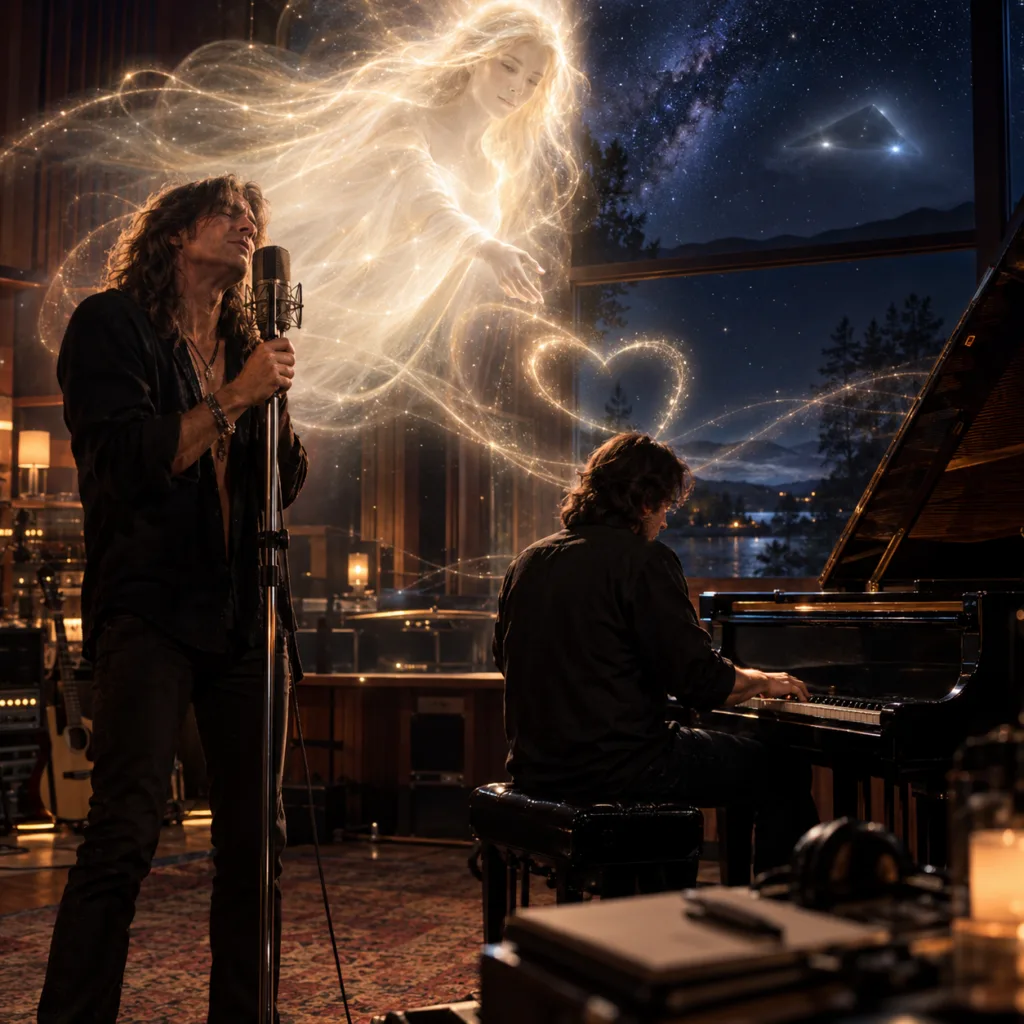
Sammy Hagar has never treated “Love Walks In” as a straight love song. He has said for years that the lyrics came from contact, and that the night he wrote them felt less like craft than like something arriving. Eddie Van Halen sat at the piano after the rest of the band had left, played a piece he had been holding for years, and Hagar said he got goosebumps. The words came immediately. He sang them into a cheap handheld mic. That take stayed on 5150. Everyone else overdubbed later. Hagar has compared that kind of writing to automatic writing: you do not think the lines so much as take them down.
The book he points to is Ruth Montgomery’s 1979 Aliens Among Us. Montgomery worked by automatic writing. She would go into a trance, type without composing, then read what had come through. The book popularized “walk-ins”: a soul or being entering a human life, often in crisis or near death, and changing the person from the inside. Hagar has said that is what the song is about, and that falling in love works the same way. Contact is all it takes. You lose your place in time. Nothing feels the same. Dreams turn strange. Some kind of alien waits for the opening and simply pulls a string. On stage in 1986 he introduced it as a song about aliens. He still does.
The personal story behind that language is older than Van Halen. Hagar has described waking as a teenager unable to move in a room flooded with white light. He says beings were downloading information from his mind telepathically. When they disconnected, the light vanished and he was sick and shaking. He bought a telescope. He started reading UFO books. He has said he was contacted three or four times, that they used him experimentally, and that he named his publishing company Nine Music after a group he associates with the ninth dimension. The silver lights, the figure in a silken gown, traveling across the Milky Way, becoming a slave until they meet again—he wrote those lines as both a contact account and a metaphor for love walking in and taking over. Most radio listeners heard only the love song. He meant both.
Decades later the song circled back through another experiencer’s story. Chris Bledsoe, author of UFO of God, has said a luminous female figure he calls the Lady gave him a short list of songs that carried a message. One of them was “Love Walks In.” Others he has named include Led Zeppelin’s “Stairway to Heaven,” “Kashmir,” and “The Battle of Evermore,” Metallica’s “Nothing Else Matters,” and Neil Young’s “After the Gold Rush.” Bledsoe’s account is that those songs were written through the musicians, who did not know they were carrying the message. When Hagar heard that his own song was on that list, he said it gave him goosebumps. The two men became friends. Bledsoe posted about skywatching with Hagar and told people to read the lyrics. In a 2026 clip Hagar walks through Montgomery and walk-ins again, calls the night Eddie played the piano part “just pure magic,” and speaks of the Lady as a very special presence.
Hagar has described contact since the late 1960s. He wrote the lyrics in one sitting off Eddie’s piano, in the same automatic way he says Montgomery wrote her books. He has never walked the story back. The 1993 Bridge School tape—Eddie on piano, Hagar still introducing it as a song about aliens—is the closest public version to that first night.
That kind of arrival is not unique to Hagar. Songs have come in dreams, in trances, and from what artists call a higher source. Robert Plant wrote himself as a traveler of both time and space in “Kashmir.” Neil Young packed “After the Gold Rush” with images that still read like a vision of another world. Paul McCartney woke with the melody of “Yesterday” already in his head. Keith Richards dreamed the riff to “Satisfaction.” John Lennon saw a craft from his balcony and later put the strangeness of that night into a song. Across those stories the same idea keeps returning: music can carry a message the writer did not sit down to invent—divine, subconscious, or non-human—and once the last note fades the listener is left holding a clue about where we stand in a curated reality. “Love Walks In” sits in that company. The words came through. The Lady later named the song. The message was love walking in.
If music can carry a message from outside, the question becomes which intelligence is speaking. Isaiah Robin has argued that the industry itself is a spiritual battlefield: artists begin as innocent figures and are pulled toward darker imagery, contracts, and symbols—serpents, witch personae, “queen of hell” staging—that he reads as demonic rather than merely theatrical. He frames that shift as a campaign aimed at the young, a fight over values dressed up as entertainment, and he answers it with a call back to Christian discernment. Set beside the alien-in-the-music idea, the two accounts share a premise and split on the source. Unseen forces use songs.
Sound itself is part of that argument. Music is physics as much as poetry: vibration moving through air, water, and the body. UFO reports are full of anomalous audio—low hums, high whines, metallic clangs, or a silence that should not be there—as if contact changes what the ear can hold. Solfeggio tones, which began as a medieval tool for teaching pitch, were later given spiritual jobs of their own: 396 Hz to lift guilt and fear, 417 Hz to undo a stuck situation and open change, 528 Hz for transformation and miracles, 639 Hz for connection, 741 Hz for intuition, 852 Hz for a return to spiritual order. Some add 174, 285, and 963 Hz. The fight over concert pitch—A=440 against A=432 or 528—belongs to the same world: the belief that the frequency of popular music can calm a spirit or agitate it, heal or pull a darker side forward. Hemi-Sync, cymatics, ceremonial rhythm, Native chant, and the idea that a craft can hold its shape in sound all point to one claim. A song is not only a story. It is a frequency that can open a door.
The oldest version of that claim is already in scripture. Mary’s Magnificat is a song first: “My soul magnifies the Lord.” An angel speaks, a humble life is entered, and she answers in hymn—gratitude, justice, the proud scattered, the lowly lifted, a promise kept. Baroque altars set that hymn under gilded angels and, in some carvings, a winged sphere instead of the usual dove, as if divine presence could look celestial as well as holy. The Bible is a songbook: Moses and Miriam at the sea, Deborah, Hannah, David, the Psalms, Zechariah’s Benedictus, the Gloria, Simeon’s Nunc Dimittis, the hymns in Paul, the Song of the Lamb. Intervention arrives as music. A being walks in. A life is changed. The soul answers by singing.
The fight does not stop at who writes the song. It continues over the words after they are already in the world. Many people remember Prince singing “celebrate this thing called life” in “Let’s Go Crazy.” What plays now is “get through this thing called life.” One line lifts. The other endures. That kind of swap is usually filed as a Mandela Effect—a mismatch between memory and the official record—but the spiritual reading is sharper. Words shape outlook. A single verb can turn life into a feast or a trial. If angels and demons both use music, they would not only inspire new songs. They would contend for the ones already loved, testing faith, resilience, and free will by changing what the crowd thinks it has always heard. Philip K. Dick was already writing that problem in the 1960s: parallel tracks, a consensus reality that can be edited, a trickster stirring the file. In that frame the war for the music is not only about downloads and walk-ins at the piano. It is about whether “love walks in” stays love, or becomes something you merely get through.