Skinwalkers at the Pentagon
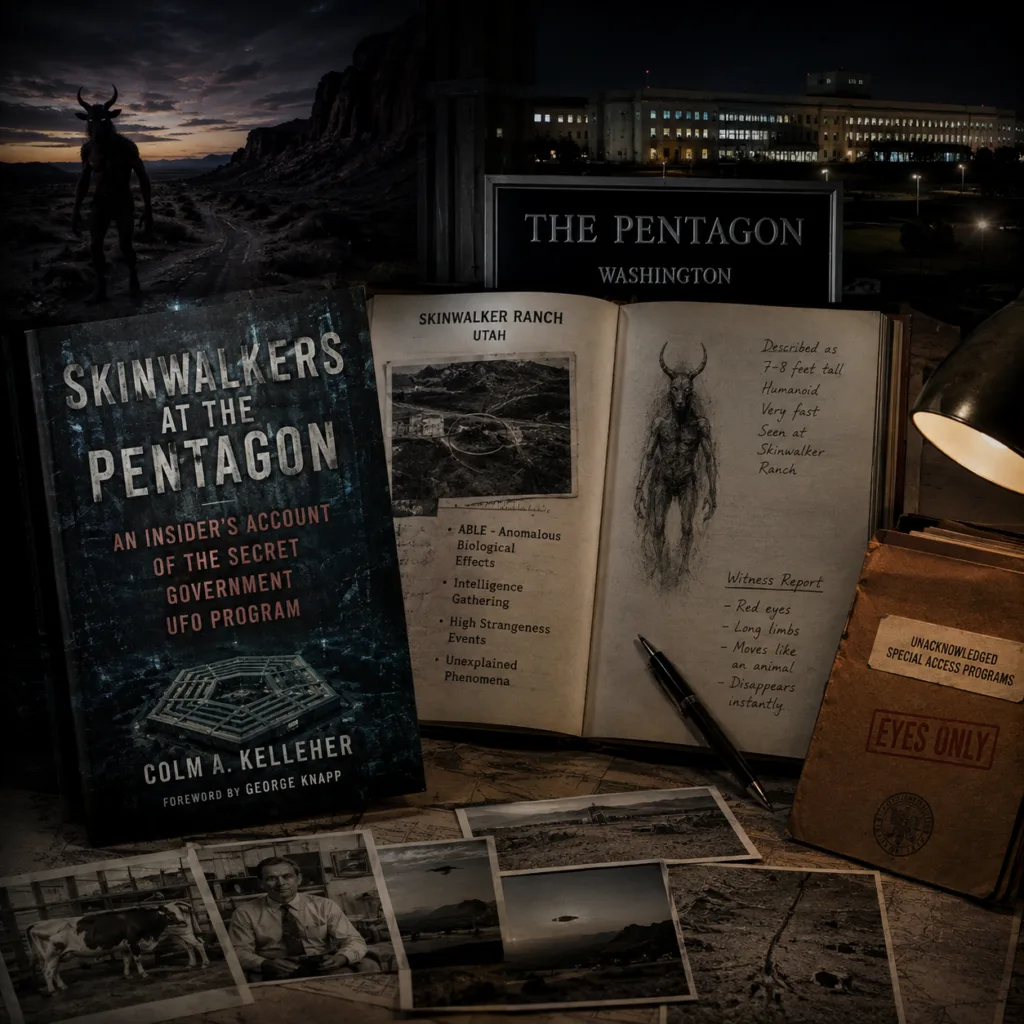
Skinwalkers at the Pentagon stands as an insider account of one of the most significant government-funded efforts to examine unidentified aerial phenomena and the strange events that so often surround them. Written by James T. Lacatski, a Defense Intelligence Agency analyst who helped create and manage the program, Colm A. Kelleher, the biochemist who ran day-to-day operations for the primary contractor, and investigative journalist George Knapp, the book was reviewed by the Department of Defense and cleared for public release on May 11, 2021.
It seeks to correct the public record that emerged after the 2017 New York Times reporting and to present a fuller picture of what the Advanced Aerospace Weapon System Applications Program, known as AAWSAP, actually accomplished between 2008 and 2010. The title itself draws from Navajo folklore, in which skinwalkers are malevolent witches or shape-shifters believed capable of transforming into animals by donning the skin of the creature they wish to become; local Ute and Navajo traditions long associated the remote Utah ranch with such beings, and the name stuck as reports of bipedal wolf-like creatures, vanishing animals, and other shape-shifting or predatory anomalies accumulated there over decades.
Central to the narrative is the figure given the pseudonym Jonathan Axelrod, a senior naval intelligence officer who led a team visit to Skinwalker Ranch in 2009 and later experienced the so-called hitchhiker effect in his own home. Many researchers and observers have identified Axelrod as Jay Stratton (also referred to as John F. Stratton Jr.), the career intelligence official who worked in Naval Intelligence and at the Defense Intelligence Agency, helped investigate the Tic Tac encounters, and later directed the Pentagon’s Unidentified Aerial Phenomena Task Force. This identification, widely accepted in both insider and critical discussions of the book, transforms the account from a collection of anonymized anecdotes into a story with direct continuity to later official UAP efforts.
The program’s origins trace directly to Skinwalker Ranch in northeastern Utah, a remote property long associated with cattle mutilations, vanishing animals, glowing orbs, unusual creatures, and poltergeist-like disturbances. Lacatski and colleagues within the Defense Intelligence Agency read the earlier book Hunt for the Skinwalker, which chronicled private scientific investigations at the ranch under Robert Bigelow’s National Institute for Discovery Science. Intrigued by the possibility that the activity might represent both a threat and an opportunity for national defense, Lacatski arranged a visit in 2007. What he encountered there proved transformative and helped set in motion the creation of a formal DIA contract. With critical support from Senators Harry Reid, Ted Stevens, and Daniel Inouye, approximately twenty-two million dollars was directed to Bigelow Aerospace Advanced Space Studies, the contractor that would execute the work under Kelleher’s operational leadership.
Stratton, under the Axelrod pseudonym, emerges in the book as a key early participant who helped investigate the Tic Tac encounters and who personally carried the ranch’s effects back to suburban Virginia, where his family reported dark figures, orbs, and a bipedal wolf-like creature. That personal continuum—from ranch visitor and hitchhiker experiencer to later head of the UAP Task Force—recasts the entire AAWSAP story as less an isolated historical episode and more a through-line connecting the high-strangeness investigations of 2008–2010 to the public-facing UAP bureaucracy that followed.
AAWSAP was never limited to the narrow study of structured craft that later became popularly associated with the label AATIP. According to the authors, AAWSAP was the genuine, fully funded program. It maintained a broad mandate that encompassed both military and civilian cases, field investigations across the United States and abroad, the construction of a large multi-database archive, and the deliberate examination of high-strangeness phenomena that frequently appeared alongside conventional UAP reports. AATIP, by contrast, is described as a smaller, essentially unfunded activity focused more tightly on specific military encounters that produced video evidence. The authors insist that the two efforts should not be collapsed into one another and that the bulk of the serious analytical work and archival material belonged to AAWSAP. When Axelrod is understood as Stratton, the distinction gains sharper institutional weight: the same officer who documented ranch anomalies and family hauntings later occupied a position of formal leadership over subsequent UAP inquiries, suggesting that the paranormal dimensions of the original program were not fully excised from later official work.
Central to the book’s narrative is the investigation of classic “nuts-and-bolts” events, most prominently the 2004 USS Nimitz Tic Tac encounters off the coast of San Diego. AAWSAP personnel were among the first to systematically gather witness accounts and perform engineering analysis of the object’s reported performance characteristics years before the incidents entered public awareness. The program also examined reports of UAP activity near military bases and other sensitive facilities. At the same time, investigators devoted substantial attention to Skinwalker Ranch itself. Teams documented orbs of various colors, bipedal wolf-like creatures, shadow beings, poltergeist activity, and other anomalies that defied easy categorization. The ranch functioned less as an isolated curiosity and more as a concentrated laboratory for phenomena that appeared repeatedly in the wider case files. Stratton’s reported experiences, once the pseudonym is set aside, place a future director of the UAP Task Force squarely inside that laboratory and then inside the contagion that followed him home.
Perhaps the most unsettling theme developed in the book is what the authors term the hitchhiker effect, also framed as an infectious agent model. Military personnel and investigators who spent time at Skinwalker Ranch frequently reported that anomalous activity followed them home. Within weeks of returning to the East Coast, family members began experiencing dark humanoid figures standing over beds at night, floating orbs inside houses, unexplained noises, and, in some instances, physical marks or injuries. The phenomenon sometimes persisted for years and appeared capable of affecting people who had never visited the ranch. Similar patterns of secondary activity were noted in certain non-ranch UAP close-encounter cases, suggesting that the hitchhiker effect was not unique to Utah. The authors treat this transmissibility seriously, proposing that proximity to the phenomena can somehow attach or transfer anomalous effects in a manner analogous to contagion. Identifying Axelrod as Stratton makes this claim personal and consequential: the same official who later shaped public and congressional understanding of UAP had, according to the book, lived through the very attachment process the program sought to document.
Linked to these experiential reports are documented physiological and pathological consequences. AAWSAP tracked cases in which individuals who interacted with UAP or ranch-related anomalies later developed serious medical issues, including autoimmune conditions and other health problems. The program collected data on physiological effects, psychological impacts, and longer-term medical outcomes, creating one of the more systematic attempts within a government framework to examine the human cost of these encounters rather than focusing solely on the performance of aerial objects.
By the end of its roughly two-year funded period, AAWSAP delivered more than one hundred technical reports to the Defense Intelligence Agency, some running to hundreds of pages. Among them was a detailed assessment of Soviet and later Russian UAP research capabilities, often referred to in connection with the Thread III program, as well as work on the design and construction of a functional prototype for an autonomous UAP surveillance platform. The program also assembled an extensive data warehouse containing multiple specialized databases of cases drawn from military pilots, civilian pilots, and international sources. These materials, the authors argue, remain valuable resources that subsequent government efforts have only partially utilized.
The book closes by underscoring the national security and scientific stakes. Whether UAP represent natural but poorly understood phenomena, interdimensional activity, or something else entirely, the data already collected demand rigorous, coordinated analysis. Attempts to extend AAWSAP beyond its original term or transfer its work to other parts of government ultimately failed, yet the archive and the lessons learned helped shape later official interest. When the central hitchhiker experiencer is recognized as the man who later directed the UAP Task Force, the story acquires a tighter institutional arc. The high-strangeness investigated at Skinwalker Ranch did not remain confined to a remote Utah property or to anonymized case files; it traveled home with a senior intelligence officer who continued to occupy positions of influence over the government’s approach to the unknown.