Eric Burlison
Eric Burlison has emerged as one of the most active, persistent, and procedurally effective voices in Congress pushing for full transparency on UFOs, UAPs, hidden programs, crash retrievals, and the government’s handling of potential non-human intelligence. His involvement did not begin with prior belief, but with direct exposure after entering Congress in 2023. Following the July 26, 2023 hearing featuring whistleblower David Grusch and claims of non-human biologics and concealed crash-retrieval programs, Burlison recognized that these allegations were being presented directly to him as a sitting lawmaker. That moment marked a decisive shift.
He moved quickly from observer to active participant. Bringing Grusch in as a special advisor, Burlison began helping organize hearings, identify witnesses, categorize testimony, and map out alleged legacy programs. What started as curiosity became a structured effort to determine what exists, who controls it, and why Congress continues to face resistance when attempting to access it.
His impact is most visible through legislative and institutional action. In March 2024, he led a bipartisan effort calling for the creation of a dedicated investigative body under the House Oversight Committee with full classified access, citing concerns over hidden funding, legacy programs, and lack of accountability. That push helped build momentum toward the November 13, 2024 hearing focused on UAP transparency. On August 29, 2025, he introduced the UAP Disclosure Act of 2025 as part of the FY2026 National Defense Authorization Act. The proposal aimed to preserve all UAP-related records, establish a centralized archive within the National Archives, and create an independent review board to oversee declassification under congressional authority. Although significantly reduced during the legislative process, it remains one of the most direct attempts to formalize disclosure.
As chair of the Oversight Subcommittee on Economic Growth, Energy Policy, and Regulatory Affairs, and an active member of the Task Force on the Declassification of Federal Secrets, Burlison has used his position to question witnesses, examine internal reporting structures, and push for stronger whistleblower protections. During hearings, he has pressed for systems that ensure credible UAP encounters are documented and preserved for congressional review rather than buried within fragmented agency structures.
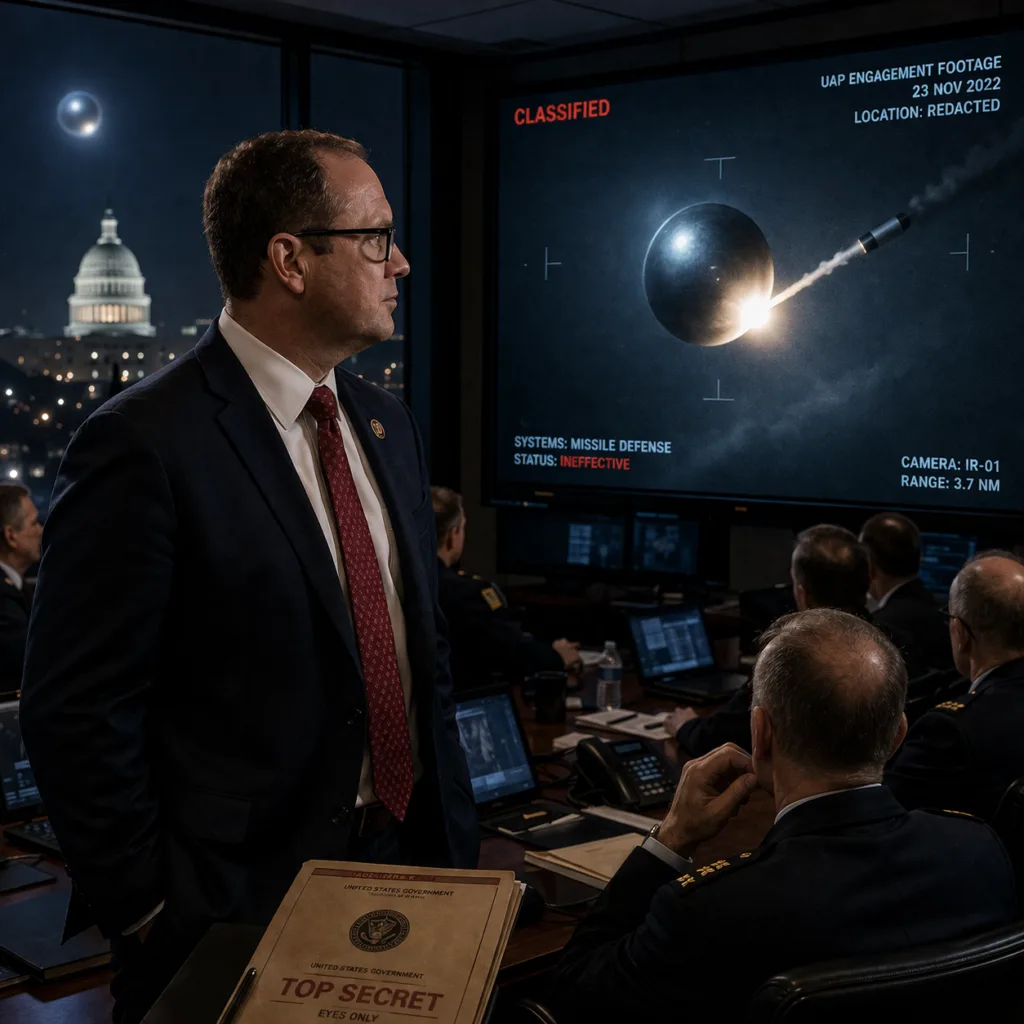
His perspective has been further shaped by classified briefings, site visits, and direct engagement with experts. In those settings, he has reviewed sensitive UAP footage, including luminous orb-like objects that remain stationary before accelerating at extreme speeds beyond known capabilities. He has publicly stated that the United States possesses a crash-retrieval program and has described these objects as defying known aerodynamics. He has conducted at least one classified site visit, with additional visits planned, including locations reportedly tied to large craft that could not be moved.
Burlison has expanded the issue beyond sightings into broader national security concerns. On April 20, 2026, alongside Oversight Chairman James Comer, he sent formal letters to the Department of Energy, Department of Defense, FBI, and NASA requesting briefings on a group of scientists and personnel connected to nuclear, aerospace, and UAP-related programs who have died or disappeared under unusual circumstances since approximately 2023. These cases include individuals from NASA’s Jet Propulsion Laboratory, Los Alamos, and other high-level institutions. He has described the pattern as not normal and potentially indicative of a larger threat, including the possibility of foreign adversary involvement.
He has also pointed to findings from the Intelligence Community Inspector General indicating that certain Special Access Programs are not being properly reported to Congress. In his view, the structure of these programs appears intentionally fragmented across agencies in a way that prevents clear oversight, creating what amounts to an accountability gap at the highest levels.
Publicly, he continues to apply pressure through hearings, interviews, podcasts, and social media. He has released and discussed UAP-related video evidence, including footage showing objects surviving direct weapons engagement, and has repeatedly called for access to additional classified material. His messaging remains consistent: transparency is not optional, and Congress cannot fulfill its role without full visibility.
What distinguishes Burlison is his balance between caution and persistence. He does not claim to have complete answers, but he consistently emphasizes that Congress is not being given full access to programs that clearly exist. That lack of access is, in his view, the central issue. If these programs are legitimate and benign, transparency should follow. If they are not, then oversight becomes even more critical.
Through legislation, investigations, classified engagement, and sustained public advocacy, Eric Burlison has helped move the UAP issue from the margins into formal government scrutiny. He has warned that Congress may ultimately need to force access if cooperation does not occur, and has suggested that the current system appears designed to avoid accountability.