The Disclosure President
For decades, the question of whether governments are withholding information about unidentified aerial phenomena has lingered on the edge of public discourse, surfacing in waves through testimony, leaked footage, and political pressure. What was once dismissed or quietly contained has now moved into a more direct confrontation between elected officials and the intelligence agencies that control access to classified material. With missed deadlines, public statements from senior politicians, and promises of imminent releases, the issue has entered a phase where expectations are tied to specific actions.
Recent developments have intensified that pressure. On March 31, 2026, Representative Anna Paulina Luna, acting in her role as Chairwoman of the House Oversight Task Force on the Declassification of Federal Secrets, formally requested the release of 46 specific classified UAP video files from the Department of Defense. The request outlined discrete incidents, including formations over Iran, encounters in the Persian Gulf, the East China Sea, and U.S. domestic airspace, with detailed case references tied to specific dates and sensor recordings. A deadline of April 14, 2026 was set for delivery. That deadline has now passed without the videos being provided, with the Pentagon later attributing the delay to a clerical error. As of April 20, 2026, no formal response or materials have been delivered. In response, Luna has publicly stated she is prepared to pursue subpoenas and work directly with Secretary of Defense Pete Hegseth to compel release.
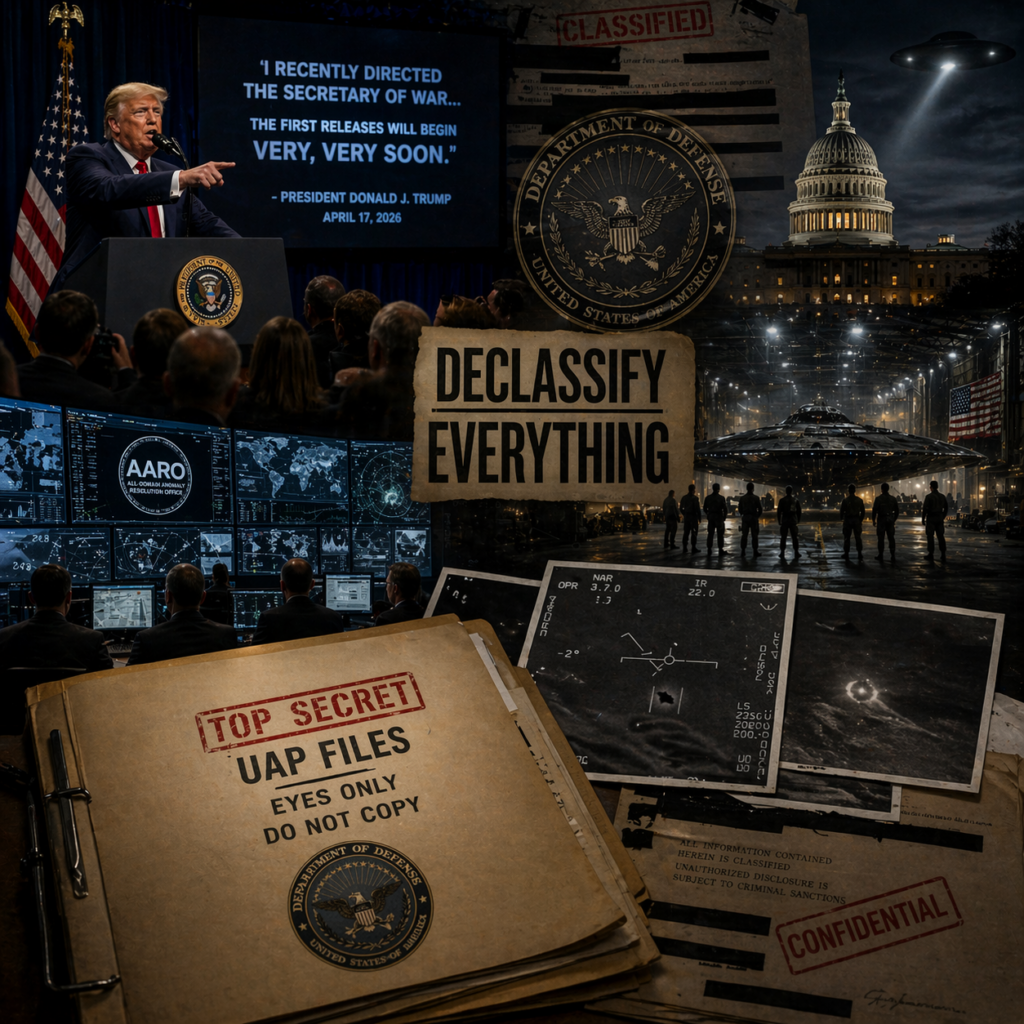
Just days after that missed deadline, President Donald Trump spoke at a Turning Point USA event in Phoenix on April 17, where he repeated that he had “recently directed the Secretary of War” to begin releasing government files related to UFOs and unexplained aerial phenomena, referencing his earlier February directive. In that same statement, he publicly confirmed for the first time that the review process had already uncovered “many very interesting documents” and said the first releases would begin very soon. These remarks serve as the immediate trigger for the congressional response now unfolding.
Congressman Eric Burlison appeared on Fox News during The Sunday Briefing with Peter Doocy. The discussion centered heavily on a pattern of approximately 10 to 11 scientist deaths and disappearances tied to classified nuclear, aerospace, and UAP-related programs, which Burlison has raised publicly and for which he has requested briefings from federal agencies. He also addressed the now-passed deadline for the 46 UAP videos and the possibility of subpoenas if agencies fail to comply. Burlison pointed to Trump’s recent comments and expressed cautious optimism that the administration’s directive could lead to meaningful disclosure.
Eric Burlison specifically addressed a claim he has previously raised publicly: the existence of a massive craft that is allegedly too large to move, with a structure built around it to conceal it. When asked whether the upcoming releases might include information on this, he said he certainly hopes they do. He has also indicated that, if given access, he would seek to visit the site himself.
Burlison emphasized that obtaining this information is not straightforward. He stated that Congress may have to “wrestle the Intelligence Community to the ground” to get access to these materials, describing ongoing resistance from within classified channels. He has also referenced viewing footage of luminous, orb-like UAPs that do not align with known human technology, reinforcing his view that there is a significant gap between classified knowledge and public disclosure.
While Trump has stated that a review is underway and that materials have been identified, there has been no formal confirmation from the Pentagon or the All-domain Anomaly Resolution Office regarding any coordinated release process. As of now, no official files or videos have been released.
Another concrete step taken by the administration is the registration of the domains alien.gov and aliens.gov in March 2026 by federal entities, widely seen as potential platforms for future public releases of UAP-related information, though no content has been published.
Interest in government transparency around UFOs and UAPs intensified in the early 2000s and 2010s through public testimonies and lobbying efforts. The 2016 documentary, The Disclosure President, followed activist Stephen Bassett’s attempts to pressure political leaders during that election cycle, reflecting the ongoing push for transparency rather than defining it.
That momentum accelerated significantly in the 2020s with Pentagon UAP task forces, congressional hearings, and whistleblower claims describing recovered craft and highly classified programs. It was further amplified by media and film projects, including the 2025 documentary The Age of Disclosure, which brought the issue further into the public spotlight.
Within this environment, President Trump has increasingly been labeled by supporters as a potential “disclosure president,” a figure expected to break long-standing barriers around access to information on non-human intelligence and advanced aerial phenomena. His recent directive to begin identifying and releasing government-held material is viewed by some as the first concrete step toward that outcome, though the results remain to be seen.
Members of Congress involved in the issue have taken varied but reinforcing positions. Representative Tim Burchett has stated that classified information suggests the reality of non-human intelligence and has warned about the seriousness of withheld material. Representative Anna Paulina Luna has pushed aggressively for access to specific records and has criticized the Pentagon’s lack of compliance following the April 14 deadline. Burlison’s statements align with this broader pattern, emphasizing the divide between classified knowledge and public awareness.
At the same time, uncertainty remains about what the eventual releases will contain. Possibilities range from historical reports and pilot encounters to sensor data and more controversial material referenced by whistleblowers. Even with disclosure, the information released will not fully resolve the underlying questions.
This current push toward disclosure also builds on earlier moments of heightened expectation. On December 16, 2024, which some in the UAP community informally called “Official Disclosure Day,” President Trump commented on the wave of drone and UAP sightings over New Jersey. He stated that the military knew where the objects came from and where they went, saying, “Our military knows where they took off from… They know where it came from and where it went.” He added, “For some reason, they don’t want to comment, and I think they’d be better off saying what it is,” and criticized the government for keeping people “in suspense.”
As the situation develops, attention is now focused on whether the administration will follow through on its promise of imminent releases or whether the process will stall under continued institutional resistance. With deadlines missed, pressure escalating, and directives issued at the highest levels, the coming weeks may determine whether this moment represents a genuine turning point or another cycle of limited transparency.