Lambros D. Callimahos
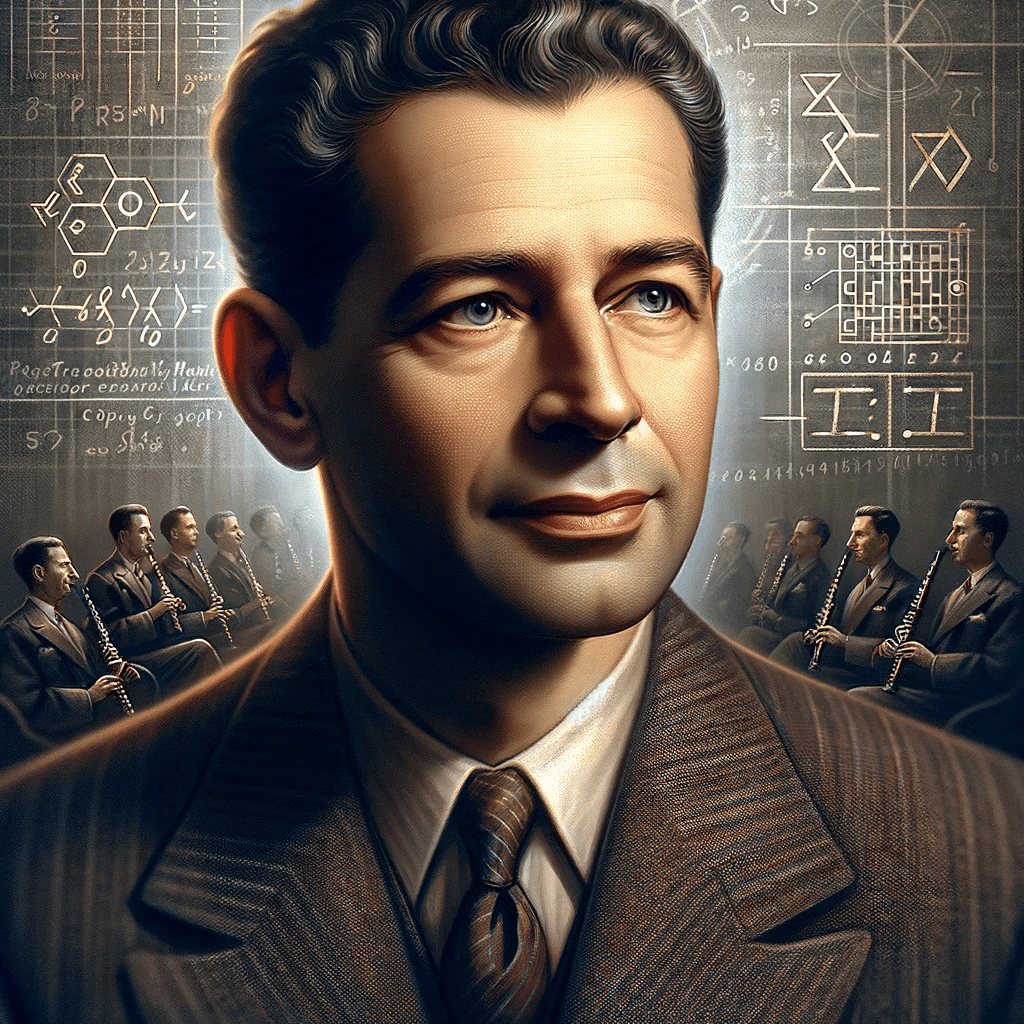
Lambros D. Callimahos stands out as one of those rare individuals whose life feels split between two completely different worlds, yet somehow both sides fed into each other. On one side, a world-class musician performing at the highest level. On the other, a cryptologist working deep inside one of the most secretive intelligence systems ever built. That contrast isn’t just interesting — it actually explains how he ended up thinking about problems that most people wouldn’t even consider.
He was born on December 16, 1910, on Gezirah island in the Nile near Cairo, Egypt, to Greek parents, before immigrating to the United States at a young age. His early life already hints at the kind of cross-disciplinary thinking that would define him later. He originally followed a path in music, training at the Juilliard School of Music and graduating in 1933. He was genuinely world-renowned in his field.
Then everything shifted. In February 1941, instead of being drafted, Callimahos voluntarily entered the U.S. Army, driven in part by a fascination with cryptology. He was eventually commissioned and served in the China-Burma-India theater, where he worked in signals intelligence and cryptanalysis, including efforts tied to Japanese communications. The transition might seem drastic, but it follows a clear pattern. Music and cryptology both rely on recognizing structure, rhythm, and hidden meaning — and that skill carried over directly.
After the war, he continued in cryptology and joined the National Security Agency. There, working alongside William F. Friedman, he helped build the agency’s first formal training system for cryptanalysts. He later created and taught the advanced CA-400 course, shaping generations of elite analysts. His influence extended beyond teaching: he founded the NSA Technical Journal and played a central role in developing the intellectual culture of the agency, including the legendary Dundee Society of top graduates.
But one of the most unique aspects of his work is that he didn’t limit himself to human communication. Callimahos began thinking about what happens when the message doesn’t come from Earth at all. In his NSA technical paper on communication with extraterrestrial intelligence, originally presented as part of a 1965 IEEE Conference panel alongside linguists, physicists, astronomers, and John C. Lilly, he approached the idea as a pure cryptographic problem. No shared language, no shared culture, no assumptions. Just signal and meaning. His core argument was that extraterrestrial intelligence is not only possible, but likely. He referenced scientific estimates suggesting there could be around one hundred million stars in our galaxy capable of supporting life, and potentially up to a billion civilizations across the observable universe. The real question wasn’t whether they exist. It was where they are, and how we would recognize them. He also pointed out the major limitation of distance.
Even relatively close systems like Epsilon Eridani or Tau Ceti are about eleven light years away, while more advanced civilizations might be over one hundred light years away. That means communication could take centuries just for a reply. He didn’t assume these civilizations would survive indefinitely either. Drawing on ideas from astronomer Iosif Shklovsky, he outlined several potential crises that could end advanced civilizations, including nuclear self-destruction, genetic instability, overwhelming information growth, extreme specialization, and the creation of artificial intelligence.
Callimahos grounded his ideas in real-world scientific efforts. He discussed early signal detection experiments such as Project Ozma, which searched for radio signals at the hydrogen line frequency of 1420 MHz. This frequency is significant because hydrogen is the most abundant element in the universe, making it a logical universal reference point. Later reprints of his paper also incorporated developments such as international CETI discussions and early transmission attempts like the Arecibo message, though these were not part of the original 1965 version.
What makes the paper stand out is how practical the approach is. He argued that any intelligent signal must first prove it is not random. The most effective way to do that is through mathematics. Sequences like natural numbers and prime numbers would immediately signal intelligence. From there, the message could gradually introduce more complex ideas. This is where his concept of inverse cryptography becomes central. Instead of hiding meaning, the goal is to make meaning as clear as possible. The sender must do the work to ensure the message can be understood, even by a completely unfamiliar intelligence.
Communication with Extraterrestrial Intelligence
He provided a detailed example of a binary transmission that, when arranged correctly, forms a raster image. The correct layout reveals a pictogram containing a star, planets, and two humanoid figures. The figures point to their home world, chemical symbols indicate a similar biological basis, and visual elements suggest water and exploration. Physical traits and measurement systems are also encoded, including the implication of a base-12 number system and a height derived from the signal’s wavelength.
He then went further by constructing a full example of an alien communication system. Starting with a set of symbols, he demonstrated how a message could teach numbers, then operations, then increasingly complex mathematical concepts such as powers, roots, factorials, and constants like pi and e. At one point, the message introduces Euler’s identity as a demonstration of advanced knowledge. By the final transmissions, the system evolves into full symbolic language, effectively allowing complete sentences to be constructed from scratch. The message teaches the code as it delivers it.
He also suggested that true proof of intelligence would come from knowledge beyond our own. Humanity might ask for solutions to unsolved mathematical problems like Fermat’s Last Theorem or Goldbach’s conjecture, or for more precise values of physical constants. Even a small advancement would demonstrate superiority.
This is the original 1965 version and includes the full symbol key and encoded mathematical problems, functioning as a technical payoff where readers can see the complete system in its original form.
He emphasized that decoding such communication would require managing thousands of symbolic elements, representing a level of complexity beyond traditional cryptanalysis. When you look at his life as a whole, it fits together. A musician trained in pattern recognition, a wartime cryptanalyst, and a teacher of elite codebreakers who then applies that mindset to the biggest unknown possible. So Callimahos wasn’t just shaping how we decode messages here on Earth. He was preparing for the possibility that one day, the message might come from somewhere else entirely.