The Washington D.C. Flap (1952)
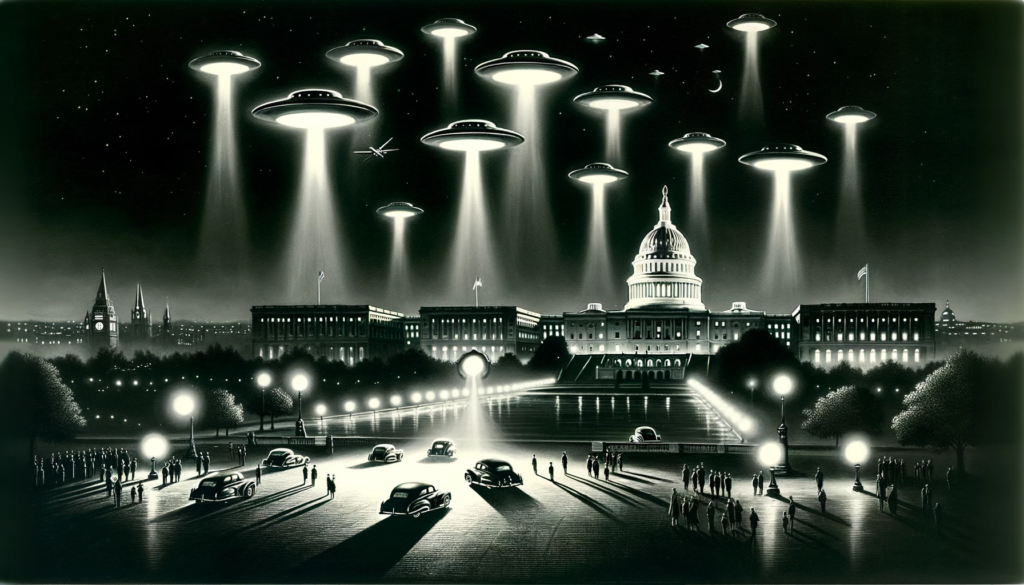
The Washington D.C. Flap of 1952 remains one of the most important UFO incidents in American history. Although the most famous events occurred during the nights of July 19–20 and July 26–27, the larger wave of sightings surrounding Washington D.C. stretched across much of July 1952 during a massive national surge in UFO reports. For two consecutive weekends in July, unidentified objects appeared over the capital of the United States, crossing some of the most sensitive airspace in the country. Radar operators tracked them. Pilots saw them. Military jets were scrambled. Air traffic controllers watched the objects move in ways that did not match ordinary aircraft.
The events took place during a period of intense national tension. The Cold War was underway, the United States was watching the skies closely, and Washington D.C. represented the heart of American political and military power. When unknown objects began appearing over the city, the situation quickly became more than a local sighting. It became a national security concern.
The most dramatic phase of the flap began late on July 19, 1952, when radar operator Edward Nugent at Washington National Airport detected seven unknown objects approximately fifteen miles south-southwest of the city shortly before midnight. The targets did not follow established flight paths and immediately stood out as unusual. Senior controller Harry Barnes quickly joined the effort as the unusual targets continued appearing across radar screens. Barnes reportedly instructed controllers to verify the radar equipment multiple times before escalating the situation, and operators confirmed the systems appeared to be functioning normally. The targets appeared on radar screens in areas where no known aircraft were supposed to be operating. Senior controller Harry Barnes and his team watched the returns carefully and realized the objects did not behave like normal air traffic. Barnes later described their movements as completely radical compared to those of ordinary aircraft.
The objects appeared to hover, shift direction, stop abruptly, and accelerate suddenly. Some moved slowly through the humid summer skies while others crossed the radar screen at remarkable speed. Later discussions surrounding the incident would include estimates suggesting some radar returns appeared to move at speeds approaching 7,000 miles per hour during portions of the sightings, far beyond the known capabilities of aircraft in 1952. At the same time, radar personnel at Andrews Air Force Base also reported unidentified targets. Master Sergeant Charles E. Cummings and other personnel described orange-red lights without visible trails that hovered, stopped suddenly, and accelerated away. This meant the sightings were not limited to one radar station or one group of operators.
Commercial pilots also began seeing strange lights in the sky. Controllers Howard Cocklin and Joe Zacko reportedly observed a bright orange light hovering in the sky while simultaneously tracking an unknown target on radar before the object accelerated away with incredible speed. Airman William Brady in the tower later described an orange ball of fire with a tail that accelerated away at unbelievable speed, while another observer reported an orange disk moving at approximately 3,000 feet above the city. Captain S.C. “Casey” Pierman of Capital Airlines, who had initially been awaiting takeoff, reported six bright white tailless lights moving rapidly through the air near his aircraft over a fourteen-minute period while in radio contact with Harry Barnes. Pierman later compared the objects to falling stars without tails. Radar operators confirmed unknown targets appearing close to his flight path while the sightings were taking place, with visual observations matching radar returns in real time. Other pilots and observers described luminous objects that did not match ordinary aircraft, stars, or meteors. The fact that radar sightings and visual sightings happened at the same time made the incident far more serious.
Air traffic control alerted the military. Fighter jets were scrambled to intercept the objects. F-94 Starfire interceptors were sent from New Castle Air Force Base in Delaware, but the objects proved difficult to approach. Reports from the night describe targets disappearing when military jets arrived around 3 a.m., then returning after the jets departed because of fuel limitations. Harry Barnes later believed the objects appeared to react intelligently to the military response and possibly even monitor radio traffic. To the radar operators watching the situation unfold, the objects appeared to react to the attempted intercepts.
One pilot reportedly saw a bright light near his aircraft that suddenly accelerated away. Other accounts from the first weekend described unknown targets moving beyond the performance of conventional aircraft of the era while repeatedly disappearing from radar as interceptor jets approached and then returning after the aircraft departed because of fuel limitations. Other accounts describe unknown targets moving beyond the performance of conventional aircraft of the era. The activity continued into the early morning hours before fading from radar and sight.
Over the following days, additional reports continued appearing across the Washington area before the phenomenon returned in full force the next weekend.
On July 26, 1952, radar operators again detected unknown objects over Washington D.C. Earlier in the evening, a National Airlines pilot and stewardess reported strange lights above their aircraft around 8:15 p.m., helping trigger another night of alerts and sightings. As the hot and humid summer night continued, radar systems at Washington National Airport and Andrews Air Force Base began tracking dozens of unknown targets appearing across multiple sectors of the city. The new wave of sightings brought even greater attention because newspapers had already begun reporting on the earlier events. People were watching the skies. The public was alarmed. The phrase “flying saucers” became part of the national conversation.
Once again, unidentified objects appeared on radar. Once again, military aircraft were sent to investigate. Witnesses described bright bluish-white and orange lights moving over the city, sometimes appearing in groups and sometimes maneuvering with unusual speed. Some objects moved slowly before abruptly reversing direction or accelerating away at tremendous speed, with certain radar tracks later estimated at speeds approaching 7,000 miles per hour. The objects appeared near highly sensitive locations including the White House, the Capitol, and nearby military facilities, with some radar targets reportedly passing directly over these areas. The reports came from radar operators, pilots, military personnel, and civilians. By approximately 9:30 p.m., radar operators were tracking unknown targets appearing across nearly every sector surrounding the city. The objects were seen over an area that included government buildings, military facilities, and restricted airspace.
The repeated nature of the sightings made the case extraordinary. During the second weekend, Lieutenant William Patterson reportedly chased four glowing white objects at maximum speed without gaining on them before radioing that the lights appeared to surround his aircraft. According to later accounts, ground controllers briefly fell silent before Patterson watched the objects rapidly pull away into the distance. Radar stations at both Washington National Airport and Andrews Air Force Base continued tracking unknown targets while visual sightings unfolded simultaneously. This was not a single strange light seen by one person. It was a series of events involving multiple radar systems, trained aviation personnel, commercial pilots, military response, and public attention. The objects were not simply reported from the ground. They were tracked by instruments and seen by witnesses who understood aircraft behavior.
The United States government was forced to respond. President Harry Truman was briefed on the matter and reportedly requested updates through aides connected to Project Blue Book, and the Air Force faced growing pressure to explain what had happened. The sightings over Washington created concern because they suggested that unknown objects could enter protected airspace over the nation’s capital and leave without being identified or intercepted.
On July 29, 1952, the Air Force held a major press conference at the Pentagon. Major General John Samford, Director of Air Force Intelligence, addressed reporters alongside Major General Roger Ramey. It became the largest Pentagon press conference since World War II, reflecting the enormous public anxiety and media attention surrounding the Washington sightings. The size of the press conference showed how much public attention the Washington sightings had generated.
The Washington D.C. Flap became a turning point in the history of the UFO phenomenon. During the summer of 1952, Project Blue Book received hundreds of UFO reports, with some counts placing the total above five hundred sightings during July alone. Across the United States, approximately 148 major newspapers published more than 16,000 articles about flying saucers and unexplained aerial activity during the broader wave.
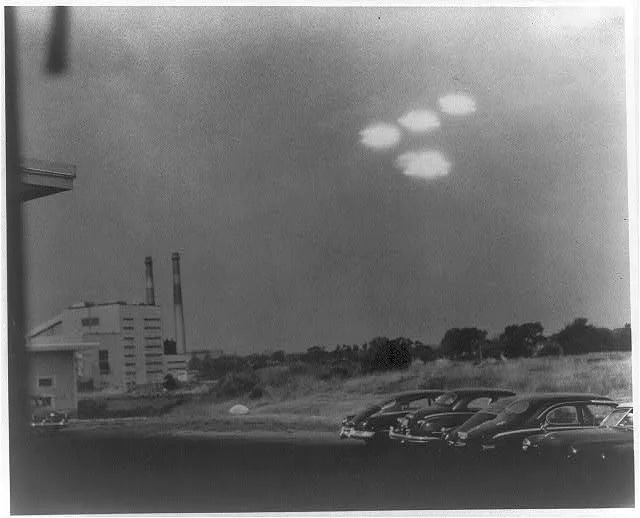
One striking visual record from the same intense 1952 national wave comes from Salem, Massachusetts, on July 16, 1952. U.S. Coast Guard photographer Shell Alpert, while working at the Salem Coast Guard Air Station, observed four bright luminous objects in formation outside his laboratory window. He quickly grabbed his camera and captured the now-famous daylight photograph through the window screen at 9:35 a.m. The image, officially logged as U.S. Coast Guard Photo #5554 and later archived in the Library of Congress, shows four glowing objects hovering in the sky. This authentic military photograph, taken just days before the Washington D.C. radar-visual events, remains one of the clearest images associated with the summer 1952 flap and illustrates how the phenomenon extended far beyond the nation’s capital.
The Washington sightings became the dramatic climax of that nationwide wave. It proved that UFO reports were no longer limited to isolated witnesses or rural sightings. They could appear over the capital of the United States, show up on radar, draw military aircraft into action, and force the Pentagon to speak publicly.
The case also became deeply connected to Project Blue Book, the Air Force’s official UFO investigation program. The events of 1952 helped push UFOs into the center of public discussion and made the government’s handling of unexplained aerial phenomena a lasting issue. For many researchers, the Washington D.C. Flap remains one of the clearest early examples of a radar-visual UFO event involving trained witnesses and official military concern.
One of the most powerful parts of the incident is the number of credible witnesses involved. Air traffic controllers repeatedly checked their equipment and confirmed the radar systems appeared to be functioning normally during the events. Air traffic controllers, radar operators, commercial pilots, military personnel, and civilians all played a role in the story. The objects appeared on radar and were also seen visually, giving the case a stronger foundation than many other reports from the same era.
Civilian sightings also added to the growing wave of reports. Around sunrise on July 20, radio engineer E.W. Chambers reportedly observed five large disk-shaped objects moving in loose formation before tilting upward and ascending rapidly into the sky.
The Washington D.C. Flap also helped define the public image of UFOs in the 1950s. Newspapers covered the story widely, the term “flying saucers” spread quickly, and the American public became increasingly aware that unidentified objects were being reported not only by ordinary citizens but also by trained professionals and military personnel.
Decades later, the case still stands out because of where it happened and who witnessed it. Washington D.C. was not an ordinary location. It was the center of American government power. Unknown objects appearing over that airspace carried a special meaning. They suggested that the phenomenon could not be ignored, hidden, or dismissed as a simple misunderstanding.