Paradise Lost
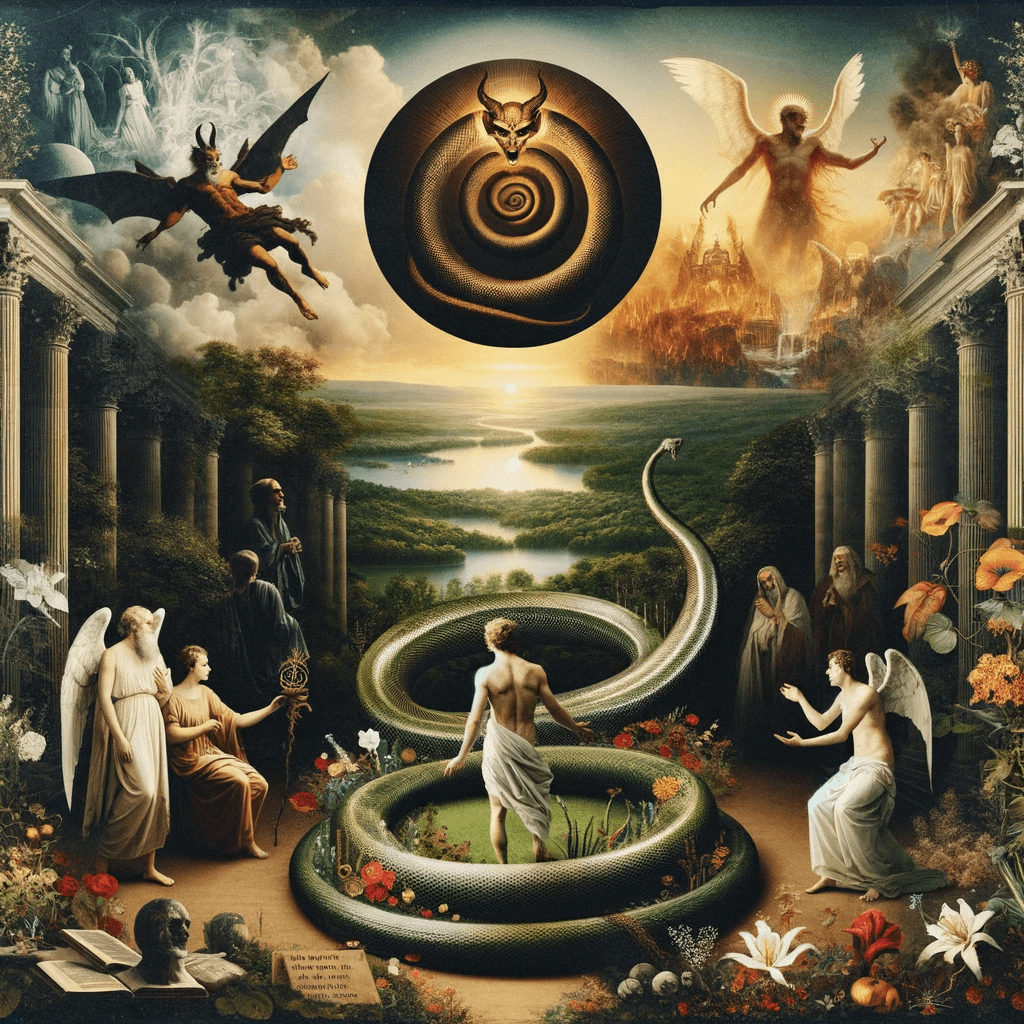
“Paradise Lost” is an epic poem by the English poet John Milton, first published in 1667. It remains one of the most ambitious and influential works in the English language. Milton begins the poem with a solemn invocation asking divine inspiration from the heavenly spirit that inspired the biblical account of creation. In the opening lines he announces the theme of the epic: “Of Man’s first disobedience, and the fruit / Of that forbidden tree, whose mortal taste / Brought death into the World, and all our woe.” These lines immediately establish both the biblical foundation and the cosmic scale of the story. His stated purpose is bold and philosophical: to recount humanity’s first disobedience and ultimately to “justify the ways of God to men.” In this sense the poem is a sweeping exploration of freedom, rebellion, responsibility, justice, and redemption.
The first edition of the poem appeared in 1667 and was divided into ten books. Milton later revised the structure, and the 1674 edition—published shortly before his death—reorganized the work into twelve books, deliberately echoing the structure of Virgil’s Aeneid. The poem contains more than ten thousand lines of blank verse and represents the culmination of Milton’s lifelong intellectual, religious, and political reflections.
Milton composed the poem under extraordinary circumstances. By 1652 he had become completely blind, most likely from glaucoma, yet he continued writing by dictating the poem aloud to assistants, friends, and sometimes his daughters. Lines were spoken from memory and later written down and revised. Despite blindness and personal losses, Milton produced one of the greatest epics in Western literature. Blank verse is structured rhythm without rhyme, which gives poetry a natural, speech-like flow while still sounding elevated and musical.
Milton believed that the poem was created with divine assistance. Like many poets of the ancient epic tradition, he described the act of composition as inspiration flowing from a higher source rather than simple invention. In the poem’s opening invocation he asks the heavenly spirit that inspired the biblical prophets to guide his words. In Milton’s time this was understood as divine inspiration from God rather than literal dictation. Today some people describe creative experiences in similar terms using ideas such as subconscious creativity, altered states of imagination, or even “channeling.” For Milton himself, however, the source of the poem was clear: he believed he was being spiritually guided in writing a Christian epic that revealed deeper truths about humanity, rebellion, and divine order.
Rather than beginning in the Garden of Eden, Milton deliberately opens the poem in the aftermath of a cosmic catastrophe. The reader first encounters Satan and the fallen angels in Hell after their defeat in the war against Heaven. Cast down by the power of God, they lie stunned on a burning lake within a vast abyss. Milton describes this place as a terrible prison where flames burn but produce no light, creating what he famously calls “darkness visible,” a phrase that captures the paradoxical horror of Hell—light enough to reveal suffering, but never enough to bring comfort. The fallen angels are immortal, condemned to endure suffering without the release of death.
Satan slowly rises from the fiery lake and surveys the devastation around him. Although defeated, his pride remains unbroken. His mind immediately transforms defeat into defiance. Rather than submitting to God, he declares in one of the poem’s most famous lines that it is “Better to reign in Hell, than serve in Heav’n.” This declaration captures the core of Satan’s character: pride so powerful that domination is preferred even in misery. This moment establishes the psychological core of the poem. Satan’s rebellion is not simply political or military but deeply rooted in pride, ambition, and the refusal to acknowledge any authority greater than himself.
Satan soon gathers the fallen angels and rouses them from their stunned confusion. The once-glorious angels, now transformed into demons, assemble across the fiery plains of Hell. Under Satan’s command they construct Pandæmonium, a vast palace rising suddenly from the infernal deep. Within this dark capital the rebel angels hold a council to determine their next course of action.
During the council several leading demons present different strategies. Moloch calls for renewed war against Heaven, Belial argues for passive submission and avoidance of further punishment, and Mammon proposes that the demons build their own kingdom within Hell. Ultimately Beelzebub supports Satan’s plan to corrupt the newly created human race. If Heaven cannot be conquered directly, Satan will attempt revenge by destroying the happiness of God’s newest creation.
Milton also introduces symbolic figures such as Sin and Death, grotesque beings who guard the gates of Hell. Sin is portrayed as having sprung from Satan’s own head, while Death is the monstrous offspring of their union. These allegorical figures reinforce Milton’s central idea that evil originates through corruption and rebellion rather than existing as an independent force equal to good.
The rebellion of Satan itself forms a major background narrative within the poem. Later books recount the War in Heaven, a vast cosmic conflict lasting three days between the loyal angels and the rebel host. The battle ends when the Son of God intervenes and drives the rebellious angels out of Heaven, casting them into the abyss where Hell becomes their prison. Milton transforms a brief theological concept into a dramatic epic battle on a cosmic scale.
After escaping Hell, Satan journeys through Chaos until he reaches the newly created world. In the Garden of Eden he observes Adam and Eve living in harmony with nature and with each other. Milton portrays their relationship as innocent and balanced, grounded in reason and mutual affection. The temptation of Eve therefore unfolds as a gradual psychological persuasion rather than a simple deception.
Disguised as a serpent, Satan flatters Eve’s beauty and intelligence and suggests that eating the forbidden fruit will grant her greater knowledge and godlike awareness. The temptation appeals to curiosity, pride, and the desire for independence. Eve eventually eats the fruit and later persuades Adam to share her fate. Adam understands that disobedience will bring disaster, yet he knowingly chooses to eat because he refuses to lose Eve.
Milton presents the fall not as an instant catastrophe but as a tragic transformation. Love becomes lust, harmony becomes accusation, and fear replaces innocence. Adam and Eve blame one another and experience shame for the first time. Eventually they reconcile and accept responsibility for their actions.
God pronounces judgment upon the serpent, Eve, and Adam. The world itself changes as suffering, labor, and death enter human existence. Adam and Eve are expelled from the Garden of Eden and forced to begin life in a fallen world. Yet the poem does not end in despair.
The archangel Michael later reveals the future history of humanity to Adam through a series of prophetic visions. Adam sees the long history of human suffering but also the promise of eventual redemption through Christ. Milton’s epic therefore ends with hope rather than despair, reinforcing the poem’s central theological argument that divine justice and mercy ultimately restore the possibility of salvation.
Milton’s portrayal of Satan has generated centuries of debate. Satan displays courage, intelligence, and persuasive power, yet these qualities are consistently shown to be corrupted by pride and resentment. His refusal to accept divine authority traps him in a cycle of rebellion and self-deception. Later Romantic writers such as William Blake and Percy Shelley interpreted Satan as a heroic rebel, but Milton’s original intention was to demonstrate how charisma and rhetoric can make rebellion appear attractive while ultimately leading to ruin.
Heaven, Hell, Chaos, and the newly formed Earth all become part of a single dramatic universe.
By transforming the brief biblical story of humanity’s fall into a sweeping cosmic drama, Milton created an epic that continues to challenge readers to reflect on the nature of pride, the meaning of obedience, and the enduring possibility of restoration after loss.