The Utsuro-bune Incident (1803)
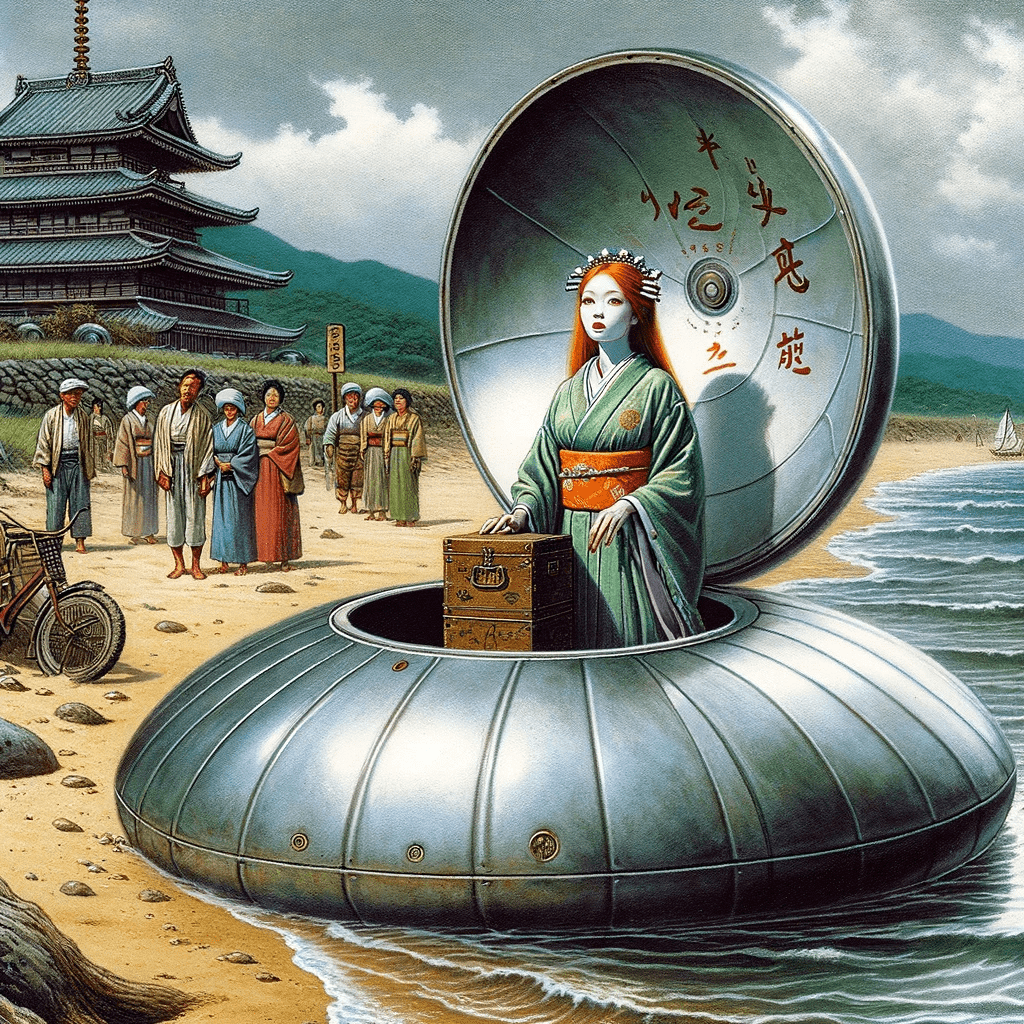
The Utsuro-bune Incident is one of those stories that kind of sticks with you the more you think about it. It goes back to early 1803 in Japan, with accounts placing it in late winter or early spring, when a strange vessel reportedly washed up along the shore of Hitachi province. The landing site is most strongly associated with Sharihama beach in what is now Kamisu, Ibaraki, though period texts give slightly different place names. People at the time didn’t describe it like a simple boat. Instead, they compared it to something more like an incense burner or a round cooking pot—barrel-shaped, enclosed, and clearly constructed with purpose. The vessel was large, measuring roughly 5.4 meters across and about 3.3 meters high.
Its structure was unusually detailed. The lower half was reinforced with metal plates or ribs, likely for protection against rocks, while the upper portion was made of lacquered wood—most consistently described as red-lacquered rosewood in the main illustrated accounts. Several glass or crystal windows were set into the sides, fitted with lattice frameworks and sealed with a resin-like substance to keep water out. The top section was said to open on a hidden hinge. Inside this unusual craft was a woman who seemed just as mysterious as the object she arrived in.
Witnesses described her as around 18 to 20 years old and about 1.5 meters tall, with pale, almost pink or snow-white skin. Her hair was vividly red, including her eyebrows, and in some accounts it was extended or decorated with white strips that may have been fabric, fur, or treated fibers. Her clothing stood out just as much—made from an unfamiliar material, fitted tightly at the top and looser toward the ankles, unlike anything local people recognized. She appeared calm and in good health, but communication was impossible. She spoke in a language that didn’t match any known dialect, and no one could understand her.
One detail that keeps coming up in retellings is the box she carried. She held onto it tightly, almost protectively, and refused to let anyone approach or touch it. No one ever opened it, and no one saw what was inside. The unreadable symbols associated with the story were not found in the box, but instead were written across the interior walls of the vessel itself, and in some versions even on the exterior. Among these markings, one figure is repeatedly noted as resembling the modern Taegeuk pattern, while others have been compared to decorative or alchemical-style symbols seen in Edo-period texts influenced by Western learning.
Inside the vessel, there were also basic supplies. Reports describe bedding or carpet-like materials, a container of water, food resembling cake or kneaded meat, and simple dishes or cups. Some versions also include a small brazier. It didn’t look like advanced technology—it looked more like a sealed living space meant for survival over water.
The story didn’t just fade away after that initial encounter. It was recorded in multiple Edo-period texts and manuscripts, not just one, and appears across a dozen or so documents identified by later researchers. While Toen shosetsu contains one of the most detailed versions, the incident also appears in earlier and later works with slight variations in date, location, and minor details. There is even a contemporary-style woodblock news sheet describing a drifting boat along the Kashima coast around the same period, suggesting the story may have circulated as current news at the time.
Another strange part of the story is how it ended. The villagers, unsure of what to do and possibly concerned about involving authorities or bringing trouble onto themselves, debated the cost of reporting the incident to their domain lord. In the end, they placed the woman back into the vessel and pushed it out to sea, setting it adrift again and leaving her fate unknown.
Over time, explanations have popped up from all directions. Some believe the woman may have been a foreign castaway, possibly from Russia or another distant region, which would explain her appearance, language, and unfamiliar clothing during a period when Japan was largely isolated.
What really drives the UFO comparison are the illustrations. Edo-period drawings of the vessel show a rounded, enclosed object with a domed upper section, reinforced lower hull, and windowed sides. When viewed today—especially after the rise of flying-saucer imagery following 1947—they can look surprisingly similar to the classic disc-shaped craft seen in modern UFO reports. That resemblance feels striking, even uncanny, but it only exists because we are looking backward through a modern lens.
Other details also feed the comparison. The unknown symbols inside the vessel get treated as “alien writing,” even though they fit well within Edo-period decorative or alchemical styles. The woman’s appearance, language barrier, and guarded box are sometimes reframed as signs of a non-human visitor, despite contemporary explanations pointing toward a foreign castaway. Even the vessel’s sealed, self-contained design gets interpreted as advanced or out of place, when it may simply reflect unfamiliar construction methods.
Put together, these elements can resemble what people today would call a close encounter—an enclosed craft and a mysterious occupant. But that pattern only emerges after the fact. At the time, witnesses compared the vessel to everyday objects like incense burners, and the story itself circulated as part of a broader tradition of strange tales and a visiting-stranger.