Summoning UFOs and the Galinstan Vortex Dynamo Theory
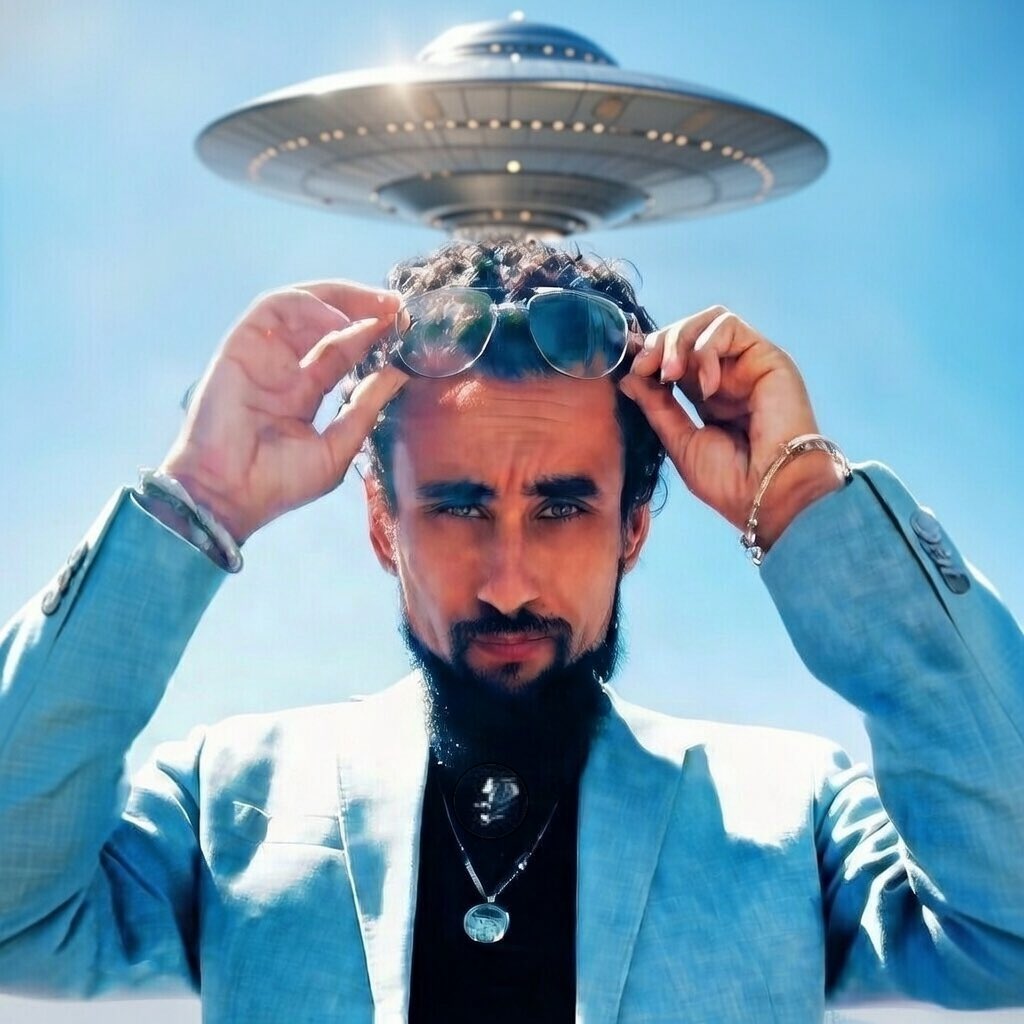
James Michael Laity, known online as LasVegasShaman, is a Las Vegas based independent researcher and self published author who has built a following on X since 2009. He presents himself as a visionary guided by persistent internal signals or downloads from a higher intelligence, combining technical ideas about antigravity and energy systems with broader commentary about hidden knowledge and institutional suppression. He positions his work as a blend of established laboratory physics and intuitive insight, framing himself as someone revealing technologies that have been overlooked or concealed. He has also described his own background and appearance, noting heritage primarily from Central Scotland, Northern Ireland, and Cornwall, with hazel eyes and dark brown hair, and a mother with blonde hair and blue eyes.
Laity interprets UFOs, orbs, and UAP not as conventional aircraft or distant extraterrestrial vehicles, but as plasma based electromagnetic phenomena that operate using the same principles he describes in his engineering concepts. He characterizes these objects as stable field structures that can move silently without visible propulsion, and connects them to non human intelligences that he claims to interact with directly. According to his view, these entities provide knowledge and guidance, and the observed orbs represent accessible technology based on an advanced understanding of electromagnetic and plasma dynamics. He has also claimed the ability to summon or observe these phenomena through intention and focused awareness, presenting videos as demonstrations of this interaction.
In his videos, the scene unfolds during the day with a handheld camera pointed at an open stretch of sky. Laity can be heard speaking while filming, occasionally explaining what he expects to happen as he scans the sky. After a short period, a small bright point of light becomes visible against the daylight background. The object appears as a reflective or luminous dot and moves in a way that is not immediately identifiable as a conventional aircraft, without visible structure or blinking navigation lights. The camera shifts slightly as he tracks it, and the object may drift, change direction subtly, or vary in brightness, which could be influenced by angle, distance, or camera exposure. Laity presents this as a direct interaction, suggesting the object is responding to his intention rather than following a predictable path.
His book The Galinstan Vortex Dynamo is a 58 page independently published conceptual blueprint released in April 2026 that outlines a proposed propellant free craft roughly 15 meters in diameter. The design is built around the idea that gravity is an emergent electromagnetic equilibrium created by a celestial bodys mass, spin, and internal energy, and that this equilibrium can be locally altered through engineered systems. The craft uses a rotating liquid metal core, layered materials, and feedback systems to generate what he describes as a plasma vacuum soliton bubble, enabling lift, hover, and directional movement without traditional thrust.
The book is a conceptual engineering proposal for a craft that attempts to counteract gravity by redefining gravity as an emergent electromagnetic balance rather than a standalone force. It argues that what is commonly understood as gravity is actually the result of interacting electromagnetic fields generated by mass, rotation, and internal energy, forming a kind of equilibrium that holds objects in place. From this perspective, if that equilibrium can be recreated, modified, or locally overridden, then a vehicle could alter how it interacts with Earths field and achieve lift without relying on traditional propulsion systems like jets, rockets, or propellers.
The design centers on a sealed toroidal chamber filled with Galinstan, a conductive liquid metal composed of gallium, indium, and tin. This fluid is spun at high speed inside the chamber, creating a powerful electromagnetic vortex through magnetohydrodynamic principles. The vortex acts as the core engine of the system, generating strong magnetic and electric fields that interact with the surrounding structure. According to the concept, this rotating plasma like environment becomes the foundation for producing a localized field that can compete with or override Earths natural field.
Surrounding this core are multiple engineered layers that work together as a unified system. A bismuth based outer skin provides diamagnetic properties, meaning it naturally repels magnetic fields and contributes a passive lifting effect. On top of that, thin layers of topological insulators are added, allowing electrons to move across the surface with extremely low resistance, improving efficiency and stability. Additional ultra thin 2D materials such as graphene like structures are introduced to fine tune how energy flows across the surface, increasing overall performance without adding significant weight.
A key feature of the system is a distributed piezoelectric feedback network embedded throughout the structure. This network converts mechanical stress from the spinning vortex into electrical signals in real time, automatically adjusting the system to maintain stability. Instead of relying on computers or external control systems, the craft effectively self regulates through its own physical responses. The entire assembly is then encapsulated in a layer of hexagonal boron nitride, which acts as both a thermal barrier and an electromagnetic stabilizer, helping contain the energy and protect the structure under extreme conditions.
At the center of the propulsion concept is what the author calls a plasma vacuum soliton bubble. This is described as a stable, self contained energy structure that forms at the boundary between the vortex and the crafts outer layers. Once this bubble is established, it becomes the primary mechanism for movement. Rather than pushing against air or expelling mass, the craft shifts its position by changing how it interacts with surrounding fields, essentially allowing it to move through controlled free fall in any direction. In this sense, propulsion is not about force, but about changing the reference frame of the craft within a larger field system.
The book provides detailed equations, simulations, and material comparisons to support the claim that this system could generate enough force to lift and maneuver a large craft. It outlines a reference design roughly 15 meters in diameter with a total mass of around 80000 kilograms, along with estimated thrust levels, power requirements, and efficiency gains once the system becomes self sustaining. It also explores how external conditions, such as lunar cycles and variations in Earths magnetosphere, could influence performance and reduce energy requirements.
While many of the individual components discussed in the book are based on known physics and existing materials, the overall propulsion system remains theoretical. The central idea that gravity can be fully explained and manipulated as an electromagnetic equilibrium is not part of mainstream physics, and the proposed integration of these systems has not been experimentally demonstrated. As a result, the design should be viewed as a speculative but detailed blueprint rather than a proven technology.
Overall, the concept reframes propulsion as the control of electromagnetic balance instead of the application of force. It suggests a closed system that does not rely on fuel in the traditional sense, but instead interacts with natural fields in a way that allows motion through alignment and imbalance rather than resistance. The book combines technical engineering language with broader philosophical ideas about humanity learning to understand and work with the underlying structure of the universe, presenting the craft not just as a machine, but as a new way of thinking about movement and energy.