The Heflin UFO Incident (1965)

The 1965 Heflin UFO incident is widely regarded as one of the strongest photographic cases in UFO history, not only because of the images themselves, but because of the detailed circumstances under which they were taken and the unresolved questions surrounding their handling. The encounter occurred on August 3, 1965, in rural Orange County, California, just outside Santa Ana, and involved highway maintenance engineer Rex Heflin, a trained observer performing routine fieldwork.
The sighting took place around 12:30–12:37 p.m. PDT. Heflin did not wear a watch, but later photographic shadow analysis refined the time to approximately 12:37 p.m. The exact location was near the intersection of Myford Road and Walnut Avenue, roughly half a mile outside the perimeter of El Toro Marine Corps Air Station. Heflin’s maintenance van was stopped facing north along Myford Road.
Heflin had pulled over as part of his job to photograph a railroad crossing sign partially obscured by tree branches. While attempting to radio his supervisor to report the obstruction, his vehicle radio suddenly failed, producing either heavy static or a complete blackout. This malfunction drew his attention upward. The radio resumed normal operation only after the object departed, and similar radio interference was later reported elsewhere in the area that same day.
At the time of the incident, Heflin was 38 years old with 15 years of exemplary service in highway maintenance. Given the proximity to El Toro, his initial assumption was that the object might be an experimental military aircraft.
Heflin described the object as metallic, disc-shaped, and silent, with a domed or hat-like profile. Based on roadway scale and distance markers, he estimated it to be 20–30 feet in diameter and 8–10 feet high, hovering at an altitude of roughly 150 feet and initially 750–1,000 feet away.
The object crossed Myford Road from west to east, hovered briefly, and exhibited a wobbling motion, likened to a slowing gyroscope. It then tipped, revealing a dark underside. From its center underside, Heflin observed a greenish-white beam of light rotating clockwise, completing a full rotation roughly every two seconds. Moments later, the craft tilted to approximately 45 degrees and accelerated silently toward the northeast, rapidly disappearing over the Santa Ana Freeway.
Immediately after this acceleration, the object released a bluish-black smoke-like vortex ring that appeared solid and well defined despite light winds. The ring measured three to four times the craft’s diameter, bent slightly upward at an estimated 50-degree angle, drifted northeast, and gradually dissipated.
No sound was reported at any point, but the radio interference suggested a possible electromagnetic effect. No additional witnesses came forward, likely due to the area being sparsely populated farmland at the time.
Heflin used a Polaroid Model 101 camera loaded with ASA 3000 black-and-white film, standard issue for his work. The photographic sequence is often mischaracterized. Three photographs show the object itself, while a fourth image captures only the smoke ring after the craft had departed. The first image was taken through the van’s windshield and shows the object hovering above the road with a telephone pole and distant freeway providing scale. The second was taken through the passenger-side window and captures the object tipped, revealing the underside and rotating light. The third shows the object farther east with a faint particulate trail behind it. The fourth was taken after Heflin drove approximately 100–200 yards north and exited the van, capturing only the smoke ring against a patchy overcast sky, with a telephone wire and orange tree branch visible as reference points.
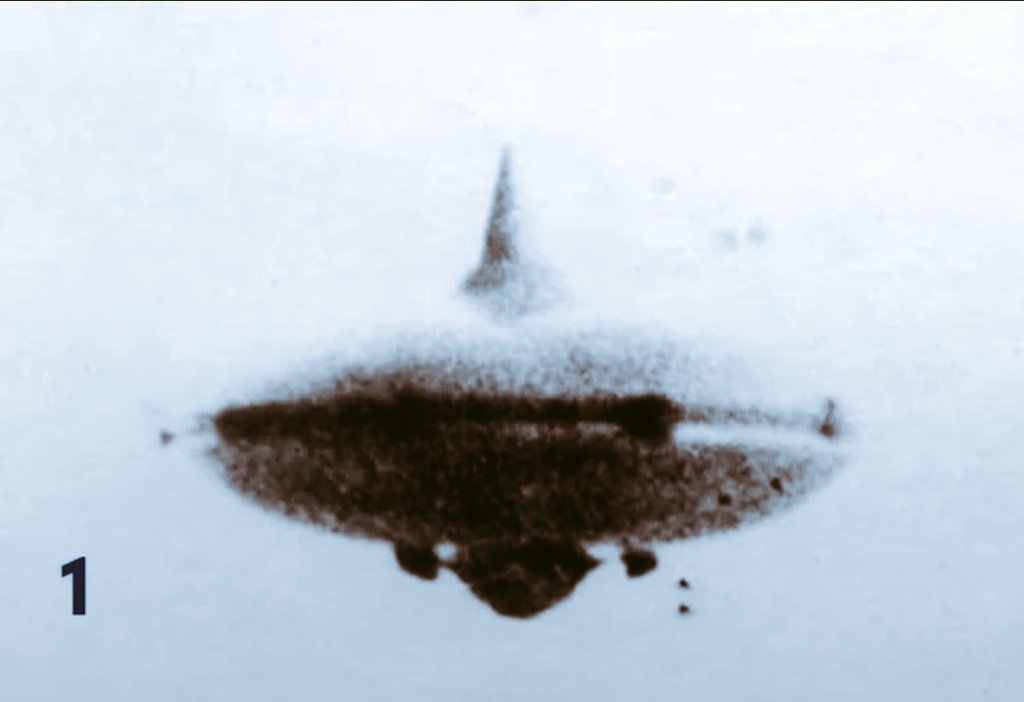
Heflin showed the photographs to coworkers that afternoon and later loaned them to relatives to make copies. The images were published in the Santa Ana Register on September 20, 1965.
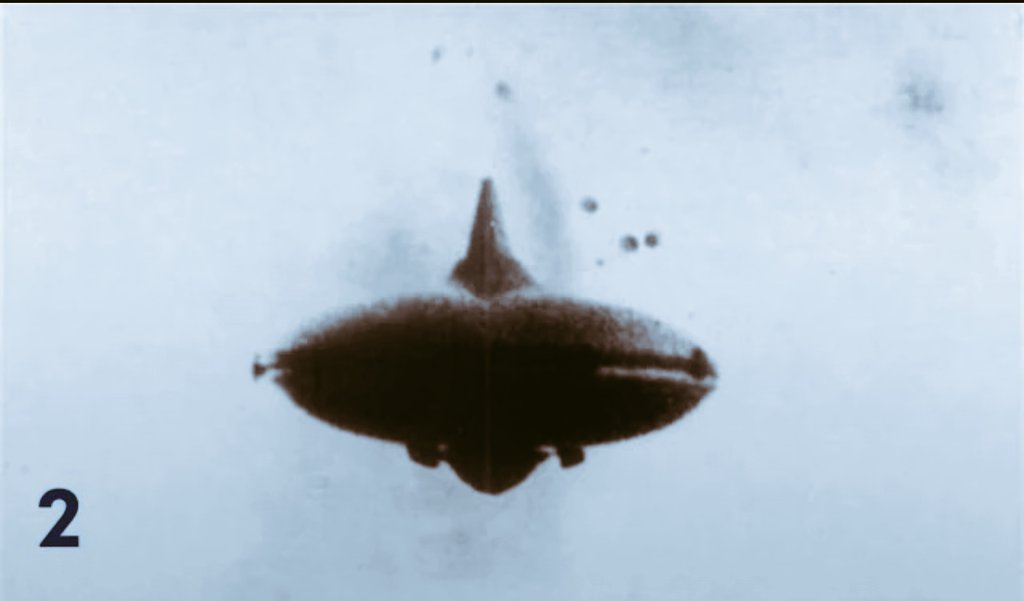
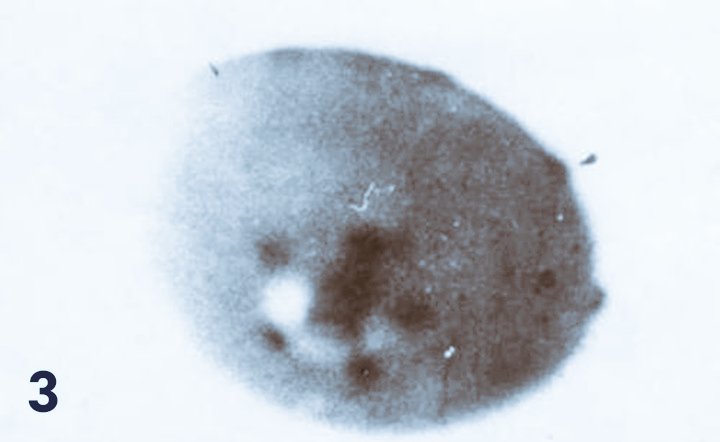
On September 22, 1965, two days after publication, two men in civilian clothing arrived at Heflin’s home driving a dark-colored car. They identified themselves as representatives of the North American Aerospace Defense Command and requested the original photographs for analysis. They examined the first three photographs, provided verbal assurances of return, but presented no identification, receipt, or official paperwork. Heflin retained the fourth photograph.
The photographs were not returned. Over the years, Heflin contacted NORAD repeatedly but received no resolution. NORAD later denied any involvement or knowledge of the images. At one point, U.S. Marine Corps Intelligence briefly borrowed unmarked copies and returned them without comment.
In 1993, twenty-eight years later, after receiving anonymous phone calls suggesting the photographs’ whereabouts, the originals unexpectedly appeared in Heflin’s mailbox in a plain envelope. No explanation was included. The photos bore Heflin’s original blue-ink numbering, along with unexplained additions, including the word “original” written in grease pencil, the number 13 in pencil, fingerprints, and stains. No agency ever acknowledged possession of the images. Heflin died in 2005 without further answers.
The case attracted early investigation by the National Investigations Committee on Aerial Phenomena and the Los Angeles NICAP Subcommittee beginning in September 1965. Investigators interviewed Heflin, confirmed his reliability, and used photogrammetry to determine the object could not be supported by strings or models. Background checks conducted through coworkers and supervisors found Heflin to be straightforward, technically competent, and not prone to fabrication or exaggeration.
Shortly after the photographs were published, early technical analysis was conducted by Robert Nathan at NASA’s Jet Propulsion Laboratory using first-generation prints and copy negatives derived from newspaper reproductions. Despite the limitations of the materials available at the time, enhancement work supported the presence of a light source on the underside of the object, consistent with Heflin’s description of a rotating greenish-white beam. This analysis predated later digital studies and provided an early counter to claims that the images showed a simple static model.
The U.S. Air Force’s Project Blue Book assigned Captain Charles F. Reichmuth, who interviewed Heflin for more than three hours and found him credible. Despite this assessment, Blue Book ultimately labeled the case a hoax, citing a flawed experiment involving a small model suspended on a tray, an explanation widely criticized for failing to match the photographic evidence.
Physicist James E. McDonald reinvestigated the case between 1967 and 1968. He confirmed reports of radio interference affecting local systems, reviewed weather data showing overcast skies with light southwest winds, and consulted multiple experts. Although he initially questioned differences in cloud appearance between the photographs, later analysis demonstrated these were caused by exposure differences between images taken through the windshield and the final image taken outdoors. No radar detections were reported at El Toro during the event.
In 1993, a detailed reanalysis by Ann Druffel, Robert M. Wood, and Eric Kelson used digitized originals at 300 dpi and 16-bit grayscale. Their work confirmed continuity across all four images, including matching mottled overcast skies, linked particulate trails in the first and third photographs to the smoke ring in the fourth, revealed a wedge-shaped light on the underside consistent with Heflin’s description, identified unusual blurring around the object possibly caused by ionized air, and found no evidence of photographic manipulation or hoaxing.
Parallels were noted with unresolved 1957 Fort Belvoir smoke-ring photographs, but Heflin’s case was judged independently genuine.
Today, the Heflin UFO photographs remain among the most credible and extensively analyzed pieces of UFO evidence on record. Despite decades of scrutiny and repeated debunk attempts, no hoax has been demonstrated. The case continues to be cited in modern discussions of unidentified aerial phenomena, with recent debates largely recycling earlier claims based on degraded copies rather than the digitized originals. The combination of detailed witness testimony, technical photo evaluation, radio interference, and an unresolved chain of custody continues to make the Heflin incident a cornerstone case in discussions of unidentified aerial phenomena.