Betz Sphere
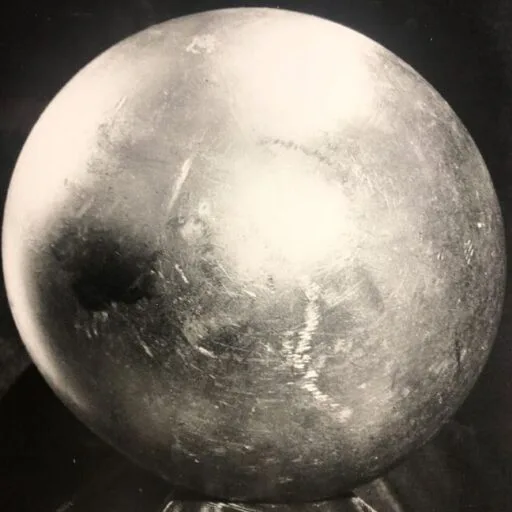
On March 27, 1974, 21-year-old pre-med student Terry Betz discovered a peculiar metal sphere while inspecting damage from a small brush fire on his family’s 88-acre property, the historic Neff House, on Fort George Island, Florida. The object, which became known as the Betz mystery sphere, initially appeared to be possible satellite debris or even an old Spanish-era cannonball. Terry and his parents, Gerri Betz and Antoine Betz, brought it back to the house, where it remained largely unnoticed for nearly two weeks.
The sphere first revealed its unusual properties one evening while Terry was playing guitar nearby. According to the family, it began emitting humming or throbbing sounds that corresponded precisely to specific musical notes. Over the following days, the object demonstrated increasingly remarkable behavior. It rolled across the floor, stopped abruptly, reversed direction without being touched, and changed course without visible cause. It vibrated, emitted tones, and moved across tabletops without falling off edges. Family members reported that high-pitched sounds from the sphere caused their dogs to whine and cover their ears. Additional accounts from the period describe doors slamming and organ-like sounds within the house, which the Betz’s attributed to the sphere rather than to the home’s earlier reputation.
Terry stated that the sphere had been found resting on top of the ground in a wooded marsh area miles from the main house. There was no crater, no embedded position, no surrounding debris, and no significant burn or impact damage. Its placement suggested it had been set down deliberately rather than having crashed.
Concerned about its origin and behavior, the family contacted authorities. Gerri Betz drafted a written agreement with the U.S. Navy permitting examination of the sphere for up to two weeks, with the stipulation that it be returned if it was not government property. The object was tested at Naval Air Station Cecil Field and Naval Station Mayport in April 1974. After completing their examination and determining it was not theirs, the Navy returned the sphere to the family later that same year.
Navy X-ray analysis reportedly revealed a hollow interior with a thick outer shell of approximately one-half inch and no visible welds or seams. Inside were three small denser spheroidal elements, described as equally spaced, including one approximately one-eighth of an inch in diameter. Enhanced interpretations of the X-rays have suggested complex internal density variations and possible trace powdered residue within the cavity. The sphere exhibited a faint but permanent magnetic field with distinct polarity. Some reports indicate it emitted weak radio signals under certain testing conditions.
Metallurgical examination identified the exterior as Type 431 stainless steel, a high-strength, corrosion-resistant magnetic ferrous alloy. While the alloy itself is industrially known, the sphere’s seamless construction, internal complexity, and reported behaviors were not fully explained by standard manufacturing processes. Physical measurements recorded during Navy testing indicated a diameter of 7.96 inches, a weight of 21.34 pounds, and a circumference of roughly 25 inches. The exterior surface was highly polished and seamless aside from minor scuffs and a small triangular chip.
The sphere’s autonomous rolling and acoustic responsiveness became the most documented aspects of the case. Multiple family witnesses described repeatable motion that did not align with normal expectations for a balanced steel object. When struck, the sphere reportedly produced reverberating tones. Media coverage throughout 1974 and 1975 brought international attention, including examination by an independent panel assembled in New Orleans that included civil engineer J. A. Harder of the Aerial Phenomena Research Organization and astronomer J. Allen Hynek. While some investigators considered possible terrestrial explanations, the sphere’s internal structure, balance, acoustic responses, and apparent self-directed motion remained without a fully satisfactory conventional explanation.
After the intense public scrutiny, the Betz family gradually withdrew from media attention. The sphere was apparently returned to them in 1974, and although it was occasionally shown privately to friends, its whereabouts since the mid-1970s have not been publicly documented.
Over time, broader interpretive frameworks have placed the Betz sphere within a larger pattern of global anomalous activity. Independent researcher Patrick Jackson, in his Quantum Paranormal model, identifies objects with these characteristics as “Type 3 Low Spheres.” In this classification system, Type 3 spheres operate at ground level or low altitude as nodes within a global monitoring and communication network associated with non-human intelligence. According to this model, Type 3 spheres are capable of autonomous movement, electromagnetic emission, interaction within buildings, and coordination with higher-altitude Type 1 Interceptor and Type 2 Relay spheres. Reports of comparable metallic spheres observed worldwide provide contextual support for viewing the Betz object as part of a structured technological system rather than an isolated anomaly.
Firsthand multi-witness testimony, official military testing, X-ray records, metallurgical analysis, and decades of continued investigation have yet to produce a comprehensive conventional explanation for the combination of structural characteristics and observed behaviors associated with the object.