Multidimensional Structured Power Imprint (SPI)
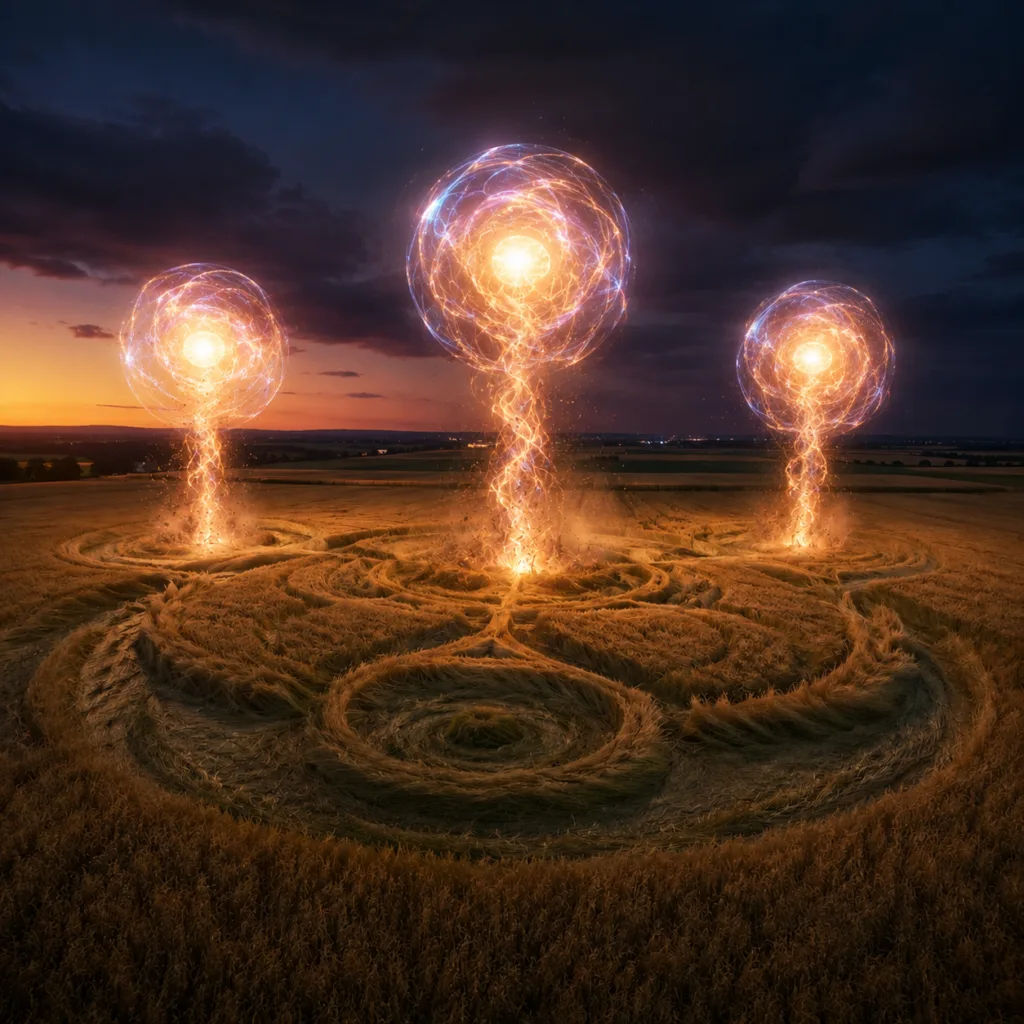
While the modern crop circle phenomenon is most closely associated with southern England, Canada has a substantial documented history of formations. The Canadian Crop Circle Research Network (CCCRN), founded in 1995 by Paul Anderson and initially known as Circles Phenomenon Research Canada, compiled roughly 200 to 270 reports dating back to the 1920s and 1960s. Saskatchewan was repeatedly identified as Canada’s primary hotspot, followed by Alberta, Manitoba, British Columbia, and Ontario. Among the Canadian cases examined in a laboratory setting, the most thoroughly studied is the seven-circle barley formation that appeared near Edmonton, Alberta, in September 1999.
In a recent appearance on the Bigelow Podcast with George Knapp, Robert Bigelow reflected on the long-standing difficulty of achieving official recognition of non-human intelligence. He noted that despite decades of well-documented UAP cases, counterintelligence efforts have consistently explained them away, a pattern that has held steady for roughly eighty years. Bigelow compared the situation to cattle mutilations, observing that no one has ever been prosecuted or caught for them, calling it “the most successful crime that exists.” He then turned to crop circles, stating that “Doug and Dave didn’t do all the crop circles, obviously,” and emphasizing that researchers know this firsthand. Drawing the threads together, Bigelow suggested that the intelligences behind these phenomena must be “scratching their heads,” wondering what more they have to do to be recognized after missile silos have been shut down or activated, crop circles and cattle mutilations have continued, and still no official acknowledgment has followed. “These human beings are really tough,” he concluded. “We’re having a hard time getting noticed.”
A seven-circle formation with an overall length of approximately 191 feet appeared in a thistle-infested barley field on the Manuel/Whitman Farm near Edmonton. It was discovered on 21 September 1999 and is believed to have formed around 14 September. Sampling was carried out on 30 September and 1–2 October by Judy and Mike Arndt of the CCCRN. Field observations recorded a radial lay of crop in all circles with a counter-clockwise perimeter ring underneath the top lay, visible apical node elongation, multiple expulsion cavities in the second and third nodes, a deep triangular hole in the small northern circle, reports of anomalous aerial light phenomena in the area around the time of formation, and cell-phone failure inside the formation.
The plant samples were analyzed at Pinelandia Biophysical Laboratory by W.C. Levengood and documented in BLT Lab Report #122, issued in July 2000 under lab code KS-04-176. Expulsion cavities, defined as holes blown out at the plant stem nodes, were found in 68 percent of the 71 plant sample sets taken inside the three sampled circles and in none of the controls. Statistically significant apical node-length increases were measured in all sampled circles, with the highest values occurring in the smallest circle and reaching as much as 109 percent in some measurements. Other plant abnormalities were consistent with previous BLT findings from formations in multiple countries. Levengood and the BLT team concluded that the plant abnormalities strongly supported the presence of a complex, thermodynamically unstable atmospheric plasma system as the causative agency and that the formation could not have been created manually.
Another Canadian case examined by the same laboratory was the August 1998 formation at Vanderhoof, British Columbia, documented in BLT Lab Report #108. Three sets of circles totaling eleven formations appeared in an oat field adjacent to the Vanderhoof airport runway. Sampling by Chad Deetken revealed significantly elevated free-radical concentrations in seedlings from inside the circles, with the highest levels occurring in the smallest circles, along with increased magnetic material in the soils that was higher immediately outside the circles than inside them, a distribution consistent with centrifugal forces operating within a rotating plasma vortex. Modest but statistically significant node-length increases of approximately five percent were also recorded. The report concluded that high-energy plasma vortices were involved in the creation of these formations.
The most distinctive Canadian-linked result came from X-ray diffraction analysis of surface soils from the same Edmonton formation. The study focused on illite/smectite clay minerals and employed the Kubler Index as a measure of crystallinity. A statistically significant increase in crystallinity, shown by sharpening of the mica 001 peak and a corresponding decrease in the Kubler Index, was found inside the circles compared with controls at the 95 percent confidence level. This increase in clay crystallinity correlated with the plant node-length increases at greater than 99 percent confidence. The observed change is normally associated with processes occurring over geological timescales in sedimentary rock and had not previously been documented in surface soils.
The work was funded by Laurance Rockefeller, completed around 2001–2002, and released as a detailed report on the BLT Research website in early 2004. Nancy Talbott summarized the findings in the May 2004 issue of the MUFON UFO Journal. A peer-reviewed journal paper was prepared with input from clay-mineral expert Robert C. Reynolds Jr., but it was never published. Health issues affecting one collaborator and funding constraints were cited as reasons for the delay.
The Edmonton results form part of a larger body of work by biophysicist W.C. Levengood and the BLT Research Team of Burke, Levengood, and Talbott. Peer-reviewed papers on biological anomalies in crop-circle plants appeared in Physiologia Plantarum in 1994 under the title “Anatomical anomalies in crop formation plants” and in 1999 under the title “Dispersion of energies in worldwide crop formations,” the latter co-authored with Nancy Talbott.
These papers reported statistically significant node elongation, expulsion cavities, cellular changes, and related effects across many formations and argued for organized ion-plasma vortex systems as the causative mechanism. Neither BLT nor the later Independent Crop Circle Researchers Association claimed to have deciphered messages or symbolic communications from formations. Their focus remained on measurable physical and biological effects.
In a presentation titled “Icky (ICCRA) Science: what should ICCRA be about?” delivered at the Independent Crop Circle Researchers Association annual meeting held at Woodland Altars in Locust Grove, Ohio, on 15–17 May 2009, Gene S. Thomas argued that researchers were still largely in a Galilean phase of basic measurement and needed to move into a Newtonian phase of developing testable principles and laws. He proposed replacing the terms “crop circle” and “crop formation” with “multidimensional Structured Power Imprint,” or SPI. His rationale was that the traditional names were both inaccurate and tainted by the public association with human hoaxing, particularly the confessions of Doug Bower and Dave Chorley.
An SPI, in his view, is a complex, multi-effect event that involves not only flattened vegetation but also changes in soil, insects, animals, vehicles, air chemistry, electrical properties, and horizontal effects that can extend beyond the visible flattened area. The imprint also changes over time. Thomas outlined four main tasks for the research community: replacing speculation with testable hypotheses, moving measurements closer in time to the actual formation event including efforts at prediction, broadening the range of measurements beyond visible plant patterns, and establishing clearer language and classification systems for the phenomenon. The proposed term multidimensional Structured Power Imprint did not gain wider adoption in the research community.
Circular Evidence, published in 1989 and written by Pat Delgado and Colin Andrews, was one of the first major books on the crop circle phenomenon. The authors concluded that the crop circles they investigated, numbering in the hundreds and located mostly in Hampshire and Wiltshire, were not hoaxes. They carefully examined the physical characteristics of the formations and argued that the plants were flattened in highly precise ways, with sharp edges, complex swirl patterns, and stems bent rather than broken. They maintained that many features could not be easily reproduced by simple mechanical means available at the time, and that conventional natural explanations such as ordinary whirlwinds or weather effects were inadequate.
Instead, they concluded that the circles were the product of unknown or subtle forces, and they leaned toward the involvement of non-human intelligence, or “unseen intelligences,” using forces not yet recognized by science. The book does not settle on one specific mechanism. It presents the phenomenon as a genuine mystery that required serious investigation, rather than offering a definitive scientific theory, in contrast to Terence Meaden’s plasma vortex hypothesis, which was published around the same time.