The Civil War Institute and the Non-Human Bodies: Decoding Eric Davis
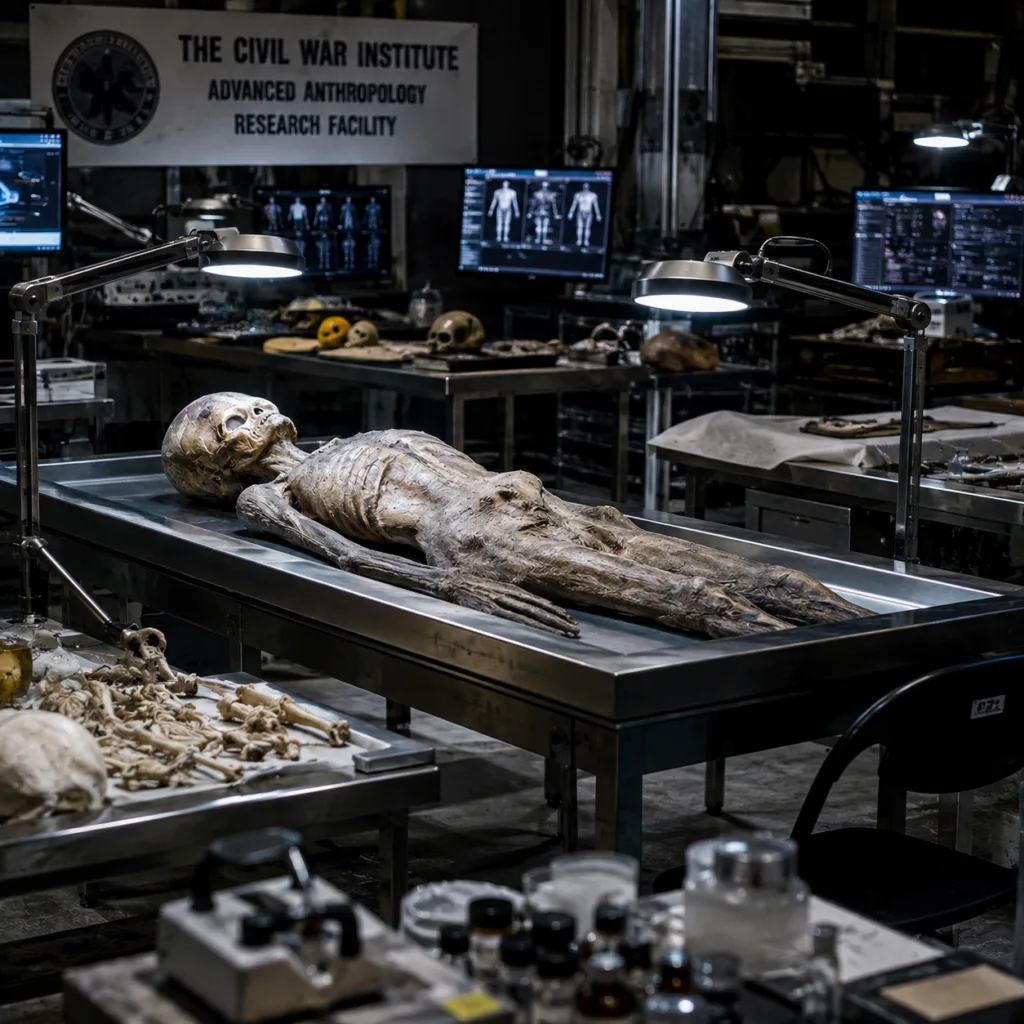
In a recent appearance on NewsNation’s Katie Pavlich Tonight, astrophysicist and longtime UAP researcher Dr. Eric Davis made one of his most specific claims yet about recovered non-human biological material. He stated that he has personally reviewed classified records, photographs, and reports documenting at least four distinct types of beings recovered from crashed craft, and that a small number of NHI bodies were found dead in some of those cases. More notably, he offered a rare organizational clue about where those remains were once held.
Davis explained that he remains bound by a Standard Form 312 intelligence NDA. He said he would need that nondisclosure agreement waived by the president so he could discuss Top Secret/SCI information about UAP evidence he has seen in person. Those materials, he noted, are still classified and are not subject to the Freedom of Information Act because they are likely protected for a 50- to 75-year period.
He expressed dissatisfaction with the pace and volume of official releases so far, while acknowledging he is not currently inside the Department of War, the intelligence agencies, AARO, or related efforts. Davis argued that more material could be revealed without harming national security. What must be protected, he said, are the methods and sources by which the information was acquired—whether from foreign adversaries, friendly nations, or recovery operations themselves. The top-level information that verifies the existence of recovered UAP technology and a small number of deceased NHI bodies, in his view, could be disclosed.
On the biological side, Davis stated there is a minimum of four types “that we know of,” adding, “I’ve seen the evidence and I’ve seen the records.” He described them as the Grays (resembling the figures shown at the end of Close Encounters of the Third Kind), Nordics (very tall, Caucasian-looking individuals), insectoid forms that resemble praying-mantis-type insects (though he noted they may not actually be insects), and reptilians whose body structure looks reptilian (while cautioning they may not be true reptiles). He attributed the insectoid and reptilian labels partly to the human tendency to impose familiar categories when confronted with something that produces “ontological shock.”
When asked where the government is keeping the bodies, Davis said he does not know the current location. During his work on the Defense Intelligence Agency’s Advanced Aerospace Weapon System Applications Program (AAWSAP) from 2008 to 2012, he and colleagues tried to track the material and obtained only a partial hint. The bodies, he said, went to a military medical institute that had existed since the Civil War—he approximated the year as 1865. That institute was later split into two or three components and relocated into different military medical institutes during the first Obama administration. The original organization, he noted, no longer exists.
Davis said he has no information about the biology or life-support needs of any living specimens because he never gained access to that level of detail. Most of the bodies he is aware of were found dead. He added that he has heard David Grusch mention one case of a being that was captured alive, but the two have not discussed it.
The institutional description Davis provided matches the historical trajectory of the Army Medical Museum, founded in 1862 during the Civil War by Surgeon General William A. Hammond to collect and study pathological specimens. The institution evolved into the Armed Forces Institute of Pathology (AFIP) and was formally disestablished in September 2011, with its functions divided and relocated. One of the principal successors is the Joint Pathology Center (JPC) in Silver Spring, Maryland, which took over many of AFIP’s core operational roles, including diagnostic consultation, education, research in pathology, and management of the extensive tissue repository—one of the largest collections of human tissue samples in the world.
In contrast, the Walter Reed – Armed Forces Institute of Pathology Medical Museum (or WR-AFIP Medical Museum) referred specifically to the museum and historical collections component of AFIP while it was based at Walter Reed Army Medical Center; that museum function continued separately as the National Museum of Health and Medicine. The JPC is therefore the modern working pathology reference center that inherited AFIP’s diagnostic and repository missions, while the old WR-AFIP Medical Museum designation pointed to the public-facing and archival museum side of the same parent organization.
Davis’s statements rest on his personal review of classified material. No photographs, documents, or physical evidence have been released publicly to corroborate the biological claims. The U.S. government has consistently maintained that there is no confirmed evidence of extraterrestrial biologics or recovered non-human craft of the kind described. The institutional history of the Army Medical Museum and AFIP is a matter of public record; linking that history to non-human remains remains Davis’s assertion based on material he says he examined while working under government contracts.
For decades, claims about recovered biologics have remained vague. A specific, checkable organizational trail is rarer. Whether or not the larger claim proves true, Davis has pointed to a real institution whose mission—pathology, specimen collection, and long-term archival storage—would have been the logical place inside the military medical system for any recovered biological material requiring formal examination. The breadcrumb itself can be examined against open records.
Because AFIP was based for decades on the campus of Walter Reed Army Medical Center, its medical museum component was commonly referred to as the Walter Reed – Armed Forces Institute of Pathology Medical Museum (or “WR-AFIP Medical Museum”). A related but separate document sometimes cited in this context is a March 23, 2001 internal memo/email summary written by Eric Davis (then at Robert Bigelow’s National Institute for Discovery Science) to Bigelow, in which Davis records statements attributed to former CIA scientist Kit Green about the 1995 “Alien Autopsy” film, including the suggestion that alien forensic tissues “could hypothetically be located” at that Walter Reed-AFIP Medical Museum.
Davis’s public request for a presidential NDA waiver does not stand in isolation. It forms part of a broader, intensifying discussion now unfolding across multiple platforms, including recent conversations between Robert Bigelow and journalist George Knapp. In those exchanges Bigelow has described a long-standing federal-private partnership in which aerospace companies have held recovered material and related secrets for decades at the government’s request, arguing that any path forward must carefully balance acknowledgment with national-security realities. The present moment is a fork in the road: continued controlled releases on one side, or a clearer presidential acknowledgment paired with immunity pathways that would allow witnesses like Davis and Grusch to speak more freely about the others.