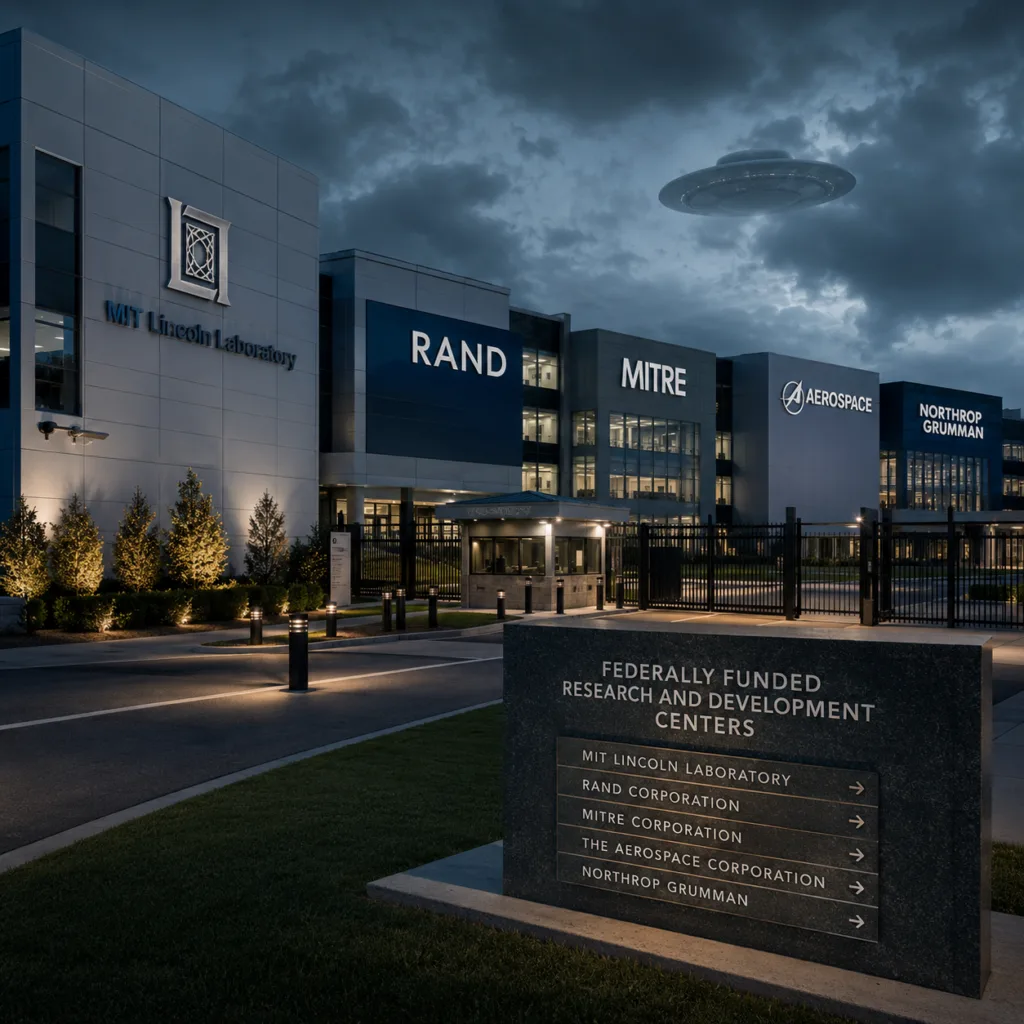
Federally Funded Research and Development Centers
Rep. Eric Burlison (R-MO) discusses a 1952 reel-to-reel recording labeled “AF-ATIC-FILM, 03/52” or “Flying Saucer Talk.” The recording features a briefing by Edward J. Ruppelt, who was the head of Project Blue Book, on UFO incursions over the United States.
Burlison identifies MIT Lincoln Laboratory, a Federally Funded Research and Development Center, or FFRDC, as “the exact type of location we should be searching.” His point is that institutions such as MIT Lincoln Laboratory, RAND, and MITRE may hold historical government-contracted UFO and UAP documents, films, videos, and related records.
He notes that his team is pursuing records from FFRDCs like MIT Lincoln Laboratory. Burlison has also publicly stated that his investigation is following records and archival trails connected to institutions including RAND Corporation, MITRE Corporation, Aerospace Corporation, Northrop Grumman, and other defense-connected contractors and research entities. A May 7, 2026 congressional letter, publicly announced around May 8, 2026, from Rep. Eric Burlison to MIT Lincoln Laboratory Director Dr. Melissa G. Choi and counsel David A. Suski requested the preservation, identification, digitization, and transfer of a reel-to-reel recording identified as “AF-ATIC-FILM, 03/52,” described as a “Flying Saucer Talk” briefing by Edward J. Ruppelt. The letter explicitly tied the recording to the Beacon Hill Study, a classified 1951–1952 MIT-led effort connected to advanced reconnaissance, radar systems, and Cold War air-defense research. The Beacon Hill Study operated during the same period that Project Lincoln and the SAGE air-defense system were being developed, placing MIT Lincoln Laboratory at the center of 1950s radar surveillance and aerospace monitoring during one of the most active UFO periods in U.S. history.
Edward J. Ruppelt reportedly briefed the Beacon Hill group in early 1952 as part of broader Air Force efforts to integrate advanced technical expertise into the study of unconventional aerial threats during the buildup of Cold War radar-defense infrastructure. The letter is not limited to the specific reel itself. It broadly requests identification, preservation, and review of any additional records relating to the Beacon Hill Study, related “flying saucer” or UAP briefings, or other government-funded work connected to anomalous aerospace objects held by MIT Lincoln Laboratory or affiliated successor entities. The preservation request specifically includes audio recordings, motion-picture film, transcripts, briefing materials, memoranda, correspondence, technical reports, accession records, inventories, metadata, classification guidance, and declassification review records tied to UFO or UAP research. Burlison referenced Sections 1841–1843 of the National Defense Authorization Act for Fiscal Year 2024, codified under 44 U.S.C. § 2107 note, which established the UAP Records Collection process through the National Archives and Records Administration under Record Group 615.
The letter further stated that if the recording remains under active classification controls, MIT Lincoln Laboratory should coordinate with the appropriate federal sponsors, classification authorities, the Information Security Oversight Office, and the Public Interest Declassification Board to review the material for potential declassification and eventual public release. Burlison also requested that MIT Lincoln Laboratory determine whether the recording still exists, whether it has been digitized, whether copies or transcripts are held in affiliated repositories, and whether any related material has already been transferred to the National Archives.
The lab has reportedly begun cooperating on review and preservation efforts with the National Archives. Burlison publicly stated that MIT Lincoln Laboratory’s legal team responded quickly and indicated they would provide a written response addressing the letter’s six specific questions within the requested 30-day response window.
The Fox News segment featuring Jesse Watters and Rep. Eric Burlison provided additional insight into why FFRDCs are becoming a central focus of modern UAP investigations. During the interview, Watters questioned why universities or research institutions would possess material connected to UFOs or “aliens.” Burlison responded by explaining that MIT Lincoln Laboratory is one of many Federally Funded Research and Development Centers, describing them as quasi-private public entities whose sole mission is conducting long-term research projects for the United States government.
Burlison stated that facilities such as MIT Lincoln Laboratory represent “the exact type of location we should be searching” for historical UFO and UAP material. He explained that his team is aggressively pursuing documents and videos held within FFRDCs including MIT Lincoln Laboratory, RAND Corporation, MITRE Corporation, Aerospace Corporation, Northrop Grumman, and similar institutions that historically handled sensitive government research contracts. Burlison has emphasized that sensitive materials were often routed through FFRDCs and major contractors to support long-term research outside traditional government filing systems, creating what amounts to a parallel archival layer that his team is now actively tracing.
Burlison’s focus on FFRDCs and private contractors directly builds on testimony and claims from David Grusch, the former Air Force intelligence officer and UAP whistleblower whom Burlison hired as a Special Advisor in March 2025. Grusch has repeatedly alleged that sensitive UAP-related programs, including crash retrieval and reverse-engineering efforts, were routed through private contractors, nonprofit entities, and long-term government-funded research organizations in ways that reduced traditional congressional visibility. Burlison has publicly stated that his investigation is following this contractor and FFRDC trail directly.
He further stated that Michael D. Thomas, Director of the Information Security Oversight Office at the National Archives and Records Administration, confirmed that coordination and preservation efforts were underway regarding the 1952 Edward J. Ruppelt briefing film.
The interview reinforced growing public attention on the role FFRDCs may have played in storing or managing historical UAP-related records outside traditional military archives.
This matters because FFRDCs were created to give the U.S. government access to long-term scientific and technical expertise outside the normal civil-service structure. In the early Cold War, institutions such as MIT Lincoln Laboratory, RAND Corporation, and MITRE Corporation worked in exactly the fields most relevant to UFO and UAP investigations: radar, air defense, reconnaissance, aerospace threat analysis, command-and-control systems, and technical evaluation of unusual aerial events. That makes them plausible places for historical UFO files, films, sensor data, technical briefings, and government-contracted studies to have been stored or reviewed.
MIT Lincoln Laboratory is especially important because it emerged from Project Lincoln, an MIT-led Air Force effort connected to air defense and advanced radar systems. Its early work overlapped with the same period in which the U.S. military was publicly and privately investigating “flying saucers” through programs that led into Project Blue Book. The Beacon Hill Study, connected to the “AF-ATIC-FILM, 03/52” item, appears to sit directly in that Cold War air-defense environment, where Soviet threats, unidentified aircraft, radar anomalies, and unusual aerial incursions were all matters of national security concern.
RAND Corporation also strengthens the broader pattern. One particularly notable example is RAND’s 1968 internal paper titled “UFOs: What To Do?” written by George Kocher. The document demonstrates that a major federally connected research institution was seriously discussing UFO reports, witness credibility, instrumentation, scientific analysis, and the possibility that some sightings represented genuine unexplained phenomena.
The internal draft document, titled UFOs: What To Do? (DRU-1571), examined historical aspects, astronomical implications, the character of reports from credible military and scientific witnesses, and phenomenological details involving luminous discs, radar correlations, electromagnetic effects, and machine-like behavior. The RAND paper argued that the UFO subject deserved careful scientific study rather than ridicule or automatic dismissal. It discussed the long historical continuity of unusual aerial phenomena, referenced military and scientific investigations, examined radar cases, and explored the possibility that some sightings involved intelligently guided craft displaying unconventional flight behavior.
The paper also acknowledged that many UFO reports came from credible witnesses, including scientists, military personnel, and technically trained observers. It referenced patterns involving luminous discs, structured craft, radar confirmations, electromagnetic interference, and reports exhibiting machine-like behavior that could not easily be explained away through conventional atmospheric or astronomical causes.
Perhaps most significant for the broader FFRDC discussion, Kocher’s RAND paper openly explored the possibility that extraterrestrial civilizations could exist elsewhere in the universe and suggested that at least some UFO reports may warrant investigation from that perspective. The document demonstrates that serious technical discussion of UFO phenomena was occurring within portions of the Cold War defense-research ecosystem decades before the modern UAP disclosure era while also criticizing institutional stigma surrounding the subject. The document further criticized the dismissive handling of the UFO subject by parts of the scientific establishment and argued that insufficient data collection and institutional stigma were limiting serious analysis.
The report even proposed coordinated scientific monitoring systems, instrument-based investigations, rapid-response observation teams, and centralized reporting structures for future UFO cases. This demonstrates that at least some researchers operating within the orbit of major defense-connected institutions were considering UFO phenomena as a legitimate technical and scientific issue decades before the modern UAP disclosure era.
The existence of a RAND study of this nature is important because it demonstrates that portions of the Cold War defense-research ecosystem were quietly studying the phenomenon with greater seriousness than was publicly acknowledged at the time. Kocher’s work provides concrete evidence that serious technical discussion about UFO phenomena was occurring inside major federally connected research institutions decades before the modern disclosure era. This supports Burlison’s broader argument that contractor archives and FFRDC repositories may contain historically significant UFO-related material that was never fully integrated into publicly accessible military archives.
MITRE Corporation fits the same pattern because of its long-standing systems-engineering role in radar, surveillance, aerospace command systems, sensor analysis, and defense technical support. As an FFRDC spun out of MIT during the Cold War era, MITRE supported radar systems, sensor fusion, command-and-control infrastructure, and aerospace monitoring technologies directly relevant to early UFO radar tracking and later UAP data-analysis efforts, including modern AARO-related technical support. MITRE became deeply involved in technologies directly connected to aerospace monitoring and radar analysis, which were central to many early UFO investigations and military tracking efforts. Even without a single public “smoking gun” equivalent to the MIT Lincoln Laboratory reel, MITRE’s historical mission makes it a logical place for sensor-analysis records, radar evaluations, technical reports, or archived studies related to anomalous aerospace events.
Taken together, these centers form a possible hidden archival layer between the military, intelligence agencies, universities, and private defense contractors. Burlison’s broader argument is that FFRDCs provided a structure where sensitive materials could be maintained outside traditional government filing systems while still remaining connected to long-term defense research and national-security projects. This approach closely aligns with David Grusch’s broader assertion that meaningful UAP-related material may exist outside traditional military or intelligence archives and instead remain embedded within long-term government-funded contractor and research ecosystems.
The stronger and better-supported claim is that FFRDCs may have handled, stored, analyzed, or preserved government-funded UFO and UAP records, including videos, briefings, films, radar data, technical reports, sensor-analysis records, and classification guidance. If official archives connected to non-human intelligence, advanced aerospace phenomena, or historical UAP investigations continue emerging through the UAP Records Collection process, these centers may represent one of the most important paper trails, film trails, and sensor-analysis trails connected to the broader disclosure effort.
The 1952 tape is a general discussion of U.S. incursions recorded in March 1952, several months before the major Washington, D.C. UFO flap in July. MIT Lincoln Laboratory is identified as a key institution that may still hold the unreleased 1952 briefing recording, along with other historical UFO or UAP records and possibly additional important UFO materials.