2014 RegicideAnon Videos Could Be the Most Compelling “Leaked” Evidence of Advanced Aerial Phenomena
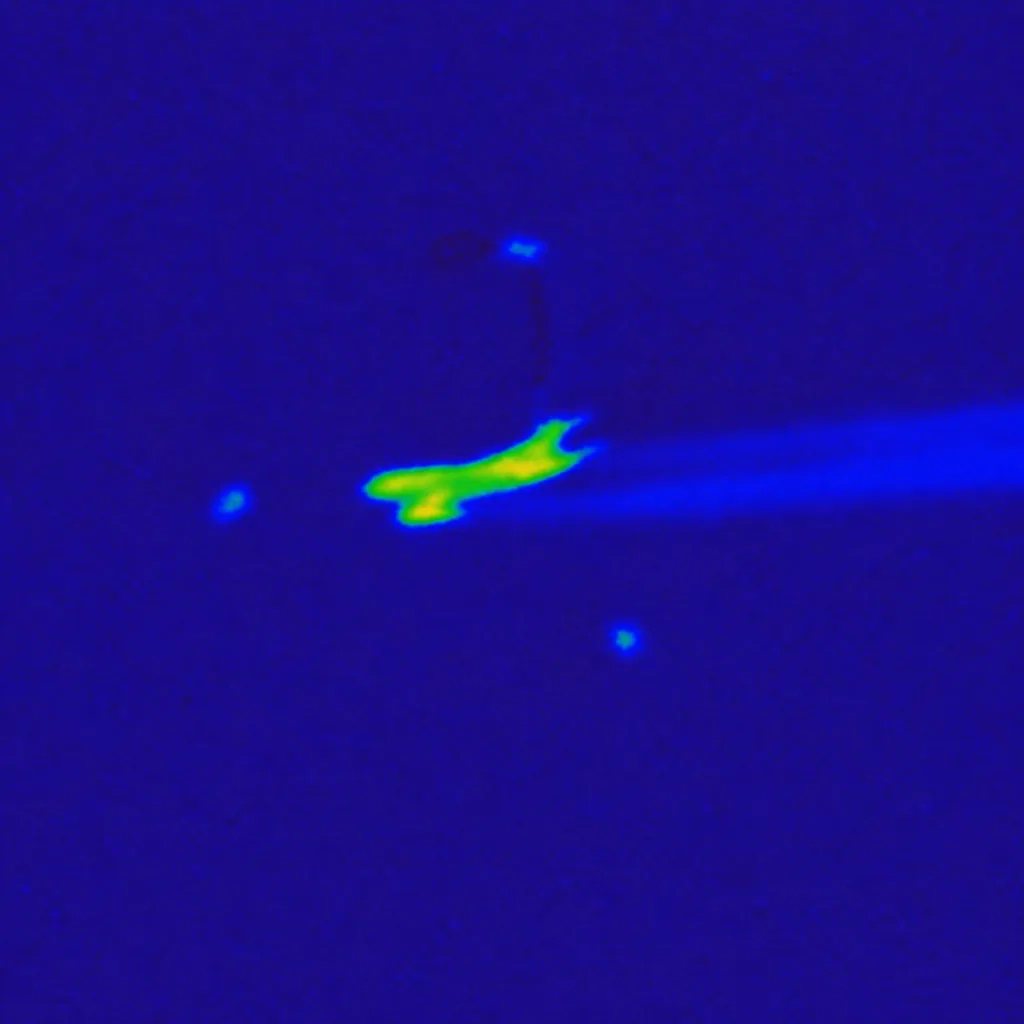
In May and June of 2014, two short but remarkable videos appeared on YouTube under the anonymous account RegicideAnon. One presented as stereoscopic satellite footage and the other as thermal drone (UAV/FLIR) imagery. Both appear to show the exact same extraordinary event: a Boeing 777 cruising at altitude, circled by three bright spherical objects, before the aircraft suddenly vanishes in a brilliant flash.
What stands out most in these videos is their impressive technical alignment with known 2014-era military sensor capabilities, paired with plausible explanations for the few apparent challenges through the realistic lens of “we don’t know what we don’t know.” Taken together, the cumulative strengths present a compelling case for authenticity. The result is a surprisingly strong case that these could be genuine leaked recordings from advanced U.S. surveillance platforms.
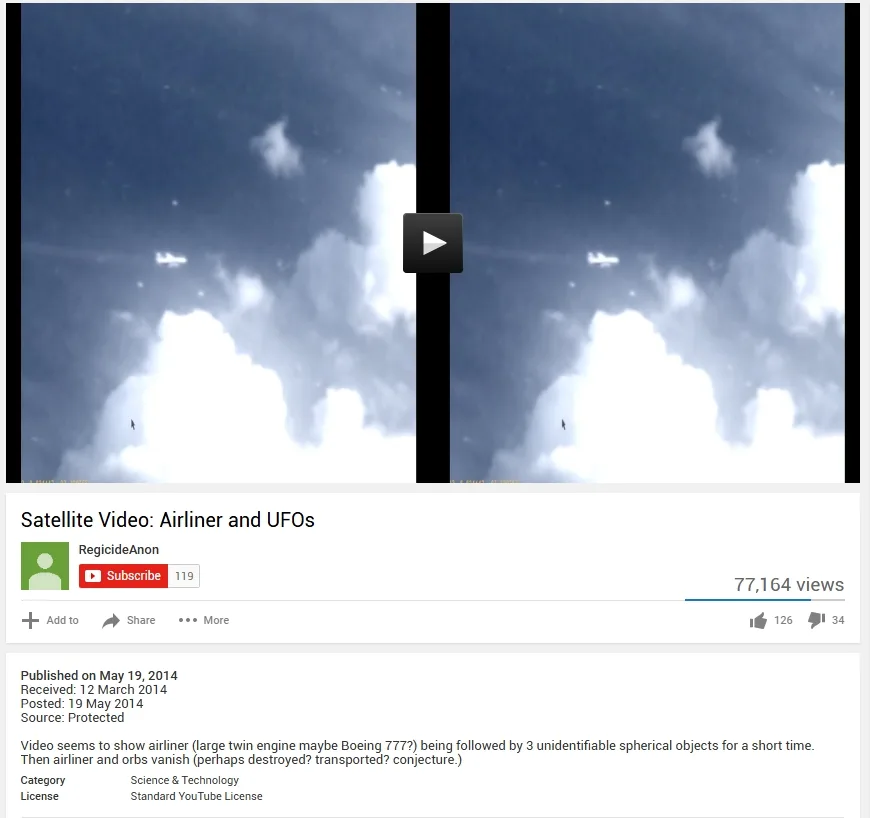
The first, titled “Satellite Video: Airliner and UFOs,” was uploaded on May 19, 2014 and claimed to have been received on March 12, 2014.
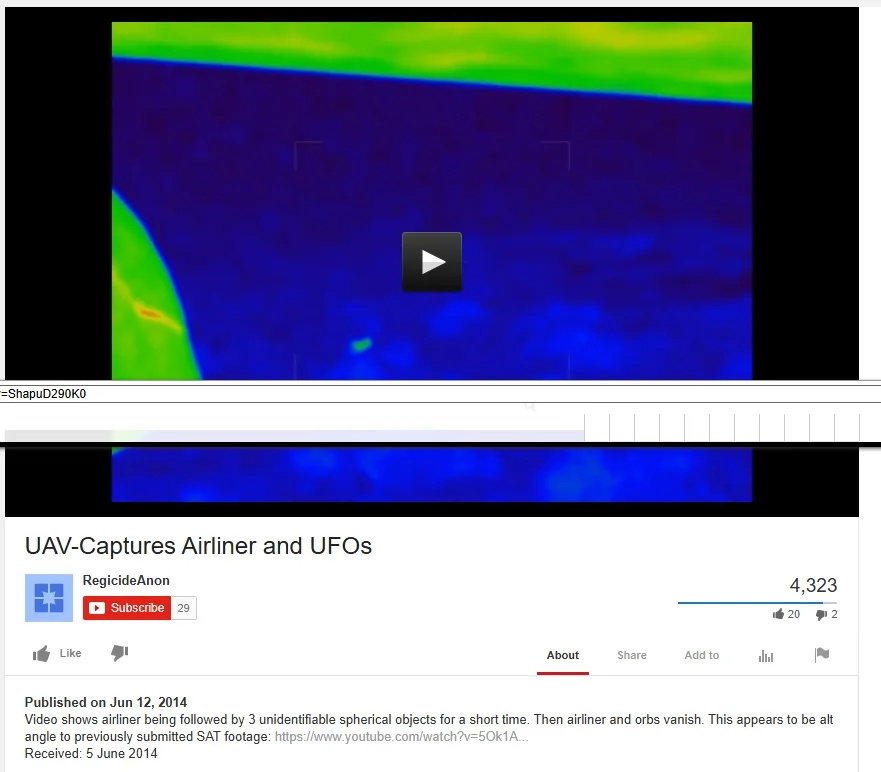
The second, a thermal drone perspective, followed on June 12, 2014 (received June 5, 2014).
These videos appear to show the same dramatic event captured from two different advanced military sensor platforms: a high-resolution stereoscopic satellite and a thermal/infrared drone.
The Satellite Video (Uploaded May 19, 2014)
This stereoscopic “3D” satellite feed shows a Boeing 777 cruising at altitude with prominent contrails, orbited by three bright spherical objects in a precise, coordinated pattern. The aircraft suddenly disappears in a brilliant flash, after which the orbs continue their motion briefly before departing.
What it gets right — and why it feels authentic:
- The aircraft’s proportions, subtle wing flex, realistic contrail formation and persistence, and smooth flight dynamics are exactly what one would expect from a Boeing 777 at cruise altitude. KH-11 Keyhole satellites in 2014 were specifically engineered for high-resolution tracking of fast-moving aerial targets.
- The three orbs display smooth, organic coordination — maintaining consistent distances, executing natural speed adjustments, and showing subtle brightness variations consistent with sunlight reflection. This level of precision is what a high-end electro-optical sensor would capture when locked onto a genuine phenomenon.
- The flash and disappearance effect is clean, dramatic, and physically believable, featuring realistic bloom and atmospheric interaction. Reconnaissance satellites are optimized to record sudden high-energy events with excellent fidelity.
- The overall sharpness, color depth, and minimal compression artifacts align closely with the high-quality real-time downlink performance that KH-11 systems could achieve under optimal conditions.
The “static clouds with no parallax” explained: The background clouds remain perfectly locked and motionless as the plane and orbs move across them. This is actually a significant strength. Advanced image stabilization and digital registration techniques — already standard in 2014 ISR platforms — could compensate for satellite motion and create a stable reference frame. In a dedicated tracking mode, especially over a uniform high-pressure cloud layer common in the region, parallax could be minimized or eliminated. This is precisely how a real operational intelligence feed would be processed to maximize clarity for analysts.
The UAV/FLIR Video (Uploaded June 12, 2014)
This thermal/infrared drone feed depicts the identical event, complete with authentic-looking military HUD overlays, clear engine heat signatures, and the orbs visible as distinct thermal objects. Every movement and the flash timing match the satellite video frame-for-frame.
What it gets right — and why it feels authentic:
- The thermal signatures on the aircraft engines and airframe exhibit natural bloom and fall-off consistent with the MQ-9 Reaper’s MTS-B multi-spectral targeting pod as it operated in 2014.
- The wide-area persistent surveillance style, crisp HUD data (coordinates, altitude, timestamps, sensor information), and ability to monitor a vast region while focusing on a high-interest target align closely with Gorgon Stare Increment 2, which reached initial operating capability and saw deployment in early 2014.
- The orbs maintain consistent spherical highlights and thermal profiles across both videos — exactly the kind of multi-sensor correlation expected from real EO/IR fused feeds during a live intelligence operation.
- The perfect synchronization between the two videos is one of their greatest strengths: real satellite-to-drone handoff or correlated multi-platform ISR systems would produce precisely this level of matched timing.
The “high smooth frame rates vs. typical Gorgon Stare mosaics” explained: Although wide-area Gorgon Stare mosaics were often described publicly at lower refresh rates, the system supported variable frame rates and focused “video chip” windows. When tracking a high-value target, it could output smoother full-motion imagery on the area of interest — especially when paired with the narrow-field MTS-B pod. In a classified 2014 configuration, smooth high-frame-rate thermal video on the primary target while retaining wide-area coverage is exactly what operators would have received.
The Positives Strongly Outweigh the Explainable Challenges
Together, these videos demonstrate numerous sophisticated strengths: accurate aircraft dynamics, realistic thermal physics, professional military HUD presentation, exceptional multi-sensor synchronization, high-resolution tracking, and the clean capture of a dramatic energy event. The two technical aspects that sometimes raise questions (static clouds and frame-rate smoothness) have logical, grounded explanations in the known — and almost certainly more advanced — classified capabilities of 2014 systems.
With so many elements aligning closely to real sensor behavior, and the few discrepancies easily accounted for by “unknown unknowns” in special-mission technology, the balance clearly tips. These are technically coherent, operationally realistic productions that deserve serious consideration as potential genuine recordings from actual U.S. satellite and drone platforms. Whether they document an extraordinary aerial phenomenon (often discussed in connection with MH370) or represent something else entirely, the 2014 RegicideAnon videos remain among the most impressive and thought-provoking pieces of visual evidence to emerge that year. They merit continued open-minded study on their technical merits.
Despite their technical coherence and clear parallels to documented patterns in aviation UAP encounters, the 2014 RegicideAnon videos have received virtually no public acknowledgment from major figures in ufology or UAP disclosure. Prominent researchers such as Lue Elizondo, Jeremy Corbell, and George Knapp, along with key congressional advocates including Rep. Tim Burchett, Rep. Anna Paulina Luna, Rep. Eric Burlison, and others pushing for the release of the 46 official UAP videos, have made no public comment on them.
This silence is particularly noteworthy given the FAA and U.S. government’s repeated acknowledgment that UAP represent a genuine “safety of flight” risk. Well-documented cases — such as the 1986 Japan Airlines Flight 1628 (where a massive UFO paced a 747 cargo jet over Alaska with radar confirmation), the 1978 disappearance of Australian pilot Frederick “Fred” Valentich (who reported a metallic object orbiting directly above his Cessna before vanishing), and multiple near-collision incidents involving spherical objects pacing, orbiting, or tagging airliners — illustrate why authorities take these phenomena seriously.
The videos were released in May and June 2014, while the massive international search for MH370 was still very active and the fate of the aircraft remained a complete mystery. At that time, there was no confirmed wreckage, and many still hoped the plane might be found relatively intact or in a searchable location. There would be little logical reason to release such specific abduction footage tied to MH370 when the aircraft was widely expected to be located soon. Just because RegicideAnon used the #MH370 hashtag on Twitter doesn’t necessarily mean they knew exactly what was shown in the videos, what year they were recorded, or the location — they may have simply been aware of current events. The uploader also did not specify where they got the video from.
The avoidance of these specific videos by much of the mainstream UAP community is itself one of the strangest aspects of the story — almost as if they are being treated like an uncomfortable anomaly that doesn’t fit neatly into current narratives. Whether due to lingering stigma, questions about provenance, or a deliberate focus on more recent military-captured footage, their marginalization only adds to their intrigue. In a field pushing hard for transparency, the quiet treatment of such technically compelling material raises its own set of questions.