The Kaikoura Lights Incident (1978)
The 1978 Kaikoura Lights Incident remains one of the most significant and well-documented aerial phenomena cases in the Southern Hemisphere. Occurring over and near the Kaikoura coastline of New Zealand’s South Island across 30–31 December 1978, the event drew national and international attention because it combined trained aviation witnesses, simultaneous radar contacts, professional 16 mm color film, and official investigation without a definitive resolution.
Safe Air Ltd’s Armstrong Whitworth AW.660 Argosy turboprop freighter, registration ZK-SAE, a dedicated newspaper-delivery cargo aircraft operating a routine Blenheim–Christchurch–Wellington run. An earlier related sighting had already occurred on 21 December 1978, when Argosy pilots Vern Powell and Ian Pirie reported bright lights pacing their aircraft between Blenheim and Christchurch while Wellington air traffic control radar tracked corresponding unidentified returns. Radar operators that night reported numerous targets appearing and disappearing near the Clarence River mouth, with some holding position before accelerating at high speed. Residents near Clarence Bridge and Kekerungu also reported unusual lights, establishing a precursor event that set the stage for heightened concern days later.
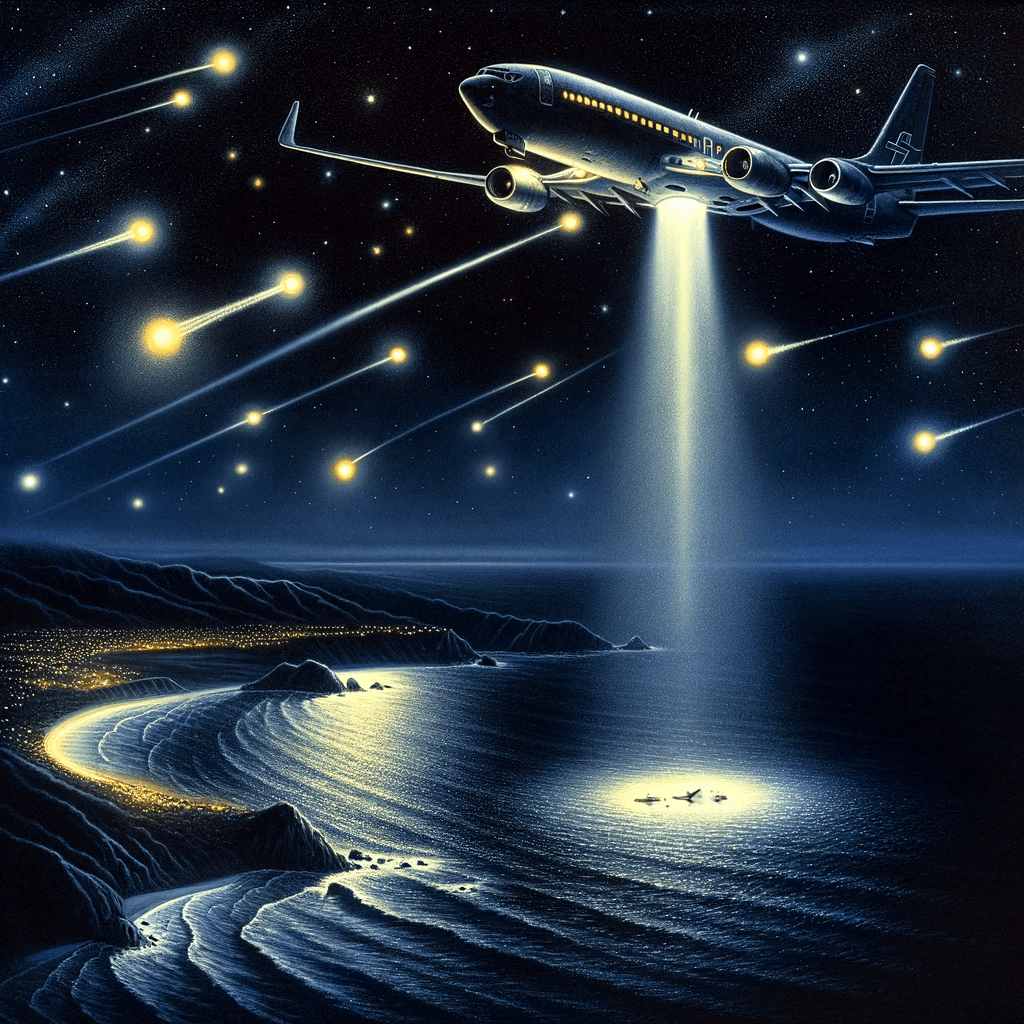
On the night of 30 December, Australian Channel 0 reporter Quentin Fogarty and cameraman David Crockett boarded the Argosy specifically to document the earlier reports. Crockett’s wife Ngaire accompanied them on the outbound leg, and Christchurch journalist Dennis Grant later joined coverage efforts. As the aircraft approached the Kaikoura coastline, crew members observed bright lights west of the aircraft. During the return leg after a 2:16 a.m. departure from Christchurch on 31 December, at relatively low altitude on portions of the climb, a line of five small bright lights accompanied by a larger luminous orb reportedly took up position off the wingtip and tracked the aircraft for nearly fifteen minutes while being filmed and described live on audio. The dominant object maneuvered in apparent response to aircraft turns, moving above, below, and in front of the Argosy. Fogarty’s recorded remark, “Let’s hope they’re friendly,” became one of the enduring quotes associated with the case.
Flight crew descriptions emphasized a huge bright white light with a faint reddish tinge that shifted position in three-dimensional space around the aircraft. Some pilots later compared its apparent scale, judging from brightness and distance, to something house-sized. Witnesses described pacing behavior, rapid acceleration, abrupt directional shifts, and moments of apparent hovering. Multiple accounts state that focused downward beams were periodically emitted, briefly illuminating patches of ocean below in a manner described as resembling a scanning or searchlight effect. The combination of structured formation, sustained tracking, responsive maneuvering, and downward illumination became central to later analysis.
Radar data formed a critical layer of the case. Wellington air traffic control reported numerous unidentified targets in the region hours earlier, including returns that appeared, vanished, and moved at unusual speeds. During the 30–31 December flight, the Argosy’s onboard radar, operating in ground-mapping mode, reportedly painted a large target at approximately 18 nautical miles consistent with the position of the visually observed bright object. Because ground-mapping radar scans downward, the return raised questions about altitude and reflectivity relative to the aircraft’s position. Wellington radar also detected unusual returns at times corresponding to visual sightings, while Christchurch radar did not register targets. The simultaneous visual observations from multiple individuals on the flight deck combined with both airborne and ground radar contacts created one of the strongest radar-visual correlation cases in late 20th-century UAP reporting.
Official reviews followed. Explanatory suggestions such as squid fishing boats, atmospheric reflections, and astronomical bodies were advanced primarily by the Department of Scientific and Industrial Research (DSIR) and elements within the Ministry of Defence. The Royal New Zealand Air Force cooperated fully, reportedly placing a Skyhawk on standby during the events and later dispatching P-3 Orion maritime patrol aircraft on 2, 5, and 7 January 1979 to investigate continued radar anomalies in the region. These follow-up flights did not produce definitive new identifications, and uncertainty persisted in declassified files released through Archives New Zealand, which include technical assessments and full witness interviews. A January 1979 DSIR briefing to the United Nations described the objects as “UFOs until identified,” while assessing extraterrestrial proof as extremely remote.
Independent analysis added further depth. U.S. Navy optical physicist Dr. Bruce Maccabee traveled to New Zealand and Australia, interviewed witnesses directly, and conducted photometric examination of the 16 mm film. He concluded that the filmed primary object was extremely bright and potentially on the order of 20 meters or more in diameter, significantly larger and more luminous than plausible plasma effects, ball lightning, or distant fishing vessels. He argued that the motion characteristics, duration of pacing, brightness levels, and radar associations were inconsistent with conventional aircraft or simple reflections, and he rejected the squid-boat hypothesis based on lack of supporting evidence for vessel presence in the reported positions.
The professional film captured by David Crockett, shot through the cockpit window on both legs of the flight, aired in prime-time broadcasts in Australia and New Zealand and was distributed internationally. Related television material from New Zealand broadcasters also circulated, drawing further scrutiny. The footage intensified official and public examination. While DSIR analysts suggested possible optical distortions through aircraft windows on portions of the film and deemed some segments unmeritorious, later reviewers disputed the extent of this interpretation, noting brightness, stability, and motion patterns that were not easily reconciled with simple reflections.
Books such as The Kaikoura UFOs (1980) by Captain Bill Startup, one of the Argosy pilots, co-authored with Neill Illingworth, preserved detailed firsthand accounts. Subsequent analyses and archival research have continued to examine the case using declassified defence documents, radar logs, recorded interviews, and technical reviews.
For the crew, the experience had lasting personal impact. Captain Startup later remarked that he still wished he knew what the objects were, while First Officer Bob Guard maintained skepticism toward extraterrestrial interpretations yet acknowledged that what they encountered remained unexplained and that the scrutiny had been burdensome.
The Kaikoura Lights Incident stands out because it combines multiple trained aviation witnesses, radar contacts from both ground and onboard systems, structured luminous formations filmed on professional equipment, official defence involvement, and decades of technical analysis. While natural explanations have been proposed, no single account has achieved universal acceptance. The case remains one of the most thoroughly documented aerial anomaly events in New Zealand’s history and continues to be cited in discussions of unidentified aerial phenomena due to its evidentiary depth, layered documentation, and unresolved elements.